Electricity — Flashcards
Tamil Nadu Board · Class 10 · Science
38 flashcards for Electricity (Tamil Nadu Board Class 10 Science) to test yourself on key terms and facts. Sample: "What is electric current and how is it"
Interactive on Super Tutor
Studying Electricity? Get the full interactive chapter.
Quizzes, flashcards, AI doubt-solver and a step-by-step study plan — built for flashcards and more.
Free trial, no card needed.
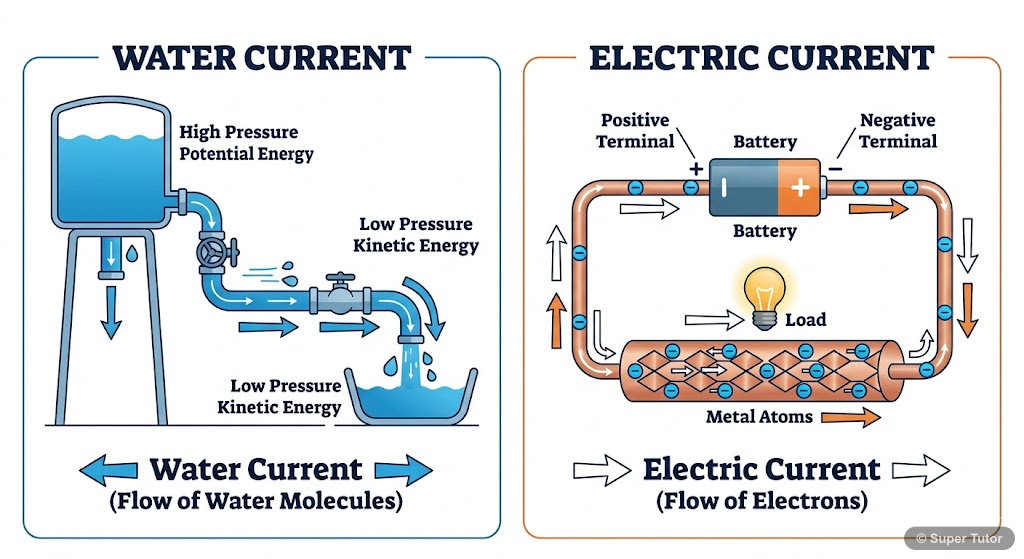
One of 13 illustrations for Electricity in Super Tutor — alongside flashcards, concept maps and practice questions.
What is electric current and how is it defined mathematically?
Answer
Electric current (I) is the rate of flow of electric charges through a conductor. It is defined as the amount of charge flowing through any cross-section of a conductor in unit time. Mathematically: I…
A charge of 12 coulomb flows through a bulb in 5 seconds. Calculate the current through the bulb.
Answer
Given: Q = 12 C, t = 5 s Using the formula: I = Q/t I = 12/5 = 2.4 A Therefore, the current through the bulb is 2.4 amperes. This means 2.4 coulombs of charge passes through every cross-section of the…
What is an electric circuit and what are its essential components?
Answer
An electric circuit is a closed conducting loop or path made of electrical wires and components that allows electrons to flow. Essential components include: (1) Power source (battery) - provides poten…
Differentiate between electric potential and electric potential difference.
Answer
Electric Potential: The amount of work done in moving a unit positive charge from infinity to a point against electric force. It is the property of a single point. SI unit: Volt (V). Electric Potenti…
Why is potential difference necessary for electric current to flow through a conductor?
Answer
Potential difference is the driving force for electric current. Charges naturally move from higher potential to lower potential (positive charges) or from lower to higher potential (electrons/negative…
The work done in moving a charge of 10 C across two points in a circuit is 100 J. What is the potential difference between these points?
Answer
Given: Q = 10 C, W = 100 J Using the formula: V = W/Q V = 100/10 = 10 volts Therefore, the potential difference between the two points is 10 V. This means 10 joules of energy is required to move 1 cou…
State Ohm's Law and write its mathematical expression.
Answer
Ohm's Law states: At constant temperature, the electric current flowing through a conductor is directly proportional to the potential difference between its ends, and inversely proportional to its res…
Calculate the resistance of a conductor through which a current of 2 A passes when the potential difference between its ends is 30 V.
Answer
Given: I = 2 A, V = 30 V Using Ohm's Law: R = V/I R = 30/2 = 15 Ω Therefore, the resistance of the conductor is 15 ohms. This means the conductor opposes the flow of current, and a potential differenc…
+30 more flashcards
Practise AllFrequently Asked Questions
What are the important topics in Electricity for Tamil Nadu Board Class 10 Science?
How many flashcards are available for Electricity?
How should I revise Electricity for the Tamil Nadu Board Class 10 board exam?
Sources & Official References
Content is aligned to the official syllabus. Refer to the board website for the latest curriculum.
More resources for Electricity
Practice Quiz
Test yourself with a quick quiz
Important Questions
Exam-style questions with answers
Revision Notes
Key points for last-minute revision
Formula Sheet
The chapter's formulas in one place
Chapter Summary
Understand the chapter at a glance
Concept Maps
See how topics connect
Syllabus
What topics to cover
For serious students
Get the full Electricity chapter — start free.
Quizzes, flashcards, an AI doubt solver and a study plan for Tamil Nadu Board Class 10 Science. Free to start, no card needed.