Types of Chemical Reaction — Important Questions
Tamil Nadu Board · Class 10 · Science
45 important questions from Types of Chemical Reaction for Tamil Nadu Board Class 10 Science, with answers. Includes multiple choice questions.
Interactive on Super Tutor
Studying Types of Chemical Reaction? Get the full interactive chapter.
Quizzes, flashcards, AI doubt-solver and a step-by-step study plan — built for important questions and more.
Free trial, no card needed.
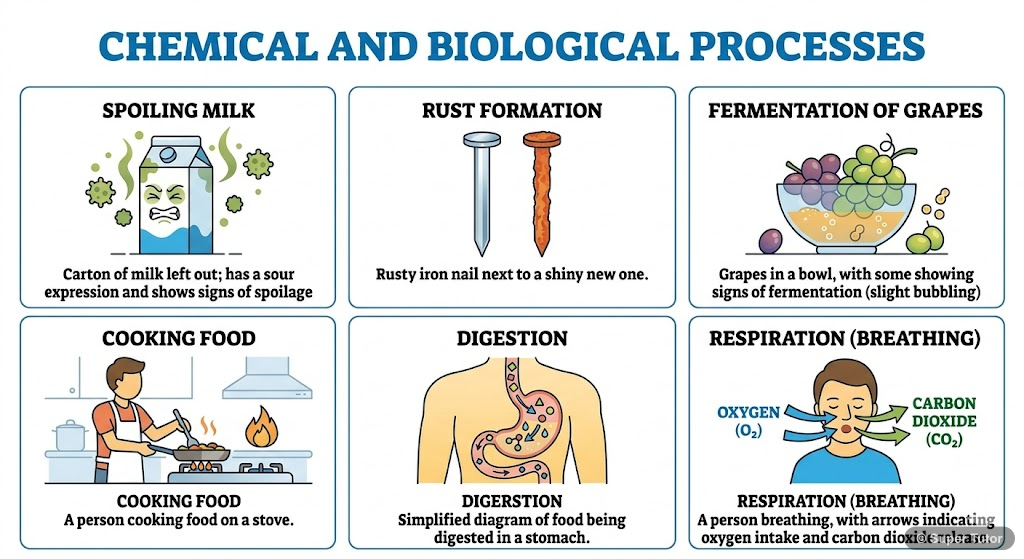
One of 12 illustrations for Types of Chemical Reaction in Super Tutor — alongside flashcards, concept maps and practice questions.
Important Questions from Types of Chemical Reaction
Which of the following is the correct chemical equation for the combustion of propane (C₃H₈)?
Show answer
C₃H₈ + 5O₂ → 3CO₂ + 4H₂O + Heat
Step 1: In combustion reactions, a fuel reacts rapidly with oxygen to form oxides and release heat energy. Step 2: Propane (C₃H₈) is a hydrocarbon present in LPG gas used for cooking. Step 3: When propane burns completely, carbon atoms form CO₂ and hydrogen atoms form H₂O. Step 4: Balancing the equation: C₃H₈ + 5O₂ → 3CO₂ + 4H₂O + Heat. Step 5: The other options show incomplete or incorrect reactions — Option A produces C₃H₆ (wrong product), Option C shows decomposition not combustion, and Option D is a steam reforming reaction.
A reversible reaction is represented by which type of arrow in a chemical equation?
Show answer
A double arrow with heads pointing in opposite directions (⇌)
Step 1: In a reversible reaction, the products can be converted back to the reactants. Step 2: This means the reaction proceeds in BOTH forward and backward directions simultaneously. Step 3: To show this two-way nature, a special double arrow (⇌) is used, with one arrowhead pointing to the right (forward reaction) and one pointing to the left (backward reaction). Step 4: A single arrow (→) is used for irreversible reactions that proceed only in one direction. Step 5: The other arrow types are not standard chemistry notation for reversible reactions.
At chemical equilibrium in a reversible reaction, which of the following statements is correct?
Show answer
The rate of forward reaction equals the rate of backward reaction.
Step 1: Chemical equilibrium is attained in a reversible reaction when no net change occurs in the amounts of reactants and products. Step 2: At equilibrium, both forward and backward reactions are still occurring — they have NOT stopped. Step 3: The key condition for equilibrium is: Rate of forward reaction = Rate of backward reaction. Step 4: Because both reactions are happening at equal rates, the concentrations of reactants and products remain constant. Step 5: This is called dynamic equilibrium — it appears static from outside but both reactions are continuously occurring.
Which of the following factors does NOT affect the rate of a chemical reaction?
Show answer
Colour of the reaction vessel
Step 1: The rate of a chemical reaction depends on several physical and chemical factors that affect how often reacting particles collide. Step 2: Temperature increases reaction rate because more heat energy means more energetic particles that break bonds faster. Step 3: Concentration of reactants affects rate because more particles per volume means more frequent collisions. Step 4: A catalyst increases reaction rate by providing an alternative pathway for the reaction without being consumed. Step 5: The colour of the reaction vessel has absolutely no chemical or physical effect on the reactio
+41 more questions on Types of Chemical Reaction (Tamil Nadu Board Class 10 Science)
Practise AllFrequently Asked Questions
What are the important topics in Types of Chemical Reaction for Tamil Nadu Board Class 10 Science?
How many important questions are there in Types of Chemical Reaction?
Sources & Official References
Content is aligned to the official syllabus. Refer to the board website for the latest curriculum.
More resources for Types of Chemical Reaction
For serious students
Get the full Types of Chemical Reaction chapter — start free.
Quizzes, flashcards, an AI doubt solver and a study plan for Tamil Nadu Board Class 10 Science. Free to start, no card needed.