Solutions — Important Questions
Tamil Nadu Board · Class 10 · Science
43 important questions from Solutions for Tamil Nadu Board Class 10 Science, with answers. Includes multiple choice and numerical questions.
Interactive on Super Tutor
Studying Solutions? Get the full interactive chapter.
Quizzes, flashcards, AI doubt-solver and a step-by-step study plan — built for important questions and more.
Free trial, no card needed.
One of 2 illustrations for Solutions in Super Tutor — alongside flashcards, concept maps and practice questions.
Important Questions from Solutions
The principle 'like dissolves like' in chemistry means which of the following?
Show answer
Polar solvents dissolve polar solutes and non-polar solvents dissolve non-polar solutes
Step 1: The phrase 'like dissolves like' refers to the polarity of substances. Step 2: Polar compounds (like common salt, NaCl) are soluble in polar solvents (like water). Step 3: Non-polar compounds (like fat, sulphur) are soluble in non-polar solvents (like ether, carbon disulphide). Step 4: This is why sulphur dissolves in CS₂ but not in water — sulphur is non-polar and water is polar. Step 5: Options C and D describe irrelevant physical properties (size, weight) that do not determine solubility.
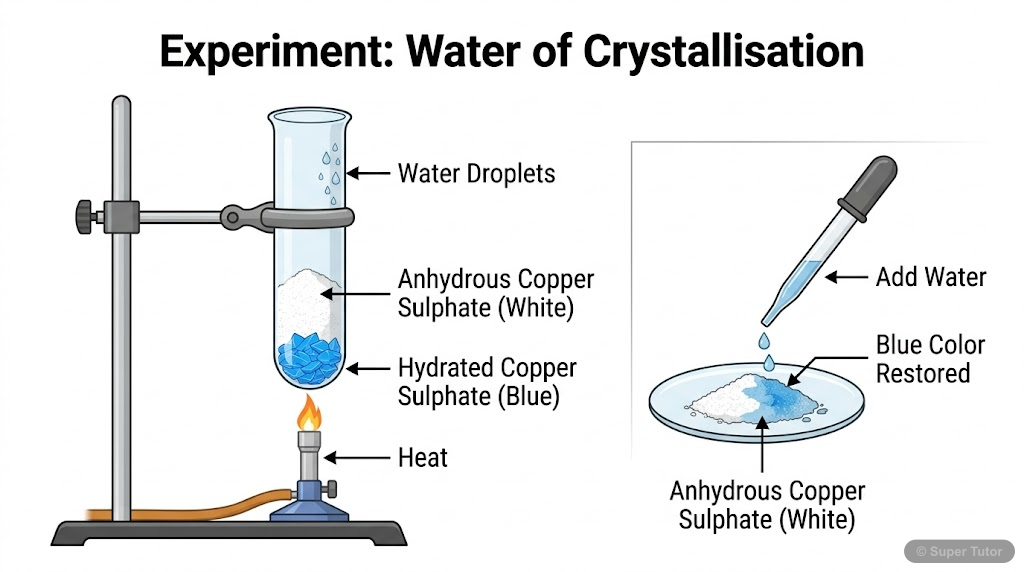
When blue copper sulphate crystals (CuSO₄·5H₂O) are gently heated, what happens?
Show answer
They lose water of crystallization and turn colourless
Step 1: Copper sulphate pentahydrate (CuSO₄·5H₂O) is a hydrated salt — it has 5 molecules of water of crystallization. Step 2: When gently heated, the salt loses these 5 water molecules: CuSO₄·5H₂O → CuSO₄ + 5H₂O. Step 3: The blue colour of CuSO₄ crystals is due to the presence of water of crystallization. Step 4: After losing water, the resulting anhydrous CuSO₄ becomes colourless/white and amorphous. Step 5: This reaction is reversible — adding a few drops of water to anhydrous CuSO₄ makes it turn blue again, which is used as a test for moisture.
What is the solubility of a solute if 1.5 g of it dissolves in 15 g of water to form a saturated solution at 298 K?
Show answer
10 g per 100 g water
Step 1: Formula: Solubility = (Mass of solute / Mass of solvent) × 100. Step 2: Mass of solute = 1.5 g; Mass of solvent = 15 g. Step 3: Solubility = (1.5 / 15) × 100 = 10 g per 100 g of water. Step 4: This means 10 g of this solute can dissolve in 100 g of water to form a saturated solution at 298 K. Step 5: Option C (15 g) is a common error where students confuse the mass of solvent directly with solubility without scaling to 100 g.
Which of the following substances is an example of a deliquescent substance?
Show answer
Caustic soda (NaOH)
Step 1: Deliquescent substances absorb so much moisture from the air that they completely dissolve in the absorbed water. Step 2: Caustic soda (NaOH) is a classic deliquescent substance — it absorbs water from humid air and eventually forms a liquid solution. Step 3: Silica gel, Quick lime (CaO), and Phosphorus pentoxide (P₂O₅) are hygroscopic substances — they absorb moisture but do not dissolve. Step 4: The key difference is that deliquescent substances change their physical state (solid → liquid), while hygroscopic substances do not. Step 5: Deliquescence is maximum at low temperatures and
+39 more questions on Solutions (Tamil Nadu Board Class 10 Science)
Practise AllFrequently Asked Questions
What are the important topics in Solutions for Tamil Nadu Board Class 10 Science?
How many important questions are there in Solutions?
Sources & Official References
Content is aligned to the official syllabus. Refer to the board website for the latest curriculum.
More resources for Solutions
For serious students
Get the full Solutions chapter — start free.
Quizzes, flashcards, an AI doubt solver and a study plan for Tamil Nadu Board Class 10 Science. Free to start, no card needed.