Types of Chemical Reaction — Revision Notes
Tamil Nadu Board · Class 10 · Science
Types of Chemical Reaction revision notes for Tamil Nadu Board Class 10 Science: 4 topics in quick points. Includes Chemical Reactions – Basics, Types.
Interactive on Super Tutor
Studying Types of Chemical Reaction? Get the full interactive chapter.
Quizzes, flashcards, AI doubt-solver and a step-by-step study plan — built for revision notes and more.
Free trial, no card needed.
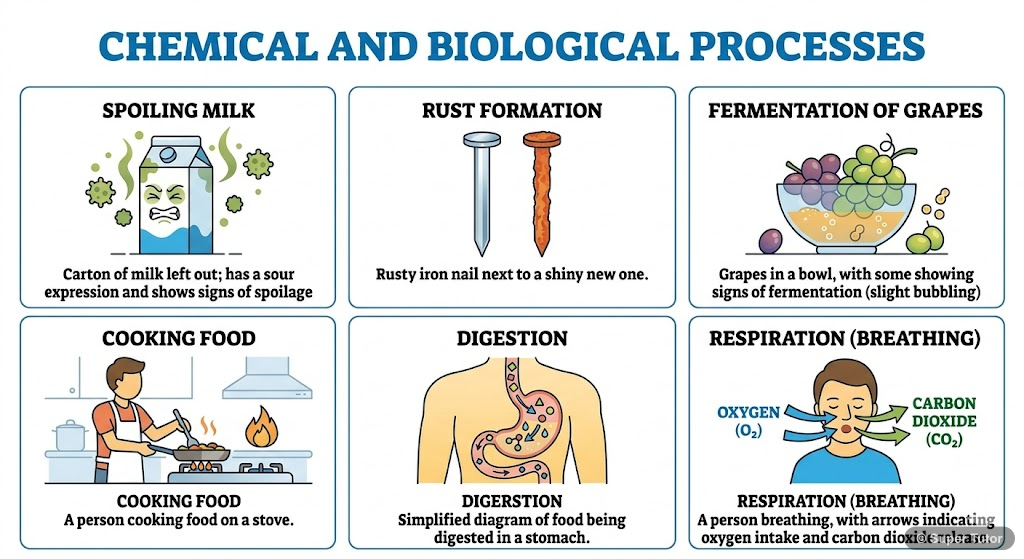
One of 12 illustrations for Types of Chemical Reaction in Super Tutor — alongside flashcards, concept maps and practice questions.
Key Topics to Revise
Chemical Reactions – Basics
- A chemical reaction involves breaking of old bonds and formation of new bonds.
- Bond breaking absorbs energy; bond formation releases energy.
- A chemical equation must be balanced — the number of atoms of each element must be equal on both sides (Law of Conservation of Matter).
Types of Chemical Reactions – Classification by Atom Rearrangement
- There are 5 main types: Combination, Decomposition, Single Displacement, Double Displacement, and Combustion.
- COMBINATION: Two or more reactants combine to form one product. A + B → AB. Also called synthesis or composition reaction. Most are EXOTHERMIC.
- 3 Sub-types of Combination: (i) Element + Element → Compound (e.g., S + O₂ → SO₂), (ii) Compound + Element → Compound (e.g., PCl₃ + Cl₂ → PCl₅), (iii) Compound + Compound → Compound (e.g., SiO₂ + CaO
Reversible and Irreversible Reactions
- Based on the DIRECTION of reaction, chemical reactions are classified as reversible and irreversible.
- REVERSIBLE REACTION: Products can be converted back to reactants under suitable conditions. Represented by a double arrow ⇌.
- Example: PCl₅(g) ⇌ PCl₃(g) + Cl₂(g) — PCl₅ decomposes and reforms continuously.
Rate of Chemical Reaction and Factors Affecting It
- Rate of reaction = change in concentration (or amount) of reactants or products per unit time.
- Formula: Rate = -d[A]/dt = +d[B]/dt for reaction A → B.
- The negative sign indicates decrease in reactant concentration; positive sign indicates increase in product concentration.
Get complete notes with diagrams and examples
Full NotesKey Concepts
Frequently Asked Questions
What are the important topics in Types of Chemical Reaction for Tamil Nadu Board Class 10 Science?
How should I revise Types of Chemical Reaction for the Tamil Nadu Board Class 10 board exam?
Sources & Official References
Content is aligned to the official syllabus. Refer to the board website for the latest curriculum.
More resources for Types of Chemical Reaction
For serious students
Get the full Types of Chemical Reaction chapter — start free.
Quizzes, flashcards, an AI doubt solver and a study plan for Tamil Nadu Board Class 10 Science. Free to start, no card needed.