Transition and Inner Transition Elements — Concept Maps
Tamil Nadu Board · Class 12 · Chemistry
3 concept maps of Transition and Inner Transition Elements for Tamil Nadu Board Class 12 Chemistry, each also written out as a text outline.
Interactive on Super Tutor
Studying Transition and Inner Transition Elements? Get the full interactive chapter.
Quizzes, flashcards, AI doubt-solver and a step-by-step study plan — built for concept maps and more.
Free trial, no card needed.
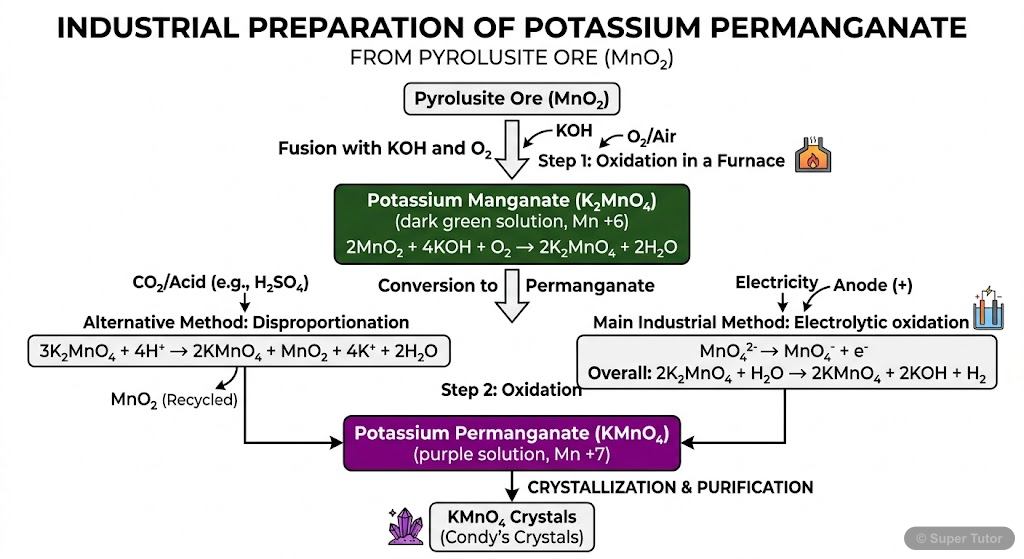
Learn better with visuals Super Tutor pairs illustrations like this with notes and quizzes for Transition and Inner Transition Elements.
Overview Mind Map: Transition and Inner Transition Elements
The map in words
- Transition and Inner Transition Elements
- d-Block Elements
- Position in Periodic Table
- Groups 3 to 12
- 3d 4d 5d series
- Electronic Configuration
- Noble gas n-1 d1-10 ns1-2
- Exceptions Cr and Cu
- General Properties
- Metallic Behaviour
- Hard high melting point
- Good conductors
- Atomic Radius
- Nearly constant 3d series
- Lanthanoid contraction effect
- Ionization Enthalpy
- Intermediate s and p block
- Increases irregularly
- Oxidation States
- Variable oxidation states
- Mn shows +2 to +7
- Extra stability d5 d10
- Electrode Potential
- Cu has positive E0
- Mn and Zn deviations
- Magnetic Properties
- Paramagnetic unpaired electrons
- Spin only formula
- Catalytic Properties
- d orbitals accept electrons
- Variable oxidation states
- Alloy Formation
- Similar atomic radii
- Hume Rothery rule
- Interstitial Compounds
- TiC ZrH Mn4N
- Non stoichiometric
- Complex Formation
- Small size high charge
- Vacant d orbitals
- Metallic Behaviour
- Position in Periodic Table
- Important Compounds
- K2Cr2O7
- From chromite ore
- Cr in plus 6 state
- Orange red crystals
- Strong oxidizing agent
- Chromyl chloride test
- KMnO4
- From pyrolusite MnO2
- Mn in plus 7 state
- Dark purple crystals
- Acid neutral alkaline medium
- Baeyers reagent
- K2Cr2O7
- f-Block Elements
- Lanthanoids
- Ce to Lu 4f filling
- Config Xe 4f 5d0-1 6s2
- Common oxidation state plus 3
- Lanthanoid contraction
- Consequences basic nature similarity
- Actinoids
- Th to Lr 5f filling
- All radioactive
- Oxidation states plus 2 to plus 7
- Form oxocations UO2 2plus
- Comparison
- 4f vs 5f
- Colourless vs coloured
- Less vs more complex formation
- No oxocations vs oxocations
- Lanthanoids
- d-Block Elements
Overview of Transition and Inner Transition Elements
The map in words
- d and f Block Elements
- d Block Elements
- 3d Series
- Sc to Zn
- Period 4
- 4d Series
- Y to Cd
- Period 5
- 5d Series
- La Hf to Hg
- Period 6
- 6d Series
- Ac Rf to Cn
- All Radioactive
- 3d Series
- General Properties
- Variable Oxidation States
- Magnetic Behaviour
- Catalytic Activity
- Alloy Formation
- Complex Formation
- Coloured Compounds
- Important Compounds
- KMnO4
- Dark Purple
- Oxidising Agent
- Three Media
- K2Cr2O7
- Orange Red
- Strong Oxidiser
- Chromyl Test
- KMnO4
- f Block Elements
- Lanthanoids
- Ce to Lu
- 4f filling
- Lanthanoid Contraction
- Actinoids
- Th to Lr
- 5f filling
- All Radioactive
- Lanthanoids
- d Block Elements
Transition and Inner Transition Elements: Comprehensive Overview
The map in words
- Transition and Inner Transition Elements
- d-Block Elements
- Position in Periodic Table
- Groups 3-12
- Periods 4-7
- 3d, 4d, 5d series
- Electronic Configuration
- Noble gas (n-1)d1-10 ns1-2
- Exception: Cr, Cu
- Half-filled and full d stability
- General Trends
- Metallic behavior
- Atomic radius variation
- Ionization enthalpy
- Variable oxidation states
- Electrode potentials
- Magnetic properties
- Catalytic properties
- Important Compounds
- Potassium dichromate K2Cr2O7
- Powerful oxidizing agent
- Orange-red crystals
- Multiple reactions
- Potassium permanganate KMnO4
- Strong oxidant
- Dark purple crystals
- Medium-dependent reactions
- Potassium dichromate K2Cr2O7
- Position in Periodic Table
- f-Block Elements
- Lanthanoids
- Ce to Lu (Z=58-71)
- 4f orbital filling
- Configuration: Xe 4f1-14 5d0-1 6s2
- Lanthanoid contraction
- Primarily +3 oxidation state
- Similar chemical properties
- Actinoids
- Th to Lr (Z=90-103)
- 5f orbital filling
- All radioactive
- Variable oxidation states
- Oxo-cation formation
- More complex chemistry
- Lanthanoids
- Properties and Applications
- Hardness and Strength
- Structural materials
- Alloys and interstitials
- Electrical Conductivity
- Copper in electronics
- Silver conductivity
- Magnetic Properties
- Ferromagnetism
- Permanent magnets
- Catalysis
- V2O5 in sulfuric acid
- Hydrogenation catalysts
- Polymerization catalysts
- Biological Functions
- Fe in hemoglobin
- Co in vitamin B12
- Mn enzyme cofactors
- Hardness and Strength
- d-Block Elements
Explore these maps interactively
Explore DiagramsFrequently Asked Questions
What are the important topics in Transition and Inner Transition Elements for Tamil Nadu Board Class 12 Chemistry?
What do the concept maps for Transition and Inner Transition Elements show?
How should I revise Transition and Inner Transition Elements for the Tamil Nadu Board Class 12 board exam?
Sources & Official References
Content is aligned to the official syllabus. Refer to the board website for the latest curriculum.
More resources for Transition and Inner Transition Elements
Practice Quiz
Test yourself with a quick quiz
Important Questions
Exam-style questions with answers
Revision Notes
Key points for last-minute revision
Formula Sheet
The chapter's formulas in one place
Chapter Summary
Understand the chapter at a glance
Flashcards
Quick-fire cards for active recall
Syllabus
What topics to cover
For serious students
Get the full Transition and Inner Transition Elements chapter — start free.
Quizzes, flashcards, an AI doubt solver and a study plan for Tamil Nadu Board Class 12 Chemistry. Free to start, no card needed.