Chapter 7 of 15
Revision Notes
Transition and Inner Transition Elements — Revision Notes
Tamil Nadu Board · Class 12 · Chemistry
Transition and Inner Transition Elements revision notes for Tamil Nadu Board Class 12 Chemistry: 4 topics in quick points.
45 questions40 flashcards2 formulas & key relations5 concepts
Interactive on Super Tutor
Studying Transition and Inner Transition Elements? Get the full interactive chapter.
Quizzes, flashcards, AI doubt-solver and a step-by-step study plan — built for revision notes and more.
Free trial, no card needed.
Super Tutor
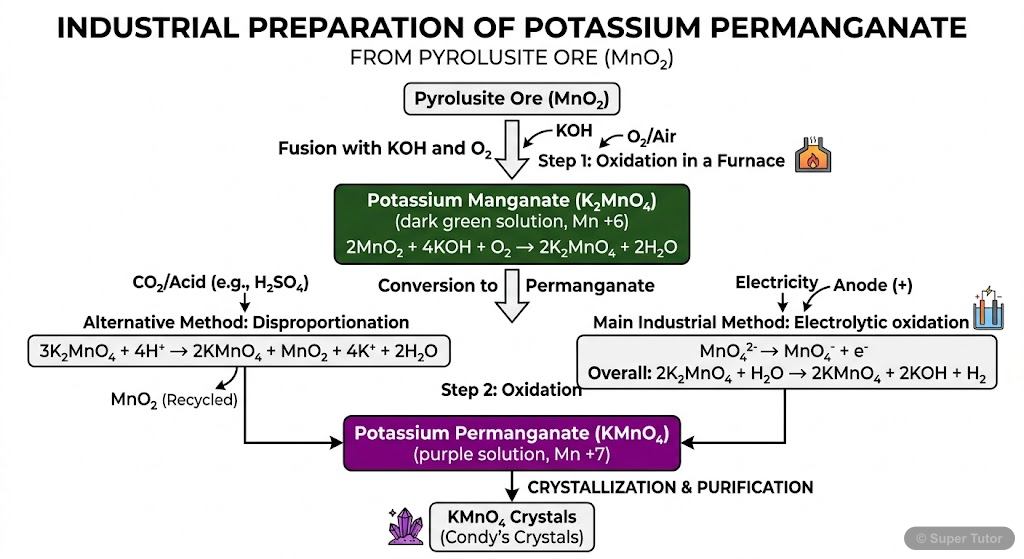
Learn better with visuals Super Tutor pairs illustrations like this with notes and quizzes for Transition and Inner Transition Elements.
Key Topics to Revise
1
Position and Electronic Configuration of d-Block Elements
- d-Block elements occupy groups 3 to 12 in the modern periodic table.
- IUPAC definition: A transition metal is an element whose atom has an incomplete d sub-shell OR which can give rise to cations with an incomplete d sub-shell.
- 3d series: Sc (Z=21) to Zn (Z=30) — 4th period, 10 elements.
2
General Trends in Properties of 3d Series Elements
- METALLIC BEHAVIOUR: All transition elements are metals, good conductors of heat and electricity. Except Group 11 (Cu, Ag, Au), all are hard.
- Silver has the highest electrical conductivity at room temperature among all known elements.
- Crystal structures: HCP (hexagonal close packed), FCC (face centred cubic), BCC (body centred cubic) — true metallic characteristics.
3
Standard Electrode Potentials and Magnetic Properties
- STANDARD ELECTRODE POTENTIAL (E°): Measures oxidizing/reducing power. Large negative E° = powerful reducing agent (loses electrons easily).
- In 3d series, E°(M²⁺/M) becomes less negative from Ti to Cu. Cu has positive E° (+0.34V) — Cu is more stable than Cu²⁺ — meaning Cu is noble.
- Exceptions in E°(M²⁺/M) trend: Mn (−1.18V) and Zn (−0.76V) are more negative than expected — due to extra stability of Mn²⁺ (3d⁵, half-filled) and Zn²⁺ (3d¹⁰, fully-filled).
4
Catalytic Properties, Alloy Formation, Interstitial Compounds and Complex Formation
- CATALYTIC PROPERTIES: Transition metals act as catalysts due to: (1) Available d orbitals to accept electrons from reactant molecules; (2) Ability to form bonds with reactants using d electrons; (3) V
- Hydrogenation example: Alkene π electrons donate to empty d orbital of catalyst → H₂ σ bond breaks → each H bonds to d electron on catalyst → H atoms bond to alkene → alkane formed.
- V₂O₅ catalyst in Contact Process (manufacture of H₂SO₄): V⁵⁺ in V₂O₅ is reduced to V⁴⁺ in VO₂ during SO₂ oxidation.
Get complete notes with diagrams and examples
Full NotesKey Concepts
Transition metals are generally defined asThe general electronic configuration of dAll transition elements are metalsIn the 3d series (ScIonization energy of transition elements
Frequently Asked Questions
What are the important topics in Transition and Inner Transition Elements for Tamil Nadu Board Class 12 Chemistry?
Key topics in Transition and Inner Transition Elements include Position and Electronic Configuration of d-Block Elements, General Trends in Properties of 3d Series Elements, Standard Electrode Potentials and Magnetic Properties, Catalytic Properties, Alloy Formation, Interstitial Compounds and Complex Formation. Study these first, then practise questions on each for the Tamil Nadu Board Class 12 board exam.
How should I revise Transition and Inner Transition Elements for the Tamil Nadu Board Class 12 board exam?
Learn the core ideas first, then work through the 45 practice questions on Transition and Inner Transition Elements. Revise definitions regularly and use flashcards for quick recall before the exam.
Sources & Official References
Content is aligned to the official syllabus. Refer to the board website for the latest curriculum.
More resources for Transition and Inner Transition Elements
For serious students
Get the full Transition and Inner Transition Elements chapter — start free.
Quizzes, flashcards, an AI doubt solver and a study plan for Tamil Nadu Board Class 12 Chemistry. Free to start, no card needed.