Transition and Inner Transition Elements — Chapter Summary
Tamil Nadu Board · Class 12 · Chemistry
Summary of Transition and Inner Transition Elements for Tamil Nadu Board Class 12 Chemistry. Part of the Tamil Nadu Board Class 12 Chemistry syllabus.
Interactive on Super Tutor
Studying Transition and Inner Transition Elements? Get the full interactive chapter.
Quizzes, flashcards, AI doubt-solver and a step-by-step study plan — built for chapter summary and more.
Free trial, no card needed.
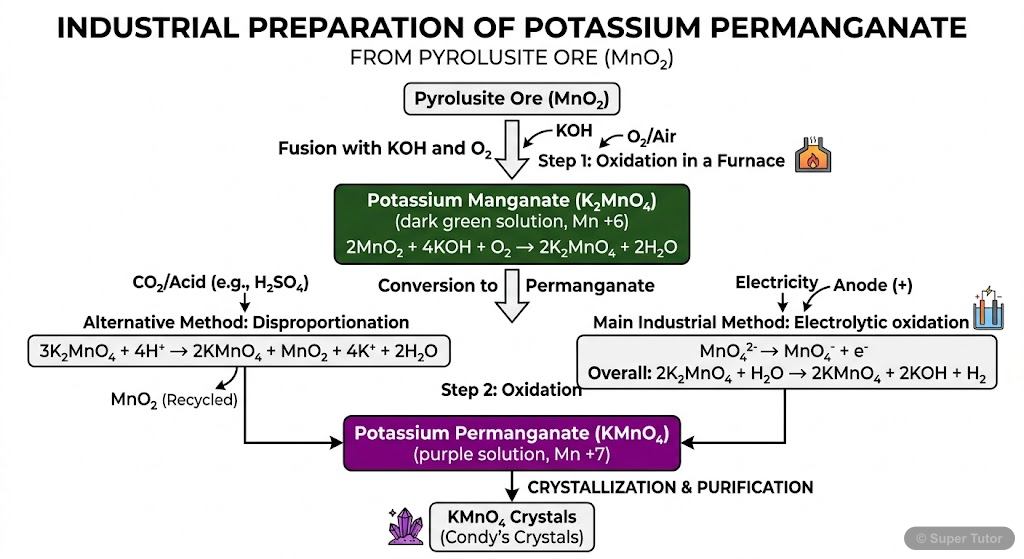
Learn better with visuals Super Tutor pairs illustrations like this with notes and quizzes for Transition and Inner Transition Elements.
Overview
Transition and inner transition elements occupy a unique position in the periodic table, bridging the highly reactive s-block metals and the diverse p-block elements. These elements are characterized by their incomplete d and f orbitals, which lead to distinctive properties including variable oxidat
Key Concepts
Transition metals are generally defined as
Transition metals are generally defined as metallic elements with incompletely filled d or f subshells in their neutral or cationic states. According
The general electronic configuration of d
The general electronic configuration of d-block elements is [Noble gas](n-1)d¹⁻¹⁰ns¹⁻² where n = 4 to 7. Electrons are filled in (n-1)d orbitals accor
All transition elements are metals
All transition elements are metals with characteristic metallic properties. Unlike s-block metals which are soft and reactive, transition metals (exce
In the 3d series (Sc
In the 3d series (Sc to Zn), the expected steady decrease in atomic radius is interrupted. From Sc to V, atomic radius decreases regularly with increa
Ionization energy of transition elements
Ionization energy of transition elements is intermediate between s-block and p-block elements. As we move left to right across a transition series, io
Learning Objectives
- Recognize the position of d and f block elements in the periodic table and understand their electronic configurations
- Describe the general trends in properties of 3d series elements including metallic behavior, atomic size, ionization enthalpy, and oxidation states
- Discuss trends in M²⁺/M standard electrode potentials and predict oxidizing and reducing properties based on E° values
- Explain the tendencies of d-block elements toward alloy, complex, and interstitial compound formation
- Describe the preparation, properties, and chemical reactions of potassium permanganate and potassium dichromate
Frequently Asked Questions
What are the important topics in Transition and Inner Transition Elements for Tamil Nadu Board Class 12 Chemistry?
How should I revise Transition and Inner Transition Elements for the Tamil Nadu Board Class 12 board exam?
Sources & Official References
Content is aligned to the official syllabus. Refer to the board website for the latest curriculum.
More resources for Transition and Inner Transition Elements
For serious students
Get the full Transition and Inner Transition Elements chapter — start free.
Quizzes, flashcards, an AI doubt solver and a study plan for Tamil Nadu Board Class 12 Chemistry. Free to start, no card needed.