Chapter 9 of 15
Concept Maps
Coordination Chemistry — Concept Maps
Tamil Nadu Board · Class 12 · Chemistry
3 concept maps of Coordination Chemistry for Tamil Nadu Board Class 12 Chemistry, each also written out as a text outline.
45 questions34 flashcards5 concepts
Interactive on Super Tutor
Studying Coordination Chemistry? Get the full interactive chapter.
Quizzes, flashcards, AI doubt-solver and a step-by-step study plan — built for concept maps and more.
Free trial, no card needed.
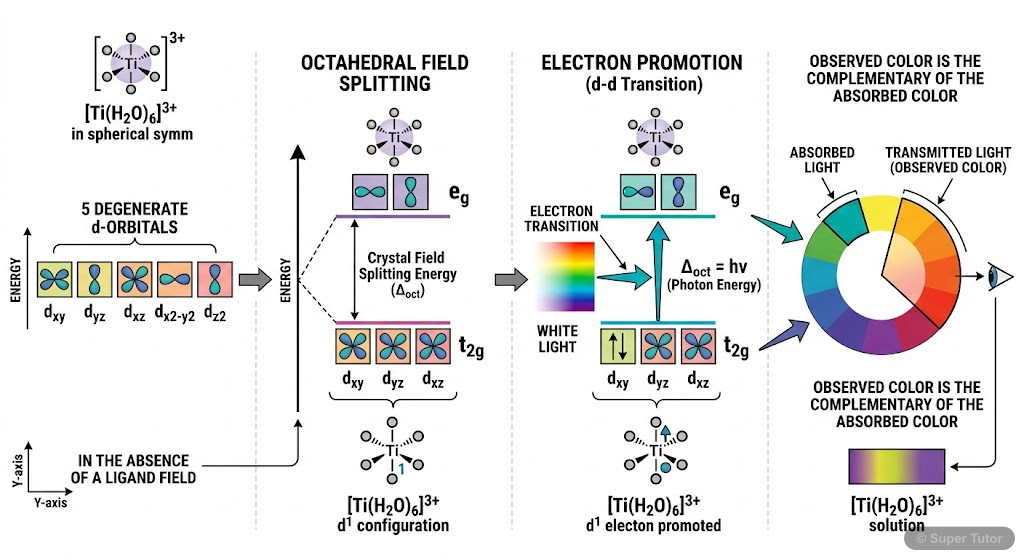
Super Tutor
One of 4 illustrations for Coordination Chemistry in Super Tutor — alongside flashcards, concept maps and practice questions.
3 Concept Maps
Step-by-step process for naming coordination compounds using IUPAC rules
The map in words
- Coordination Compound Formula
- Identify Cation and Anion
- Is Complex Cationic or Anionic?
- Cationic: Use Metal Name as is
- Add Oxidation State
- Complete IUPAC Name
- Add Oxidation State
- Anionic: Add 'ate' to Metal Name
- Cationic: Use Metal Name as is
- Is Complex Cationic or Anionic?
- List Ligands Alphabetically
- Add Greek Prefix
- Change Ligand Name Ending
- Identify Cation and Anion
Classification of structural isomerism types in coordination compounds
The map in words
- Structural Isomerism
- Linkage Isomers
- Ambidentate Ligands
- NO2- bonded at N or O
- SCN- bonded at S or N
- Coordination Isomers
- Both ions are complex
- Exchange of ligands
- Same molecular formula
- Ionization Isomers
- Counter ion as ligand
- Cl- or Br- exchange
- Different ions in solution
- Solvate Isomers
- Hydrate isomers
- Exchange with water
- Different colors
- Linkage Isomers
Decision tree for identifying types of geometrical isomerism in coordination complexes
The map in words
- Heteroleptic Complex
- Geometry?
- Square Planar: MA2B2 or MA2BC
- Similar Ligands Position?
- Same Side: cis Isomer
- Different Properties
- Opposite Sides: trans Isomer
- Same Side: cis Isomer
- Similar Ligands Position?
- Octahedral: MA3B3 or MA2B4
- Ligand Arrangement?
- Triangular Face: Facial fac
- Meridian: Meridional mer
- Ligand Arrangement?
- Square Planar: MA2B2 or MA2BC
- Geometry?
Explore these maps interactively
Explore DiagramsFrequently Asked Questions
What are the important topics in Coordination Chemistry for Tamil Nadu Board Class 12 Chemistry?
Key topics in Coordination Chemistry include Coordination Compounds vs Double Salts, Werner's Theory of Coordination Compounds, Important Terms in Coordination Chemistry, IUPAC Nomenclature of Coordination Compounds. Study these first, then practise questions on each for the Tamil Nadu Board Class 12 board exam.
What do the concept maps for Coordination Chemistry show?
The 3 maps show how the ideas in Coordination Chemistry connect: Step-by-step process for naming coordination compounds using IUPAC rules; Classification of structural isomerism types in coordination compounds. Each map is also written out as an outline on this page.
How should I revise Coordination Chemistry for the Tamil Nadu Board Class 12 board exam?
Learn the core ideas first, then work through the 45 practice questions on Coordination Chemistry. Revise definitions regularly and use flashcards for quick recall before the exam.
Sources & Official References
Content is aligned to the official syllabus. Refer to the board website for the latest curriculum.
More resources for Coordination Chemistry
For serious students
Get the full Coordination Chemistry chapter — start free.
Quizzes, flashcards, an AI doubt solver and a study plan for Tamil Nadu Board Class 12 Chemistry. Free to start, no card needed.