Transition and Inner Transition Elements — Flashcards
Tamil Nadu Board · Class 12 · Chemistry
40 flashcards for Transition and Inner Transition Elements (Tamil Nadu Board Class 12 Chemistry) to test yourself on key terms and facts.
Interactive on Super Tutor
Studying Transition and Inner Transition Elements? Get the full interactive chapter.
Quizzes, flashcards, AI doubt-solver and a step-by-step study plan — built for flashcards and more.
Free trial, no card needed.
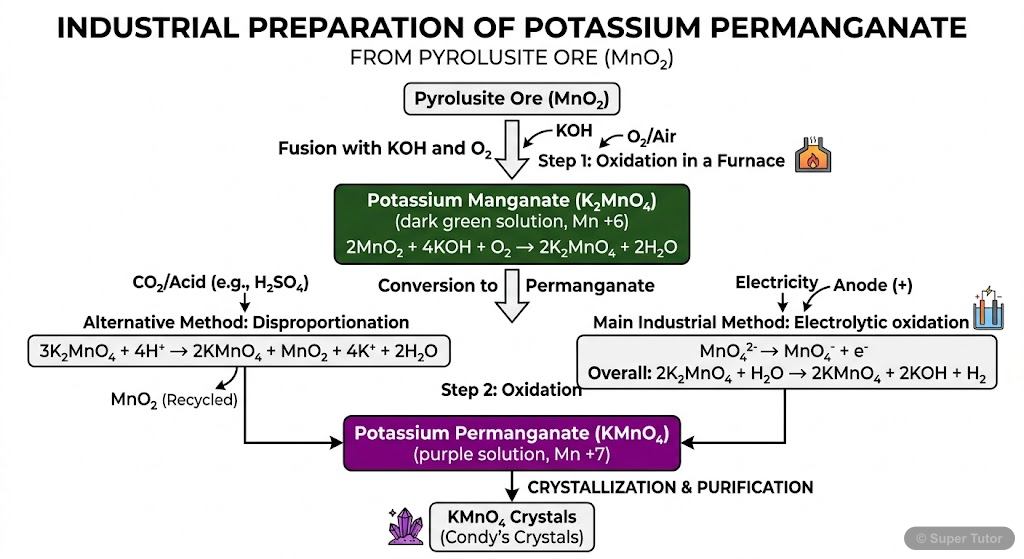
Learn better with visuals Super Tutor pairs illustrations like this with notes and quizzes for Transition and Inner Transition Elements.
What is the IUPAC definition of a transition metal?
Answer
A transition metal is an element whose atom has an incomplete d subshell or which can give rise to cations with an incomplete d subshell. Transition metals occupy the central position of the periodic …
Write the general electronic configuration of d-block elements.
Answer
General electronic configuration: [Noble gas] (n-1)d¹⁻¹⁰ ns¹⁻². Here, n = 4 to 7. For example, Scandium (3d series): [Ar] 3d¹ 4s². Note: Periods 6 and 7 also include f-orbitals: [Noble gas] (n-2)f¹⁴ (…
Why do Cr and Cu show exceptional electronic configurations?
Answer
Chromium and Copper have exceptional configurations due to extra stability of half-filled and fully-filled d orbitals. Cr: [Ar] 3d⁵ 4s¹ (half-filled 3d for stability, not [Ar] 3d⁴ 4s²). Cu: [Ar] 3d¹⁰ …
Explain the trend in atomic radius across the 3d transition series (Sc to Zn).
Answer
In the 3d series, atomic radius initially decreases from Sc to V, then remains nearly constant from V to Cu, and slightly increases at Zn. This occurs because: (1) Added 3d electrons only partially sh…
What is lanthanoid contraction and why does it occur?
Answer
Lanthanoid contraction is the gradual decrease in atomic and ionic radii of lanthanoids as atomic number increases from Ce to Lu. Cause: The 4f electrons have diffuse shapes and provide poor shielding…
Compare the ionization enthalpies of transition metals with s-block and p-block metals.
Answer
Ionization enthalpy of transition metals is intermediate between those of s-block and p-block elements. Values increase irregularly across a transition series because: (1) Added electrons enter (n-1)d…
Why do transition metals exhibit variable oxidation states?
Answer
Transition metals exhibit variable oxidation states because: (1) Energy difference between (n-1)d and ns orbitals is very small; (2) Electrons from both d and s subshells can be removed with similar e…
Interpret the following standard reduction potentials for 3d series: Ti²⁺/Ti = -1.63V, Fe²⁺/Fe = -0.44V, Cu²⁺/Cu = +0.34V
Answer
As we move from Ti to Cu, E₀ values become less negative (increase). This means: (1) Ti is most easily oxidized (strongest reducing agent); (2) Cu is most difficult to oxidize; (3) Cu²⁺ is more stable…
+32 more flashcards
Practise AllFrequently Asked Questions
What are the important topics in Transition and Inner Transition Elements for Tamil Nadu Board Class 12 Chemistry?
How many flashcards are available for Transition and Inner Transition Elements?
How should I revise Transition and Inner Transition Elements for the Tamil Nadu Board Class 12 board exam?
Sources & Official References
Content is aligned to the official syllabus. Refer to the board website for the latest curriculum.
More resources for Transition and Inner Transition Elements
Practice Quiz
Test yourself with a quick quiz
Important Questions
Exam-style questions with answers
Revision Notes
Key points for last-minute revision
Formula Sheet
The chapter's formulas in one place
Chapter Summary
Understand the chapter at a glance
Concept Maps
See how topics connect
Syllabus
What topics to cover
For serious students
Get the full Transition and Inner Transition Elements chapter — start free.
Quizzes, flashcards, an AI doubt solver and a study plan for Tamil Nadu Board Class 12 Chemistry. Free to start, no card needed.