Chemistry in Everyday Life — Important Questions
Tamil Nadu Board · Class 12 · Chemistry
44 important questions from Chemistry in Everyday Life for Tamil Nadu Board Class 12 Chemistry, with answers. Includes multiple choice questions.
Interactive on Super Tutor
Studying Chemistry in Everyday Life? Get the full interactive chapter.
Quizzes, flashcards, AI doubt-solver and a step-by-step study plan — built for important questions and more.
Free trial, no card needed.
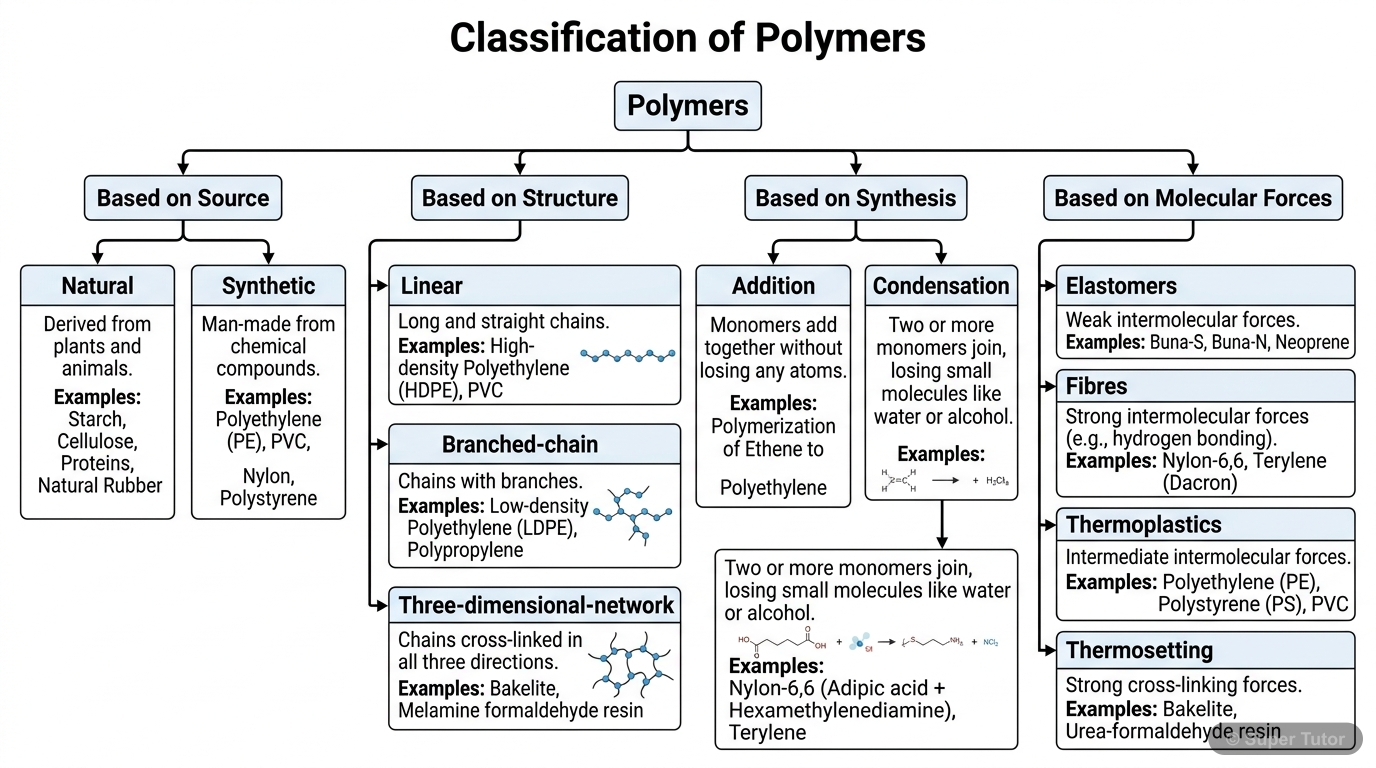
Learn better with visuals Super Tutor pairs illustrations like this with notes and quizzes for Chemistry in Everyday Life.
Important Questions from Chemistry in Everyday Life
Aspirin (acetylsalicylic acid) belongs to which class of drugs?
Show answer
Non-narcotic analgesic (NSAID)
Step 1: Analgesics are drugs that reduce pain. They are of two types: narcotic (opioid) and non-narcotic. Step 2: Aspirin (acetylsalicylic acid) is a non-narcotic analgesic and also a Non-Steroidal Anti-Inflammatory Drug (NSAID). Step 3: It works by reducing local inflammatory responses and also has antipyretic (fever-reducing) properties. Step 4: Narcotic analgesics like morphine and codeine are addictive and cause sleep — aspirin does not. Step 5: Tranquilizers act on the central nervous system for mental health, and antacids neutralize stomach acid — aspirin does neither of these as its pri
Which of the following is an example of a narcotic (opioid) analgesic?
Show answer
Morphine
Step 1: Opioid (narcotic) analgesics relieve severe pain, produce sleep, and are addictive. Step 2: Morphine binds to opioid receptors in the brain (acts as an agonist) and suppresses neurotransmitters that cause pain. Step 3: It is mainly used for post-operative pain and pain in terminal cancer patients. Step 4: Paracetamol and ibuprofen are non-narcotic analgesics — they reduce pain through anti-inflammatory pathways and are NOT addictive. Step 5: Aspirin is also a non-narcotic analgesic. The key distinction is that morphine and codeine are addictive opioids, while the others are not.
Ranitidine and cimetidine are used as antacids. How do they work?
Show answer
They bind to histamine receptors in the stomach wall and inactivate them, reducing HCl secretion
Step 1: Histamine stimulates receptors in the stomach wall to secrete HCl (hydrochloric acid), causing acidity. Step 2: Ranitidine and cimetidine are structurally similar to histamine, so they can bind to the same receptors. Step 3: However, unlike histamine, they inactivate the receptors (they are antagonists), which reduces or stops HCl production. Step 4: This treats the CAUSE of acidity, unlike simple antacids like aluminium hydroxide which only neutralize already-produced acid (treating symptoms). Step 5: Option B describes the action of traditional antacids like Milk of Magnesia, not ran
Which of the following chemicals is added to food as an antioxidant to prevent rancidity of fats and oils?
Show answer
BHT (Butylated Hydroxy Toluene)
Step 1: Foods containing fats and oils can undergo oxidation, making them rancid (spoiled with bad smell/taste). Step 2: Antioxidants are added to food to prevent this oxidation. Step 3: BHT (Butylated Hydroxy Toluene) and BHA (Butylated Hydroxy Anisole) are common food antioxidants. They react with free radicals generated during oxidation, stopping the chain reaction. Step 4: Sodium benzoate is a preservative (prevents microbial growth), not an antioxidant. Step 5: Saccharin and aspartame are artificial sweeteners — they provide sweetness without calories, and have nothing to do with preventi
+40 more questions on Chemistry in Everyday Life (Tamil Nadu Board Class 12 Chemistry)
Practise AllFrequently Asked Questions
What are the important topics in Chemistry in Everyday Life for Tamil Nadu Board Class 12 Chemistry?
How many important questions are there in Chemistry in Everyday Life?
Sources & Official References
Content is aligned to the official syllabus. Refer to the board website for the latest curriculum.
More resources for Chemistry in Everyday Life
For serious students
Get the full Chemistry in Everyday Life chapter — start free.
Quizzes, flashcards, an AI doubt solver and a study plan for Tamil Nadu Board Class 12 Chemistry. Free to start, no card needed.