Coordination Chemistry — Important Questions
Tamil Nadu Board · Class 12 · Chemistry
45 important questions from Coordination Chemistry for Tamil Nadu Board Class 12 Chemistry, with answers. Includes multiple choice questions.
Interactive on Super Tutor
Studying Coordination Chemistry? Get the full interactive chapter.
Quizzes, flashcards, AI doubt-solver and a step-by-step study plan — built for important questions and more.
Free trial, no card needed.
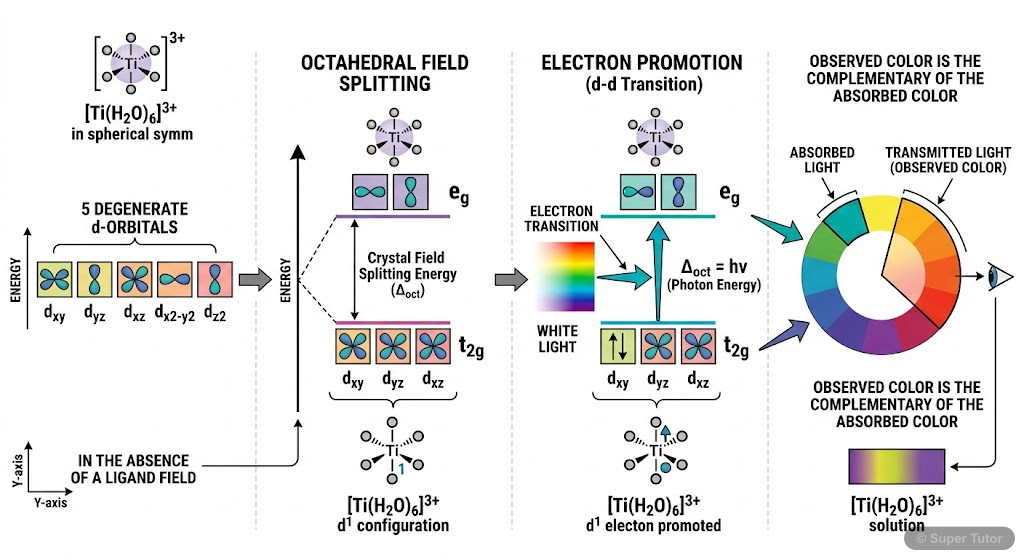
One of 4 illustrations for Coordination Chemistry in Super Tutor — alongside flashcards, concept maps and practice questions.
Important Questions from Coordination Chemistry
The type of isomerism exhibited by [Co(NH₃)₅(NO₂)]²⁺ and [Co(NH₃)₅(ONO)]²⁺ is:
Show answer
Linkage isomerism
Step 1: Both complexes have the same molecular formula and the same set of ligands (5 NH₃ and 1 NO₂⁻). Step 2: The difference is HOW the nitrite ion (NO₂⁻) is bonded. It is an ambidentate ligand — it can coordinate through either N or O. Step 3: In [Co(NH₃)₅(NO₂)]²⁺, nitrite binds through nitrogen (N-bonded, called nitrito-κN). In [Co(NH₃)₅(ONO)]²⁺, it binds through oxygen (O-bonded, called nitrito-κO). Step 4: This is the definition of linkage isomerism — same ligands, different bonding atoms. Ionisation isomers give different ions in solution. Coordination isomers involve interchange between
What is the hybridisation and geometry of [Ni(CN)₄]²⁻?
Show answer
dsp², Square planar
Step 1: Determine the electronic configuration of Ni²⁺. Ni is [Ar] 3d⁸ 4s², so Ni²⁺ is [Ar] 3d⁸ (loses 2 electrons from 4s). Step 2: CN⁻ is a strong field ligand. It causes pairing of 3d electrons. The 3d⁸ configuration rearranges: electrons pair up, leaving one 3d orbital empty. Step 3: The one empty 3d orbital, one 4s orbital and two 4p orbitals hybridize to form dsp² hybridisation (inner orbital complex). Step 4: dsp² hybridisation gives a square planar geometry. sp³ (option B) applies to weak-field tetrahedral complexes like [NiCl₄]²⁻. d²sp³ and sp³d² apply to octahedral complexes (coordin
The crystal field splitting energy Δₜ in a tetrahedral complex is related to Δ₀ (octahedral) by the expression:
Show answer
Δₜ = (4/9)Δ₀
Step 1: In an octahedral complex, all 6 ligands approach directly along the x, y, z axes, causing strong repulsion with d orbitals lying along axes (dx²-y² and dz²). Step 2: In a tetrahedral complex, only 4 ligands approach along alternate corners of a cube — none points directly at any d orbital. This means the interaction is weaker. Step 3: Also, there are fewer ligands (4 vs 6) in a tetrahedral complex. Step 4: Both factors together result in Δₜ being much smaller than Δ₀. The mathematical relationship derived is Δₜ = (4/9)Δ₀, approximately 0.44 times the octahedral splitting. This is why m
Which of the following complexes is expected to be colourless?
Show answer
[Zn(NH₃)₄]²⁺
Step 1: The colour of coordination compounds arises due to d-d transitions — electrons absorb light and jump from lower energy t₂g orbitals to higher energy eg orbitals. Step 2: For d-d transitions to occur, the central metal ion must have partially filled d orbitals (i.e., d¹ to d⁹ configuration). Step 3: Zn²⁺ has the configuration [Ar] 3d¹⁰ — a completely filled d subshell. Since all d orbitals are filled, no d-d transition is possible. Step 4: Therefore [Zn(NH₃)₄]²⁺ is colourless. Ti³⁺ is d¹ (coloured — purple/violet), Fe³⁺ is d⁵ (coloured), Cu²⁺ is d⁹ (coloured — blue). Complexes with d⁰ (
+41 more questions on Coordination Chemistry (Tamil Nadu Board Class 12 Chemistry)
Practise AllFrequently Asked Questions
What are the important topics in Coordination Chemistry for Tamil Nadu Board Class 12 Chemistry?
How many important questions are there in Coordination Chemistry?
Sources & Official References
Content is aligned to the official syllabus. Refer to the board website for the latest curriculum.
More resources for Coordination Chemistry
For serious students
Get the full Coordination Chemistry chapter — start free.
Quizzes, flashcards, an AI doubt solver and a study plan for Tamil Nadu Board Class 12 Chemistry. Free to start, no card needed.