Organic Nitrogen Compounds — Important Questions
Tamil Nadu Board · Class 12 · Chemistry
45 important questions from Organic Nitrogen Compounds for Tamil Nadu Board Class 12 Chemistry, with answers. Includes multiple choice questions.
Interactive on Super Tutor
Studying Organic Nitrogen Compounds? Get the full interactive chapter.
Quizzes, flashcards, AI doubt-solver and a step-by-step study plan — built for important questions and more.
Free trial, no card needed.
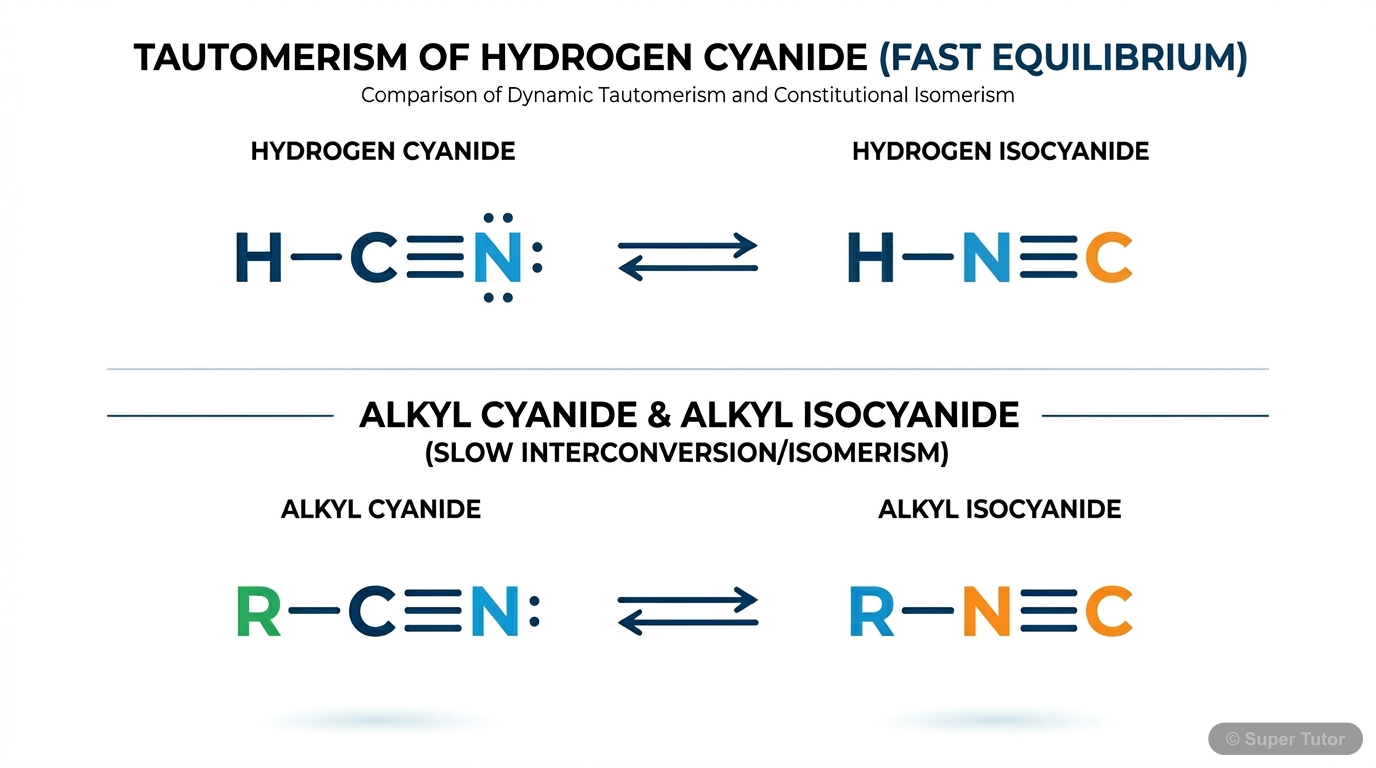
An illustration from Super Tutor's Organic Nitrogen Compounds chapter — alongside flashcards, concept maps and practice questions.
Important Questions from Organic Nitrogen Compounds
The IUPAC name of the compound CH3-NH-CH(CH3)2 is:
Show answer
N-methyl propan-2-amine
Step 1: Identify the longest carbon chain attached to nitrogen: CH(CH3)2 is isopropyl = 3 carbons = propane. Step 2: The nitrogen is attached to C2 of the propane chain, so it is propan-2-amine. Step 3: There is a methyl group (CH3) directly on the nitrogen, so we add the prefix N-methyl. Step 4: The complete IUPAC name is N-methyl propan-2-amine. Step 5: 'N-isopropyl methanamine' would be incorrect because we should choose the longer chain (propyl, 3C) as the parent, not methyl (1C). The rule is to choose the longest chain as the parent amine.
Why is aniline a weaker base than methylamine?
Show answer
The lone pair on nitrogen in aniline is delocalised over the benzene ring, making it less available for protonation
Step 1: In methylamine (CH3-NH2), the lone pair on nitrogen is fully available to accept a proton (H+), making it a good base. Step 2: In aniline (C6H5-NH2), the nitrogen's lone pair is in conjugation with the π electron system of the benzene ring. Step 3: This conjugation/delocalisation means the lone pair is spread over the entire ring through resonance, reducing its availability for accepting a proton. Step 4: Therefore, aniline is a much weaker base (pKb = 9.30) compared to methylamine (pKb = 3.38). Step 5: The -NH2 group in aniline is actually electron-donating (+M effect) to the ring, ma
The Sandmeyer reaction involves treating benzene diazonium chloride with which of the following reagents to obtain chlorobenzene?
Show answer
Cuprous chloride (CuCl)
Step 1: In the Sandmeyer reaction, the diazonium group (-N2+) is replaced by a halide group using cuprous halide salts. Step 2: For chlorobenzene: C6H5-N2+Cl- + CuCl → C6H5-Cl + N2↑ + CuCl. Step 3: The key reagent is cuprous chloride (CuCl), which is the freshly prepared cuprous salt. Step 4: The Gattermann reaction also gives chlorobenzene but uses HCl/Cu powder — this is a different reaction with lower yield. Step 5: Cl2/FeCl3 would give electrophilic substitution (halogenation), not replacement of the diazonium group. NaCl is too weak a nucleophile for this reaction.
What product is formed when aniline reacts with Br2/H2O (bromine water)?
Show answer
2,4,6-tribromoaniline (white precipitate)
Step 1: The -NH2 group in aniline is a very strong activating and ortho/para-directing group. Step 2: It strongly increases electron density at the ortho (2,6) and para (4) positions of the benzene ring. Step 3: Bromine water (Br2/H2O) without any Lewis acid catalyst is enough to brominate all three activated positions simultaneously due to the high reactivity. Step 4: The reaction gives 2,4,6-tribromoaniline as a white precipitate: C6H5-NH2 + 3Br2 → 2,4,6-Br3-C6H2-NH2 + 3HBr. Step 5: To obtain monobromo product, the -NH2 group must first be protected by acetylation to reduce its activating po
+41 more questions on Organic Nitrogen Compounds (Tamil Nadu Board Class 12 Chemistry)
Practise AllFrequently Asked Questions
What are the important topics in Organic Nitrogen Compounds for Tamil Nadu Board Class 12 Chemistry?
How many important questions are there in Organic Nitrogen Compounds?
Sources & Official References
Content is aligned to the official syllabus. Refer to the board website for the latest curriculum.
More resources for Organic Nitrogen Compounds
For serious students
Get the full Organic Nitrogen Compounds chapter — start free.
Quizzes, flashcards, an AI doubt solver and a study plan for Tamil Nadu Board Class 12 Chemistry. Free to start, no card needed.