Electrostatics — Chapter Summary
Tamil Nadu Board · Class 12 · Physics
Summary of Electrostatics for Tamil Nadu Board Class 12 Physics. Key concepts: Electric charge is, The electrostatic force and The total electric force.
Interactive on Super Tutor
Studying Electrostatics? Get the full interactive chapter.
Quizzes, flashcards, AI doubt-solver and a step-by-step study plan — built for chapter summary and more.
Free trial, no card needed.
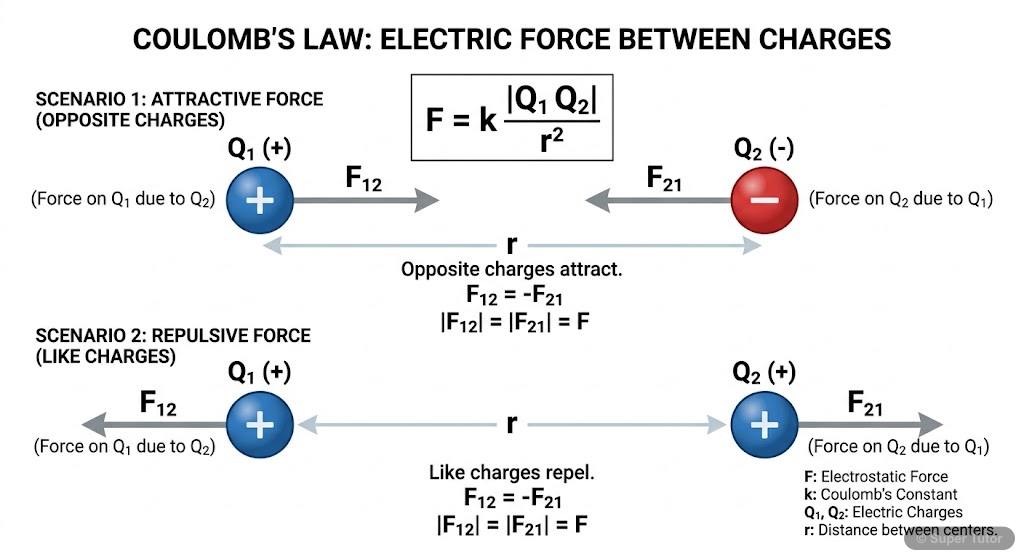
An illustration from Super Tutor's Electrostatics chapter — alongside flashcards, concept maps and practice questions.
Overview
Electrostatics is the study of electric charges at rest and the forces between them. It forms the foundation of understanding electricity and has practical applications in everyday life, from simple phenomena like rubbing a balloon to complex technologies like capacitors and Van de Graaff generators
Key Concepts
Electric charge is a fundamental property
Electric charge is a fundamental property of matter. Two types exist: positive (on protons) and negative (on electrons). Charges are conserved (cannot
The electrostatic force between two point
The electrostatic force between two point charges q₁ and q₂ separated by distance r is: F = (1/4πε₀) × (q₁q₂/r²), directed along the line joining them
The total electric force or field
The total electric force or field at a point due to multiple charges is the vector sum of forces or fields due to individual charges. This principle a
Electric field E at point P
Electric field E at point P due to charge q is defined as force per unit positive test charge: E = F/q₀ = (1/4πε₀) × (q/r²). Field lines are visual re
Electric dipole consists of two equal
Electric dipole consists of two equal and opposite charges (+q and -q) separated by distance 2a. Dipole moment p = 2qa, directed from negative to posi
Learning Objectives
- Understand the nature of electric charges and their properties (conservation, quantization)
- Apply Coulomb's law to calculate forces between point charges
- Calculate electric fields for various charge configurations using superposition principle
- Understand and apply Gauss's law for symmetric charge distributions
- Calculate electrostatic potential and potential energy for charge systems
Frequently Asked Questions
What are the important topics in Electrostatics for Tamil Nadu Board Class 12 Physics?
How should I revise Electrostatics for the Tamil Nadu Board Class 12 board exam?
Sources & Official References
Content is aligned to the official syllabus. Refer to the board website for the latest curriculum.
More resources for Electrostatics
For serious students
Get the full Electrostatics chapter — start free.
Quizzes, flashcards, an AI doubt solver and a study plan for Tamil Nadu Board Class 12 Physics. Free to start, no card needed.