Electronics and Communication — Chapter Summary
Tamil Nadu Board · Class 12 · Physics
Summary of Electronics and Communication for Tamil Nadu Board Class 12 Physics. Part of the Tamil Nadu Board Class 12 Physics syllabus.
Interactive on Super Tutor
Studying Electronics and Communication? Get the full interactive chapter.
Quizzes, flashcards, AI doubt-solver and a step-by-step study plan — built for chapter summary and more.
Free trial, no card needed.
Learn better with visuals Super Tutor pairs illustrations like this with notes and quizzes for Electronics and Communication.
Overview
Electronics and Communication is a fundamental chapter in Physics that bridges the gap between theoretical physics and practical technological applications. This chapter covers the evolution from vacuum tubes to modern semiconductor devices, the principles of signal transmission, and various communi
Key Concepts
When atoms are brought close together
When atoms are brought close together in a solid, their isolated energy levels split into closely-spaced bands. The valence band (VB) is formed from v
Pure semiconductors without any impurities
Pure semiconductors without any impurities are called intrinsic semiconductors. In silicon lattices, each atom has four valence electrons forming cova
Doping is the process of adding
Doping is the process of adding impurities to intrinsic semiconductors to increase charge carrier concentration. N-type semiconductors are created by
A p
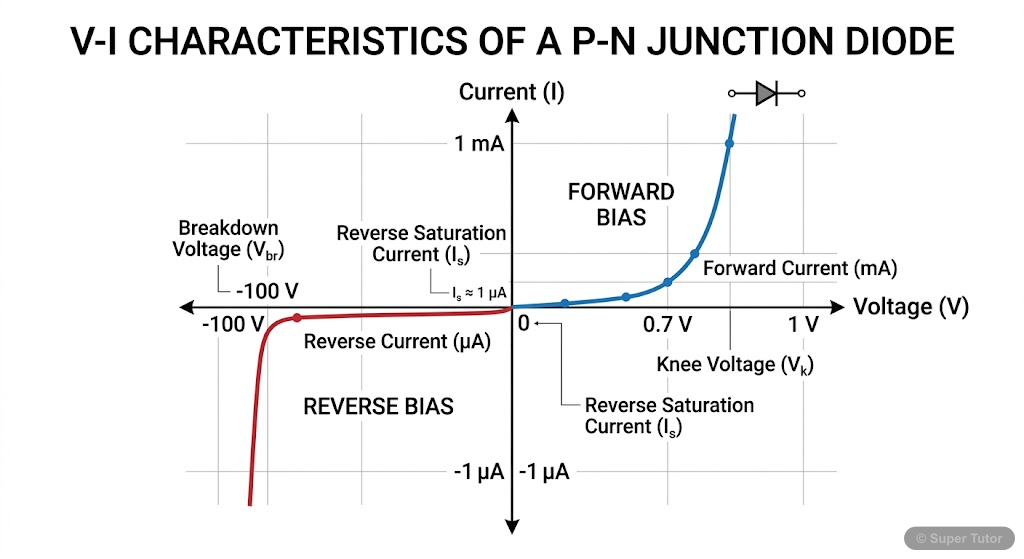
A p-n junction is formed when p-type and n-type semiconductors are joined together. Diffusion of charge carriers creates a depletion region—a thin lay
Forward bias occurs when the positive
Forward bias occurs when the positive terminal is connected to the p-side and negative to the n-side. This reduces the barrier potential, narrows the
Learning Objectives
- Understand energy band diagrams and classify materials as insulators, conductors, and semiconductors
- Comprehend the formation and working of p-n junction diodes in forward and reverse bias conditions
- Learn rectification processes using half-wave and full-wave rectifiers
- Master the principles of Zener diodes and their voltage regulation applications
- Understand optoelectronic devices including LEDs, photodiodes, and solar cells
Frequently Asked Questions
What are the important topics in Electronics and Communication for Tamil Nadu Board Class 12 Physics?
How should I revise Electronics and Communication for the Tamil Nadu Board Class 12 board exam?
Sources & Official References
Content is aligned to the official syllabus. Refer to the board website for the latest curriculum.
More resources for Electronics and Communication
For serious students
Get the full Electronics and Communication chapter — start free.
Quizzes, flashcards, an AI doubt solver and a study plan for Tamil Nadu Board Class 12 Physics. Free to start, no card needed.