Molecular Genetics — Practice Quiz
Tamil Nadu Board · Class 12 · Zoology
Try a 4-question quiz on Molecular Genetics for Tamil Nadu Board Class 12 Zoology: tap an answer to check it and see why.
Interactive on Super Tutor
Studying Molecular Genetics? Get the full interactive chapter.
Quizzes, flashcards, AI doubt-solver and a step-by-step study plan — built for practice quiz and more.
Free trial, no card needed.
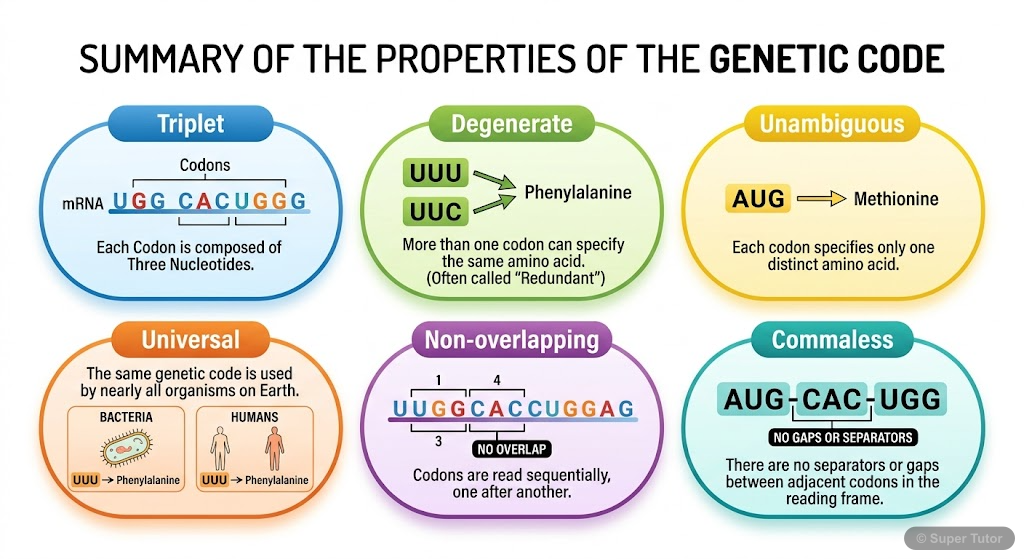
Learn better with visuals Super Tutor pairs illustrations like this with notes and quizzes for Molecular Genetics.
Quick Quiz: Molecular Genetics
0/3Tap an answer to check it instantly. No sign-up needed for these 3.
In the Hershey-Chase experiment, bacteriophages were grown in media containing radioactive ³⁵S and ³²P separately. What was the key conclusion drawn when bacteria were infected with these labelled phages?
Which of the following correctly describes the structural organization of a nucleosome?
During DNA replication, the lagging strand is synthesized discontinuously. What are the short fragments produced during lagging strand synthesis called, and which enzyme joins them?
Sample Questions
In the transcription unit, the strand of DNA that serves as a template for RNA synthesis has polarity:
Show answer
3' → 5' and is called the template strand
Step 1: In transcription, RNA polymerase reads the DNA template and synthesizes RNA in the 5'→3' direction. Step 2: To synthesize RNA in 5'→3' direction, it must read the template DNA in the 3'→5' direction (antiparallel rule). Step 3: Therefore, the template strand (also called antisense strand) has polarity 3'→5'. Step 4: The other strand (5'→3') has the same sequence as the RNA produced (except T is replaced by U) and is called the coding strand (sense strand). Step 5: Option A is wrong — the coding strand is 5'→3' but is NOT the template. Option C is wrong — a 5'→3' strand is not the templ
Which of the following statements about the genetic code is INCORRECT?
Show answer
AUG acts only as a start codon and does NOT code for any amino acid
Step 1: AUG is a special codon — it has dual functions. Step 2: AUG acts as the START/initiator codon (beginning of translation). Step 3: Additionally, AUG also codes for the amino acid Methionine (Met). So it does BOTH — it is an initiator AND codes for methionine. Step 4: Therefore, the statement 'AUG does NOT code for any amino acid' is INCORRECT. This makes option B the wrong statement. Step 5: Options A (degeneracy — e.g., GUU, GUC, GUA, GUG all code for valine), C (UAA, UAG, UGA are stop codons), and D (polarity 5'→3') are all correct features of the genetic code.
In eukaryotes, the pre-mRNA (hnRNA) undergoes post-transcriptional processing before it becomes functional mRNA. Which of the following correctly describes this processing?
Show answer
Introns are removed by splicing, methyl guanosine cap added at 5' end, and poly-A tail added at 3' end
Step 1: Eukaryotic genes have coding sequences (exons) interrupted by non-coding sequences (introns). Step 2: The primary transcript (hnRNA) contains both exons and introns. Step 3: Processing involves three key steps: (a) Splicing — introns are removed and exons are joined together. (b) Capping — an unusual nucleotide, methyl guanosine triphosphate (7-methylguanosine), is added at the 5' end. (c) Tailing — about 200-300 adenylate residues (Poly-A tail) are added at the 3' end. Step 4: This processed mRNA is then transported out of the nucleus for translation. Step 5: Options A and B are wrong
In the ribosome during translation, which site does the incoming charged tRNA (aminoacyl-tRNA) first bind to?
Show answer
A site (Aminoacyl site)
Step 1: The ribosome has three sites — A (Aminoacyl), P (Peptidyl), and E (Exit). Step 2: During initiation, the initiator tRNA carrying methionine (fMet in prokaryotes) binds to the P site at the AUG start codon — this is a special exception. Step 3: During elongation, each new incoming aminoacyl-tRNA (charged tRNA) enters at the A site, where its anticodon base-pairs with the mRNA codon. Step 4: Peptide bond formation occurs between the amino acid at the A site and the growing peptide chain at the P site (catalysed by peptidyl transferase). Step 5: The uncharged tRNA then moves from P site t
+41 more questions on Molecular Genetics (Tamil Nadu Board Class 12 Zoology)
Practise AllFrequently Asked Questions
What are the important topics in Molecular Genetics for Tamil Nadu Board Class 12 Zoology?
How many practice questions are there for Molecular Genetics?
Sources & Official References
Content is aligned to the official syllabus. Refer to the board website for the latest curriculum.
More resources for Molecular Genetics
For serious students
Get the full Molecular Genetics chapter — start free.
Quizzes, flashcards, an AI doubt solver and a study plan for Tamil Nadu Board Class 12 Zoology. Free to start, no card needed.