Human Reproduction — Practice Quiz
Tamil Nadu Board · Class 12 · Zoology
Try a 4-question quiz on Human Reproduction for Tamil Nadu Board Class 12 Zoology: tap an answer to check it and see why.
Interactive on Super Tutor
Studying Human Reproduction? Get the full interactive chapter.
Quizzes, flashcards, AI doubt-solver and a step-by-step study plan — built for practice quiz and more.
Free trial, no card needed.
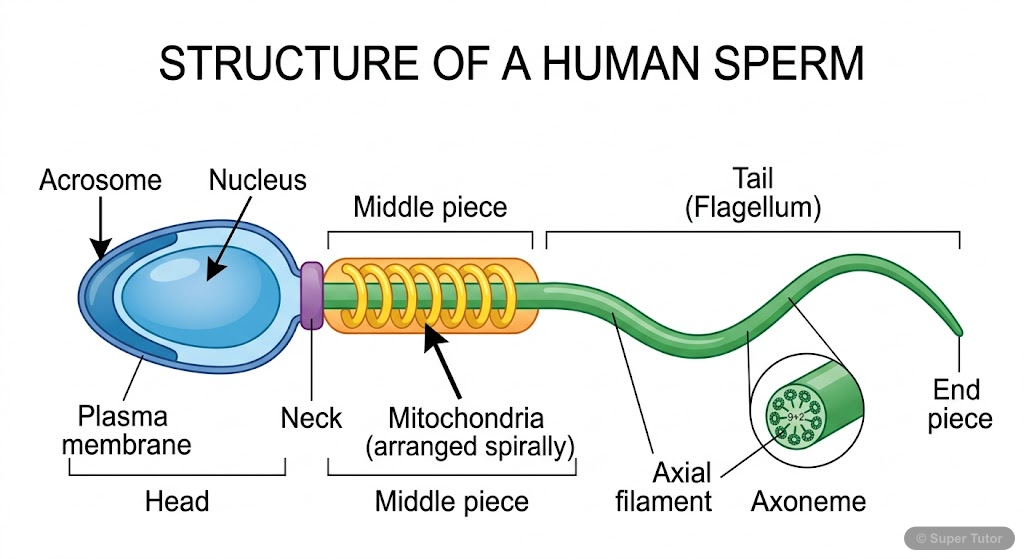
One of 2 illustrations for Human Reproduction in Super Tutor — alongside flashcards, concept maps and practice questions.
Quick Quiz: Human Reproduction
0/4Tap an answer to check it instantly. No sign-up needed for these 4.
Which cells in the seminiferous tubules secrete inhibin and provide nourishment to developing sperms?
The process by which spermatids are transformed into mature spermatozoa is called:
Which part of the human sperm contains the enzyme hyaluronidase that helps in penetrating the ovum?
During oogenesis, the primary oocyte completes its first meiotic division to form a secondary oocyte and which of the following?
Sample Questions
The LH surge on approximately the 14th day of the menstrual cycle triggers which of the following events?
Show answer
Ovulation
Step 1: The menstrual cycle is divided into four phases — menstrual, follicular, ovulatory, and luteal. Step 2: During the ovulatory phase (around day 14), both LH and FSH reach their peak levels in the blood. Step 3: This sudden and sharp increase in LH is called the 'LH surge.' Step 4: The LH surge directly triggers the rupture of the Graafian follicle and the release of the secondary oocyte from the ovary — this is called ovulation. Step 5: After ovulation, the ruptured follicle transforms into the corpus luteum (luteal phase), which then secretes progesterone. The LH surge initiates ovulat
Which structure is formed from the remnant of the Graafian follicle after ovulation and acts as a temporary endocrine gland?
Show answer
Corpus luteum
Step 1: After the Graafian follicle ruptures during ovulation, it does not simply disappear — the remaining cells reorganize. Step 2: The remnant of the ruptured Graafian follicle is transformed into a yellow, glandular structure called the corpus luteum. Step 3: The corpus luteum acts as a temporary endocrine gland and secretes large amounts of progesterone (and some oestrogen). Step 4: Progesterone maintains the thickened endometrium to support implantation if fertilization occurs. Step 5: If fertilization does NOT occur, the corpus luteum degenerates into a scar-like tissue called the corpu
Fertilization in humans normally occurs in which part of the female reproductive tract?
Show answer
Ampullary-isthmic junction of the fallopian tube
Step 1: After ovulation, the secondary oocyte is released into the peritoneal cavity and is picked up by the fimbriae of the fallopian tube. Step 2: The oocyte travels through the infundibulum into the ampulla of the fallopian tube. Step 3: Fertilization occurs only when the ovum and sperms are transported simultaneously to the ampullary-isthmic junction — the junction between the ampulla and the isthmus of the fallopian tube. Step 4: The uterus is where implantation occurs — not fertilization. Step 5: The infundibulum collects the ovum but fertilization does not take place there. The specific
The blastocyst is composed of a single layer of flattened cells called trophoblast and a cluster of rounded cells. What is the cluster of rounded cells called?
Show answer
Inner cell mass
Step 1: After fertilization, the zygote undergoes rapid mitotic divisions called cleavage, forming blastomeres. Step 2: After about 72 hours, a 16-celled berry-shaped structure called the morula is formed. Step 3: The morula continues to divide and develops into a hollow ball of about 100 cells called the blastocyst. Step 4: The blastocyst has two distinct regions: (a) Trophoblast — a single outer layer of large, flattened cells that will form the placenta, and (b) Inner Cell Mass (ICM) — a small cluster of 20-30 rounded cells on the inside. Step 5: The inner cell mass (also called embryoblast
+41 more questions on Human Reproduction (Tamil Nadu Board Class 12 Zoology)
Practise AllFrequently Asked Questions
What are the important topics in Human Reproduction for Tamil Nadu Board Class 12 Zoology?
How many practice questions are there for Human Reproduction?
Sources & Official References
Content is aligned to the official syllabus. Refer to the board website for the latest curriculum.
More resources for Human Reproduction
Important Questions
Exam-style questions with answers
Revision Notes
Key points for last-minute revision
Formula Sheet
The chapter's formulas in one place
Chapter Summary
Understand the chapter at a glance
Concept Maps
See how topics connect
Flashcards
Quick-fire cards for active recall
Syllabus
What topics to cover
For serious students
Get the full Human Reproduction chapter — start free.
Quizzes, flashcards, an AI doubt solver and a study plan for Tamil Nadu Board Class 12 Zoology. Free to start, no card needed.