Measurement — Flashcards
Tamil Nadu Board · Class 9 · Science
35 flashcards for Measurement (Tamil Nadu Board Class 9 Science) to test yourself on key terms and facts. Sample: "What is the difference between.
Interactive on Super Tutor
Studying Measurement? Get the full interactive chapter.
Quizzes, flashcards, AI doubt-solver and a step-by-step study plan — built for flashcards and more.
Free trial, no card needed.
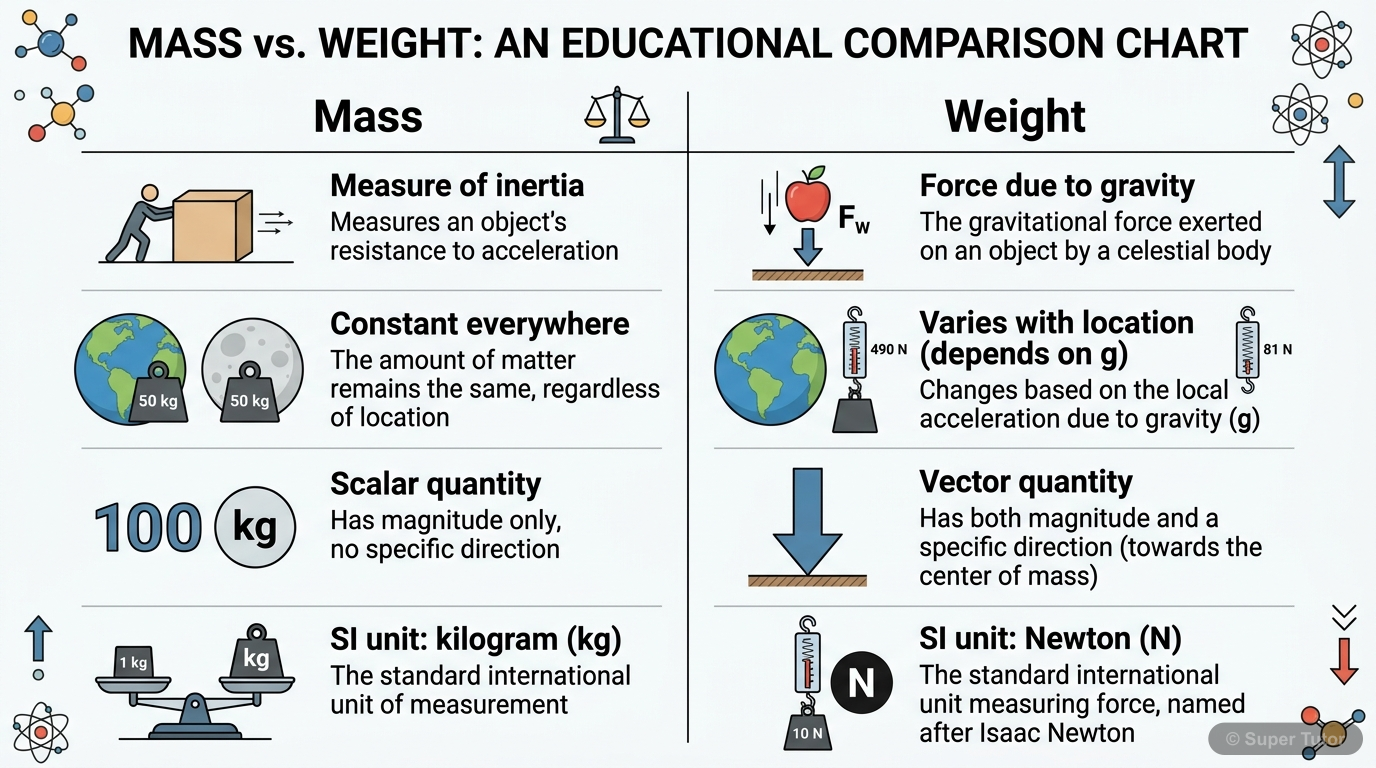
Learn better with visuals Super Tutor pairs illustrations like this with notes and quizzes for Measurement.
What is the difference between a fundamental quantity and a derived quantity? Give one example of each.
Answer
Fundamental quantities cannot be expressed in terms of any other physical quantities. Example: Length, mass, time, temperature. Derived quantities can be expressed in terms of fundamental quantities.
Name all seven fundamental quantities and their SI units with symbols.
Answer
1. Length - metre (m) 2. Mass - kilogram (kg) 3. Time - second (s) 4. Temperature - kelvin (K) 5. Electric current - ampere (A) 6. Luminous intensity - candela (cd) 7. Amount of substance - mole (mol)…
What is a unit prefix? Give three examples with their powers of 10.
Answer
A unit prefix is a symbol placed before a unit to specify the order of magnitude of a quantity. It helps express very large and very small quantities. Examples: - kilo (k) = 10³ - milli (m) = 10⁻³ - …
The density of mercury is 13,600 kg/m³. Write this in scientific notation following SI conventions.
Answer
According to SI conventions, numerical values should be written in scientific form. 13,600 kg/m³ = 1.36 × 10⁴ kg/m³ This follows the rule: Move the decimal point to get a number between 1 and 10, th…
Convert 5.2 kilometres into millimetres using unit prefixes.
Answer
5.2 km = 5.2 × 10³ m = 5.2 × 10³ × 10³ mm = 5.2 × 10⁶ mm Or step by step: 5.2 km = 5,200 m = 5,200,000 mm = 5.2 × 10⁶ mm Key: 1 km = 10³ m and 1 m = 10³ mm, so 1 km = 10⁶ mm…
Why is the SI system of units preferred over older systems like CGS and FPS?
Answer
The SI system was developed after World War II to provide a worldwide standard for measurement. It is preferred because: 1. It is universally accepted by almost all countries 2. It is based on fundam…
Why do we need unit prefixes like kilo, micro, and nano instead of always using the base unit?
Answer
Unit prefixes allow us to express very large and very small quantities conveniently: - Very large distances (like astronomical distances): 1 AU = 1.496 × 10¹¹ m is easier written as a number with a p…
What is the astronomical unit (AU) and light year? How are they used?
Answer
Astronomical Unit (AU): The mean distance from the centre of the Sun to the centre of the Earth. 1 AU = 1.496 × 10¹¹ m. Used to measure distances within our solar system. Light Year (ly): The distanc…
+27 more flashcards
Practise AllFrequently Asked Questions
What are the important topics in Measurement for Tamil Nadu Board Class 9 Science?
How many flashcards are available for Measurement?
How should I revise Measurement for Class 9 exams?
Sources & Official References
Content is aligned to the official syllabus. Refer to the board website for the latest curriculum.
More resources for Measurement
Practice Quiz
Test yourself with a quick quiz
Important Questions
Exam-style questions with answers
Revision Notes
Key points for last-minute revision
Formula Sheet
The chapter's formulas in one place
Chapter Summary
Understand the chapter at a glance
Concept Maps
See how topics connect
Syllabus
What topics to cover
For serious students
Get the full Measurement chapter — start free.
Quizzes, flashcards, an AI doubt solver and a study plan for Tamil Nadu Board Class 9 Science. Free to start, no card needed.