Measurement — Chapter Summary
Tamil Nadu Board · Class 9 · Science
Summary of Measurement for Tamil Nadu Board Class 9 Science. Key concepts: Physical quantities are, The International System and Unit prefixes are symbols.
Interactive on Super Tutor
Studying Measurement? Get the full interactive chapter.
Quizzes, flashcards, AI doubt-solver and a step-by-step study plan — built for chapter summary and more.
Free trial, no card needed.
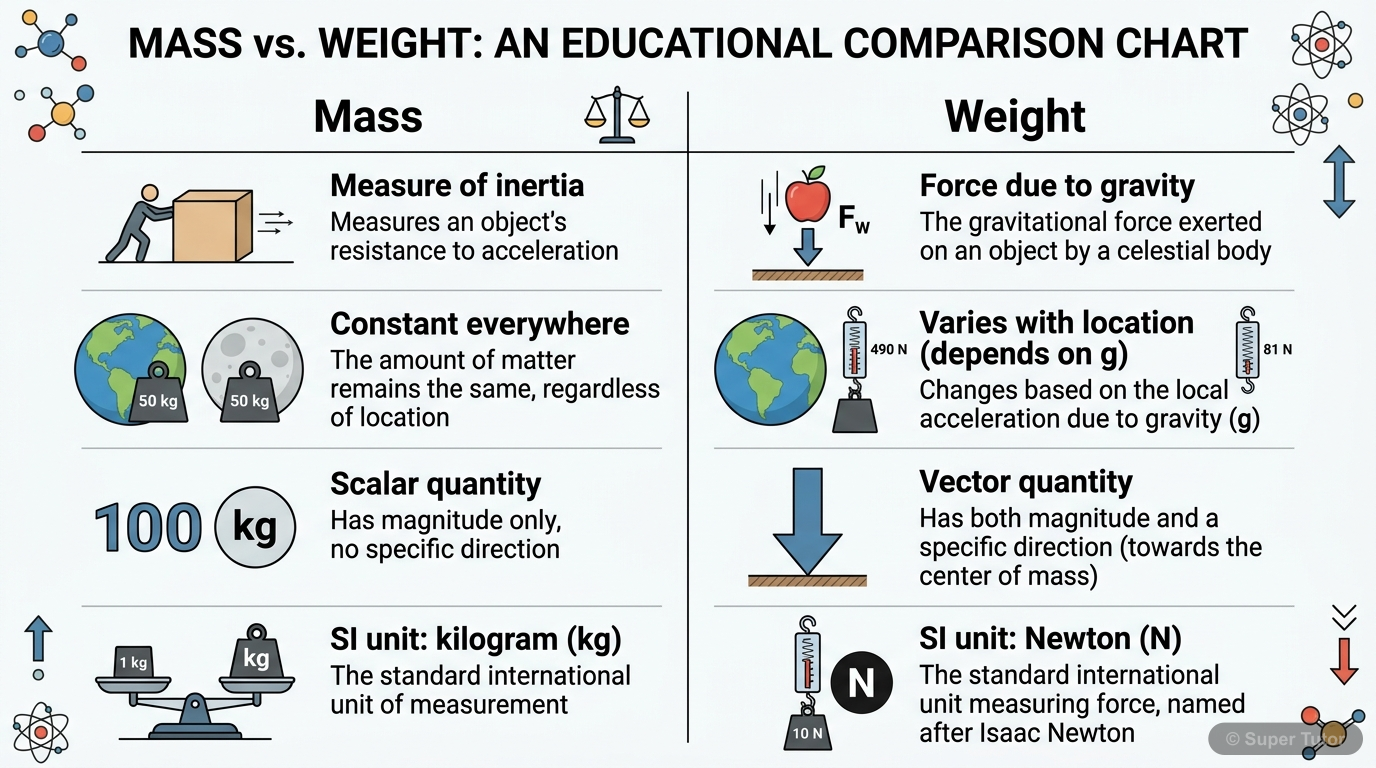
Learn better with visuals Super Tutor pairs illustrations like this with notes and quizzes for Measurement.
Overview
Measurement is the foundation of all scientific study and plays a crucial role in our daily lives. Whether we are determining height, buying groceries, or timing events, we depend on accurate measurements. This chapter explores the fundamental principles of measurement, including physical quantities
Key Concepts
Physical quantities are measurable characteristics
Physical quantities are measurable characteristics of objects or events that can be assigned numerical values and compared with standards. They consis
The International System of Units (SI)
The International System of Units (SI) is the globally accepted standard measurement system developed in 1960. It comprises seven fundamental units: m
Unit prefixes are symbols placed before
Unit prefixes are symbols placed before units to represent powers of 10, making it easier to express very large and very small quantities. Common pref
Length is the extent of
Length is the extent of an object between two points, with SI unit metre (m). For measuring very large astronomical distances, special units are used:
Mass is the quantity of matter
Mass is the quantity of matter contained in a body, with SI unit kilogram (kg). One kilogram is defined as the mass of a specific platinum-iridium cyl
Learning Objectives
- Understand fundamental and derived quantities and their SI units
- Learn rules for expressing physical quantities in SI units
- Master scientific notation for writing large and small numbers
- Identify characteristics of measuring instruments and their precision
- Use Vernier caliper effectively to measure small dimensions with 0.1 mm accuracy
Frequently Asked Questions
What are the important topics in Measurement for Tamil Nadu Board Class 9 Science?
How should I revise Measurement for Class 9 exams?
Sources & Official References
Content is aligned to the official syllabus. Refer to the board website for the latest curriculum.
More resources for Measurement
For serious students
Get the full Measurement chapter — start free.
Quizzes, flashcards, an AI doubt solver and a study plan for Tamil Nadu Board Class 9 Science. Free to start, no card needed.