Measurement — Important Questions
Tamil Nadu Board · Class 9 · Science
44 important questions from Measurement for Tamil Nadu Board Class 9 Science, with answers. Includes multiple choice questions.
Interactive on Super Tutor
Studying Measurement? Get the full interactive chapter.
Quizzes, flashcards, AI doubt-solver and a step-by-step study plan — built for important questions and more.
Free trial, no card needed.
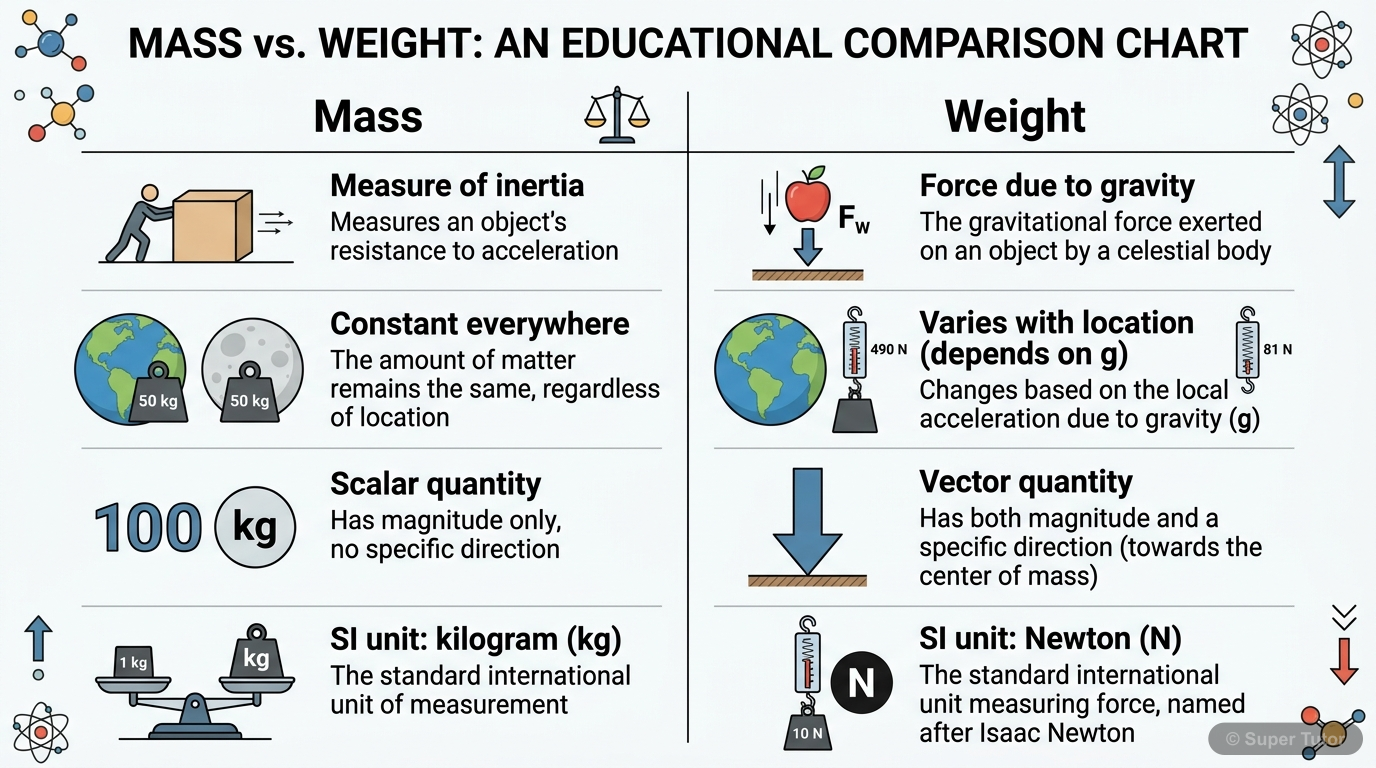
Learn better with visuals Super Tutor pairs illustrations like this with notes and quizzes for Measurement.
Important Questions from Measurement
In a Vernier caliper, the zero of the Vernier scale is shifted to the right of the zero of the main scale, and the 5th Vernier division coincides with a main scale division. What is the zero correction to be applied?
Show answer
-0.05 cm
Step 1: When the zero of the Vernier scale is to the RIGHT of the main scale zero, it is a POSITIVE zero error. Step 2: Positive zero error = +n × LC = +5 × 0.01 = +0.05 cm. Step 3: Zero correction is always opposite in sign to zero error. Step 4: Since zero error is +0.05 cm, zero correction = -0.05 cm. Step 5: This means the reading is more than actual, so we subtract the correction from the reading.
The pitch of a screw gauge is 1 mm and the head scale has 100 divisions. What is its least count?
Show answer
0.01 mm
Step 1: Least count of screw gauge = Pitch / Total number of head scale divisions. Step 2: Pitch = 1 mm, Head scale divisions = 100. Step 3: LC = 1 mm / 100 = 0.01 mm. Step 4: This means the screw gauge can measure up to 1/100th of a millimetre. Step 5: This is 10 times more precise than a Vernier caliper (which has LC = 0.1 mm).
Which instrument works on Hooke's law to measure the weight of an object?
Show answer
Spring balance
Step 1: Hooke's law states that the extension of a spring is directly proportional to the force applied to it. Step 2: A spring balance uses this principle — when an object is hung, the spring stretches proportionally to the weight. Step 3: A pointer on the rod reads the weight on a graduated scale. Step 4: A physical balance or beam balance compares mass with standard masses — it does NOT use Hooke's law. Step 5: Spring balance measures weight (in Newtons), not mass.
A man has a mass of 60 kg on Earth. What is his weight on Earth? (Take g = 9.8 m/s²)
Show answer
588 N
Step 1: Weight = mass × acceleration due to gravity, i.e., W = mg. Step 2: Given mass (m) = 60 kg and g = 9.8 m/s². Step 3: W = 60 × 9.8 = 588 N. Step 4: Weight is NOT the same as mass — mass is 60 kg but weight is 588 N. Step 5: The unit of weight is Newton (N), not kg. Answering 60 N is a very common mistake — remember to multiply by g.
+40 more questions on Measurement (Tamil Nadu Board Class 9 Science)
Practise AllFrequently Asked Questions
What are the important topics in Measurement for Tamil Nadu Board Class 9 Science?
How many important questions are there in Measurement?
Sources & Official References
Content is aligned to the official syllabus. Refer to the board website for the latest curriculum.
More resources for Measurement
For serious students
Get the full Measurement chapter — start free.
Quizzes, flashcards, an AI doubt solver and a study plan for Tamil Nadu Board Class 9 Science. Free to start, no card needed.