Matter around us — Flashcards
Tamil Nadu Board · Class 9 · Science
28 flashcards for Matter around us (Tamil Nadu Board Class 9 Science) to test yourself on key terms and facts. Sample: "What is matter? Give two essential"
Interactive on Super Tutor
Studying Matter around us? Get the full interactive chapter.
Quizzes, flashcards, AI doubt-solver and a step-by-step study plan — built for flashcards and more.
Free trial, no card needed.
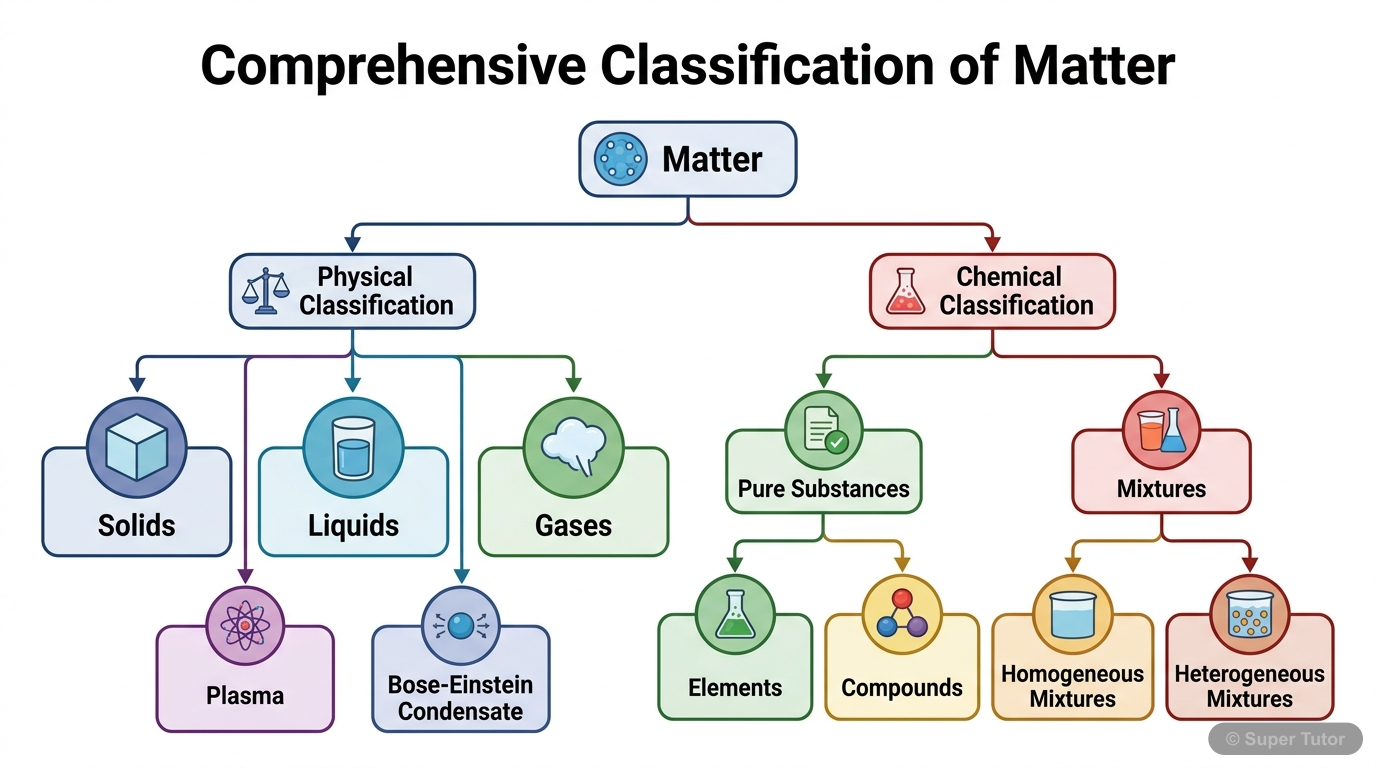
Learn better with visuals Super Tutor pairs illustrations like this with notes and quizzes for Matter around us.
What is matter? Give two essential properties.
Answer
Matter is anything that has mass and occupies space. Two essential properties: 1. Mass - The amount of substance it contains 2. Volume - The space it occupies Examples: Air, water, books, stones, food…
Classify the following as pure substances or mixtures: Air, pure water, salt solution, milk, iron nail, brass
Answer
Pure substances: Pure water, Iron nail Mixtures: Air, Salt solution, Milk, Brass Explanation: Pure substances contain only one type of particle (element or compound). Mixtures contain two or more subs…
Define element with an example. What is the smallest unit of an element?
Answer
Element: A pure substance made up of only one kind of atom that cannot be broken down into simpler substances. Smallest unit: An atom Examples: - Oxygen (O) - made of only oxygen atoms - Carbon (C) - …
What is a compound? How does it differ from the elements that make it?
Answer
Compound: A pure substance formed when two or more elements combine chemically in a fixed ratio. Key difference: A compound has completely different properties from its constituent elements. Example: …
What is a mixture? Give 5 examples from daily life.
Answer
Mixture: An impure substance containing two or more elements or compounds physically mixed together in any ratio. Characteristics: Components can be present in any proportion and retain their individu…
You mix iron filings and sulfur powder. When you heat this mixture, what happens and why is this significant?
Answer
Process and observations: 1. Before heating: Mixture appears dirty yellow, magnetic (iron is attracted) 2. During heating: Chemical reaction occurs at high temperature 3. After heating: Black brittle …
What are homogeneous and heterogeneous mixtures? Give 3 examples of each.
Answer
Homogeneous mixture: Components are uniformly mixed; cannot be seen separately with naked eye Properties: Uniform composition throughout Examples: 1. Salt solution (appears clear) 2. Milk (appears uni…
Which separation method would you use to separate components from: (a) Sand and water, (b) Salt from salt water, (c) Iron and sulfur, (d) Oil and water?
Answer
(a) Sand and water: Filtration - Sand is insoluble, stays on filter paper - Water passes through as filtrate (b) Salt from salt water: Evaporation or Distillation - Heat causes water to evaporate - S…
+20 more flashcards
Practise AllFrequently Asked Questions
What are the important topics in Matter around us for Tamil Nadu Board Class 9 Science?
How many flashcards are available for Matter around us?
How should I revise Matter around us for Class 9 exams?
Sources & Official References
Content is aligned to the official syllabus. Refer to the board website for the latest curriculum.
More resources for Matter around us
For serious students
Get the full Matter around us chapter — start free.
Quizzes, flashcards, an AI doubt solver and a study plan for Tamil Nadu Board Class 9 Science. Free to start, no card needed.