Electric Charge And Electric Current — Important Questions
Tamil Nadu Board · Class 9 · Science
45 important questions from Electric Charge And Electric Current for Tamil Nadu Board Class 9 Science, with answers. Includes multiple choice questions.
Interactive on Super Tutor
Studying Electric Charge And Electric Current? Get the full interactive chapter.
Quizzes, flashcards, AI doubt-solver and a step-by-step study plan — built for important questions and more.
Free trial, no card needed.
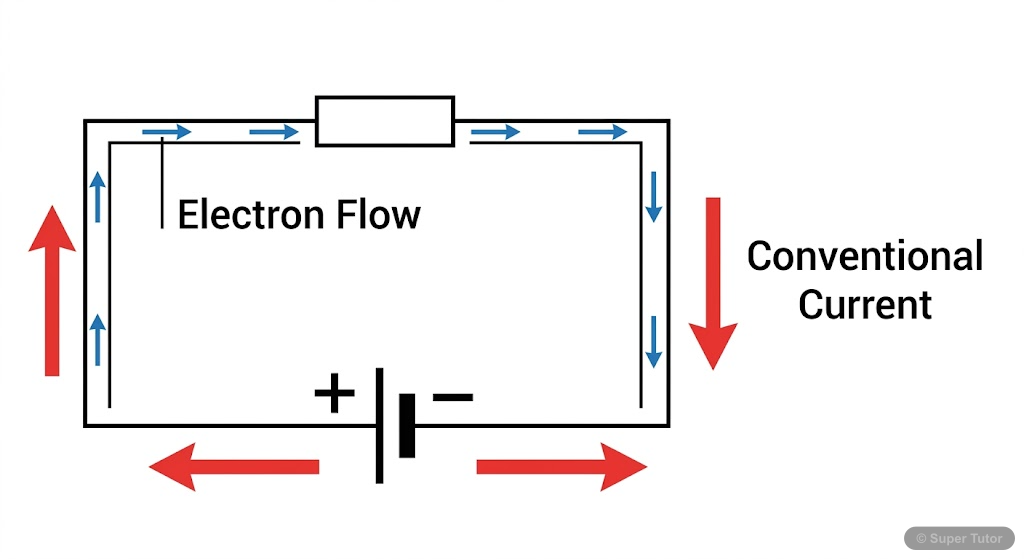
Learn better with visuals Super Tutor pairs illustrations like this with notes and quizzes for Electric Charge And Electric Current.
Important Questions from Electric Charge And Electric Current
Electric current is defined as the rate of flow of charge. If 25 C of charge passes through a wire in 5 seconds, what is the current?
Show answer
5 A
Step 1: The formula for electric current is I = q / t. Step 2: Here, q = 25 C (charge) and t = 5 s (time). Step 3: So, I = 25 / 5 = 5 A. Step 4: The unit of current is ampere (A), where 1 A = 1 C/s. Step 5: Option 0.2 A would be wrong because that is t/q, not q/t — a common mistake to avoid.
Which instrument is used to measure electric current in a circuit?
Show answer
Ammeter
Step 1: An ammeter is the instrument designed specifically to measure electric current. Step 2: It is always connected in series in a circuit so that the same current flows through it. Step 3: A voltmeter measures potential difference (voltage) and is connected in parallel. Step 4: A thermometer measures temperature, not current. Step 5: A galvanometer can detect very small currents but is not the standard instrument for measuring current in normal circuits.
What does EMF (electromotive force) of a battery represent?
Show answer
The work done by the source to drive one unit charge around the complete circuit
Step 1: EMF stands for Electromotive Force, represented by the symbol ε. Step 2: It is defined as the work done (W) by the electrical energy source in driving one unit of charge (q) around the complete circuit. Step 3: Formula: ε = W / q. Step 4: The SI unit of EMF is volts (V) or joules per coulomb (J/C). Step 5: A battery is like a water pump — it 'pushes' the charges to flow, and EMF is a measure of that pushing ability.
How is a voltmeter connected in a circuit to measure potential difference across a bulb?
Show answer
In parallel with the bulb
Step 1: A voltmeter measures the potential difference (voltage) across a component. Step 2: To measure the voltage across any component, the voltmeter must be connected in parallel — meaning it is connected across the two terminals of the component. Step 3: When connected in parallel, both the voltmeter and the bulb experience the same potential difference. Step 4: An ammeter, on the other hand, is connected in series. Step 5: Remember: Voltmeter → Parallel; Ammeter → Series.
+41 more questions on Electric Charge And Electric Current (Tamil Nadu Board Class 9 Science)
Practise AllFrequently Asked Questions
What are the important topics in Electric Charge And Electric Current for Tamil Nadu Board Class 9 Science?
How many important questions are there in Electric Charge And Electric Current?
Sources & Official References
Content is aligned to the official syllabus. Refer to the board website for the latest curriculum.
More resources for Electric Charge And Electric Current
For serious students
Get the full Electric Charge And Electric Current chapter — start free.
Quizzes, flashcards, an AI doubt solver and a study plan for Tamil Nadu Board Class 9 Science. Free to start, no card needed.