Sound — Important Questions
Tamil Nadu Board · Class 9 · Science
43 important questions from Sound for Tamil Nadu Board Class 9 Science, with answers. Includes multiple choice questions.
Interactive on Super Tutor
Studying Sound? Get the full interactive chapter.
Quizzes, flashcards, AI doubt-solver and a step-by-step study plan — built for important questions and more.
Free trial, no card needed.
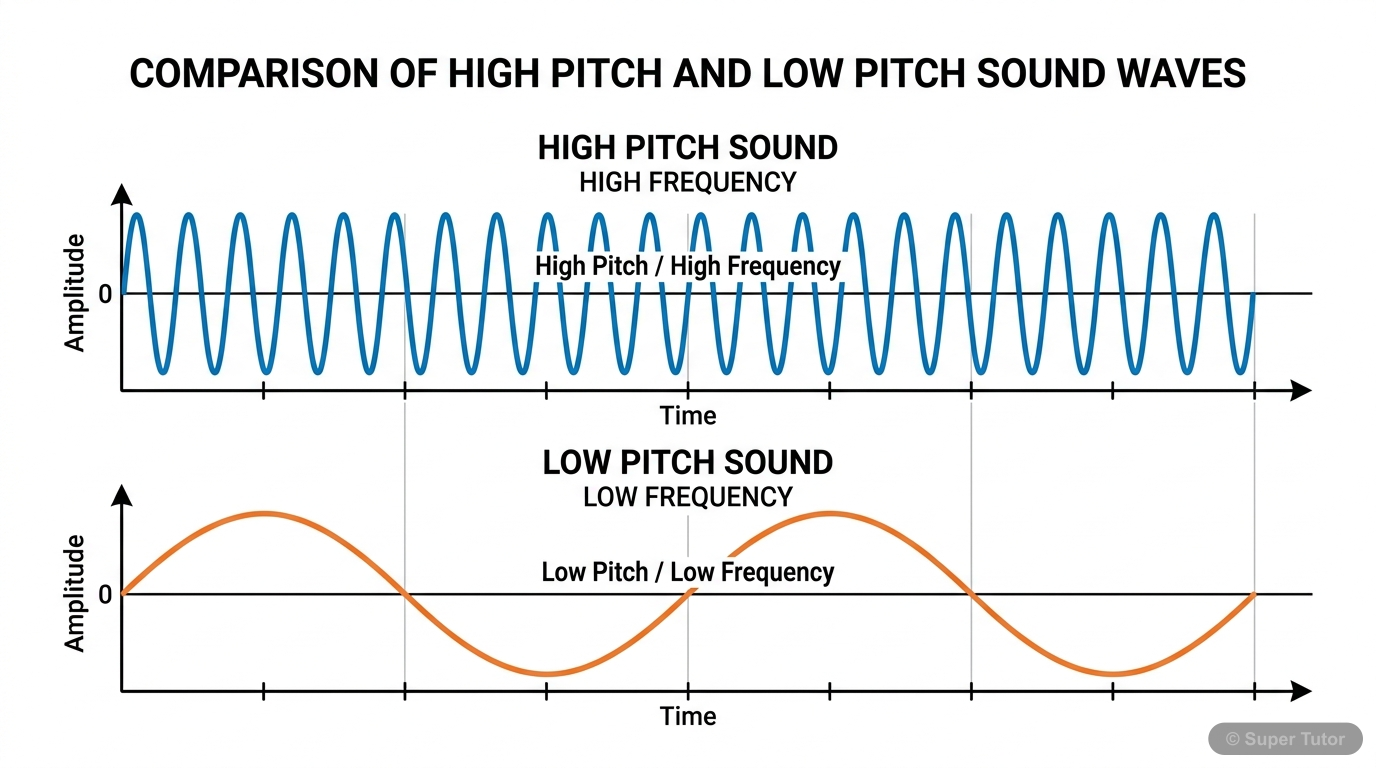
One of 3 illustrations for Sound in Super Tutor — alongside flashcards, concept maps and practice questions.
Important Questions from Sound
Which of the following correctly explains why the roaring of thunder persists for several seconds after a lightning flash?
Show answer
Sound of thunder undergoes successive reflections from clouds at different heights and the ground, causing reverberation
Step 1: Reverberation is the persistence of sound due to repeated reflections from multiple surfaces. Step 2: Thunder is produced at one instant by lightning discharge in the atmosphere. Step 3: The sound of thunder reflects repeatedly off clouds at different heights, the ground, and other surfaces. Each reflection returns a slightly delayed version of the sound to our ears. Step 4: This persistence of sound through multiple reflections is called reverberation, which makes the thunder seem to 'roll' and continue. Step 5: Option A is incorrect — the persistence is not due to multiple bolts. Opt
A ship uses SONAR and detects an ultrasonic echo from the seabed after 4.2 s. If the speed of ultrasound in seawater is 1500 m/s, what is the depth of the seabed?
Show answer
3150 m
Step 1: In SONAR, ultrasound travels from the ship to the seabed and back. So total distance = 2d. Step 2: Total time = 4.2 s; speed = 1500 m/s. Step 3: Total distance = speed × time = 1500 × 4.2 = 6300 m. Step 4: Depth d = 6300 / 2 = 3150 m. Step 5: Option A (6300 m) forgets to divide by 2 — it's the total path, not depth. Option C (1575 m) incorrectly divides by 4. Option D (4200 m) is from a calculation error.
In the propagation of a longitudinal sound wave, which of the following is being transferred from the source to the listener?
Show answer
Energy in the form of compressions and rarefactions
Step 1: When a sound source vibrates, it disturbs the particles of the medium near it. Step 2: Each particle oscillates to and fro about its own mean position — it does NOT travel all the way to the listener. Step 3: Each particle only passes the disturbance (energy) to the next adjacent particle, which then passes it further. Step 4: This chain of compressions (high pressure regions) and rarefactions (low pressure regions) moves through the medium, carrying energy from source to listener. Step 5: Option A is wrong — particles stay near their original positions. Option B is wrong for the same
Two sounds A and B have the same frequency and loudness but are produced by a flute and a sitar respectively. How can a listener tell them apart, and what characteristic of sound is responsible?
Show answer
By timbre or quality, because different instruments produce different wave shapes even at the same frequency and loudness
Step 1: Pitch depends on frequency — but both sounds have the same frequency here, so pitch is the same. Step 2: Loudness depends on amplitude — but the problem states both sounds have the same loudness, so amplitude is effectively the same. Step 3: The remaining distinguishing characteristic is Timbre (also called quality). Step 4: Timbre arises because different instruments produce complex waveforms made up of a fundamental frequency and different sets of overtones/harmonics, giving each instrument a unique wave shape. Step 5: This is why a flute and sitar playing the same note at the same v
+39 more questions on Sound (Tamil Nadu Board Class 9 Science)
Practise AllFrequently Asked Questions
What are the important topics in Sound for Tamil Nadu Board Class 9 Science?
How many important questions are there in Sound?
Sources & Official References
Content is aligned to the official syllabus. Refer to the board website for the latest curriculum.
More resources for Sound
For serious students
Get the full Sound chapter — start free.
Quizzes, flashcards, an AI doubt solver and a study plan for Tamil Nadu Board Class 9 Science. Free to start, no card needed.