Electric Charge And Electric Current — Chapter Summary
Tamil Nadu Board · Class 9 · Science
Summary of Electric Charge And Electric Current for Tamil Nadu Board Class 9 Science. Part of the Tamil Nadu Board Class 9 Science syllabus.
Interactive on Super Tutor
Studying Electric Charge And Electric Current? Get the full interactive chapter.
Quizzes, flashcards, AI doubt-solver and a step-by-step study plan — built for chapter summary and more.
Free trial, no card needed.
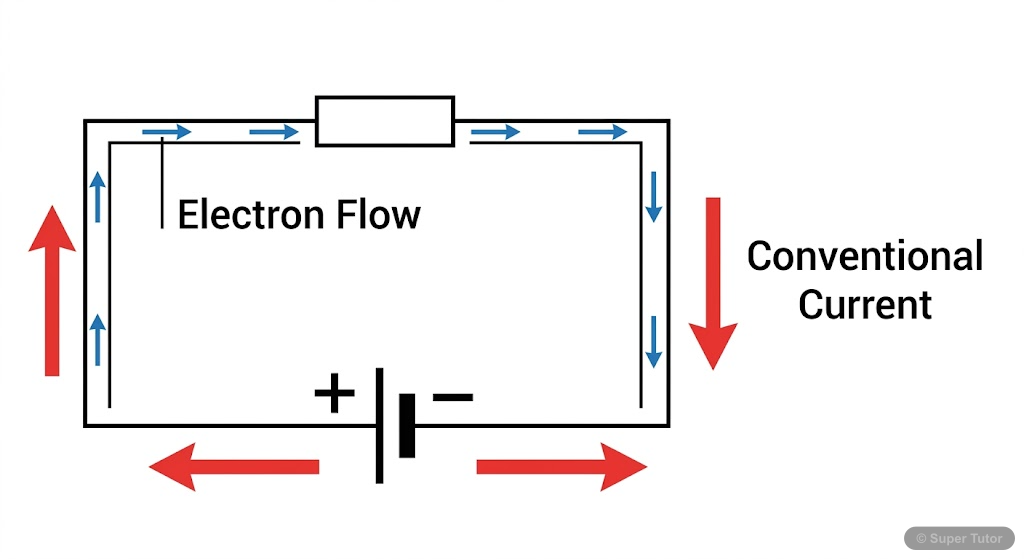
Learn better with visuals Super Tutor pairs illustrations like this with notes and quizzes for Electric Charge And Electric Current.
Overview
Electric charge is a fundamental property of matter, just like mass and length. Everything around us is made of atoms containing electrons (negatively charged), protons (positively charged), and neutrons (uncharged). When electrons move through a conductor, they create electric current, which powers
Key Concepts
Electric charge is a fundamental property
Electric charge is a fundamental property of matter that determines how it responds to electromagnetic forces. There are two types of charges: positiv
Electric charges exert forces on each
Electric charges exert forces on each other even when not in contact. Like charges (both positive or both negative) repel each other, while unlike cha
An electric field is the region
An electric field is the region surrounding an electric charge where another charge experiences an electric force. Electric fields are represented by
Electric potential is the work done
Electric potential is the work done per unit charge to bring that charge to a point against all electrical forces in a field. It represents the electr
Electric current is the flow
Electric current is the flow of electric charge through a conductor. Physically, it's the movement of electrons from the negative terminal of a batter
Learning Objectives
- Understand the concept of electric charge, electric field, and Coulomb's law of electrostatic forces
- Explain the relationship between electric current, voltage (potential difference), and resistance
- Apply Ohm's law to solve problems involving electric circuits
- Draw and analyze electrical circuit diagrams for series and parallel configurations
- Identify and explain the heating effect, chemical effect, and magnetic effect of electric current
Frequently Asked Questions
What are the important topics in Electric Charge And Electric Current for Tamil Nadu Board Class 9 Science?
How should I revise Electric Charge And Electric Current for Class 9 exams?
Sources & Official References
Content is aligned to the official syllabus. Refer to the board website for the latest curriculum.
More resources for Electric Charge And Electric Current
For serious students
Get the full Electric Charge And Electric Current chapter — start free.
Quizzes, flashcards, an AI doubt solver and a study plan for Tamil Nadu Board Class 9 Science. Free to start, no card needed.