Magnetism And Electromagnetism — Important Questions
Tamil Nadu Board · Class 9 · Science
42 important questions from Magnetism And Electromagnetism for Tamil Nadu Board Class 9 Science, with answers. Includes multiple choice questions.
Interactive on Super Tutor
Studying Magnetism And Electromagnetism? Get the full interactive chapter.
Quizzes, flashcards, AI doubt-solver and a step-by-step study plan — built for important questions and more.
Free trial, no card needed.
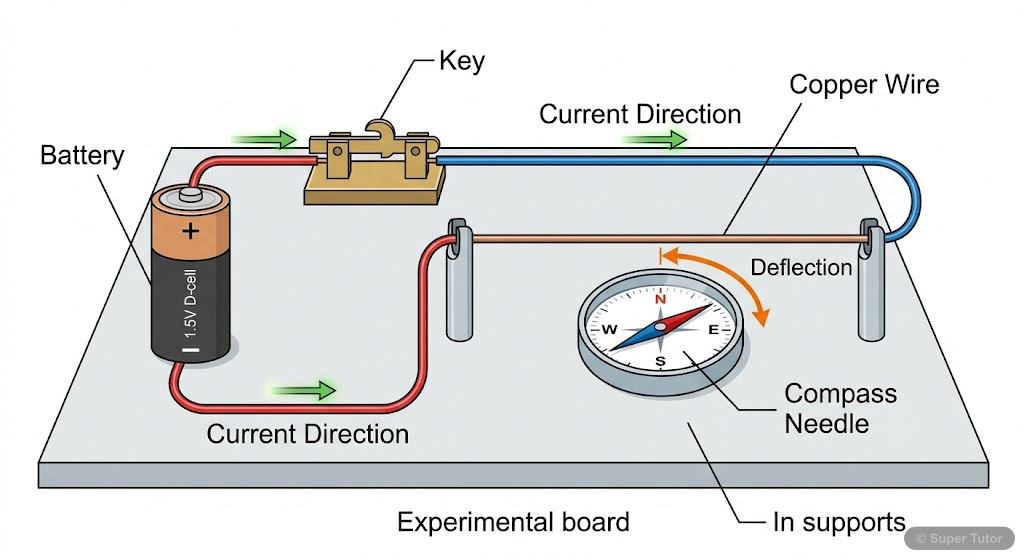
Learn better with visuals Super Tutor pairs illustrations like this with notes and quizzes for Magnetism And Electromagnetism.
Important Questions from Magnetism And Electromagnetism
Magnetic field lines always start from which pole of a magnet?
Show answer
North Pole
Step 1: This question tests your knowledge of the properties of magnetic field lines. Step 2: By convention, magnetic field lines always START (emerge) from the North Pole of a magnet. Step 3: These field lines then curve around outside the magnet and END (enter) at the South Pole. Step 4: Inside the magnet, field lines travel from South Pole to North Pole, making them closed, continuous loops. Step 5: This direction (North to South outside, South to North inside) is the standard convention used in all science textbooks and is important for drawing field line diagrams.
Who discovered that a current-carrying conductor produces a magnetic field around it?
Show answer
Hans Christian Oersted
Step 1: This question is about the history of the discovery of the magnetic effect of electric current. Step 2: On 21st April 1820, Hans Christian Oersted, a Danish physicist, noticed that a compass needle deflected when current flowed through a nearby wire during a lecture. Step 3: He conducted further experiments and confirmed that a current-carrying conductor produces a magnetic field around it — this is called the Magnetic Effect of Current. Step 4: Michael Faraday discovered electromagnetic induction (1831) — the reverse effect. Step 5: Lorentz described the force on a moving charge in a
A conductor of length 1 m carries a current of 2 A and is placed perpendicular to a magnetic field of 3 T. What is the force on the conductor?
Show answer
6 N
Step 1: Use the formula for force on a current-carrying conductor: F = I × L × B. Step 2: Identify the given values: Current (I) = 2 A, Length (L) = 1 m, Magnetic field (B) = 3 T. Step 3: Substitute into the formula: F = 2 × 1 × 3. Step 4: Calculate: F = 6 N. Step 5: The conductor is placed perpendicular to the field, which gives the maximum force. If it were parallel to the field, the force would be zero. The unit of force is Newton (N).
What happens to two parallel wires carrying current in the SAME direction?
Show answer
They attract each other
Step 1: Each current-carrying wire produces a magnetic field around itself. Step 2: The first wire creates a magnetic field at the location of the second wire, and vice versa. Step 3: When currents flow in the SAME direction, applying Fleming's Left Hand Rule shows that the force on each wire is directed TOWARDS the other wire. Step 4: Therefore, wires with current in the same direction ATTRACT each other. Step 5: The opposite is true for wires with current in OPPOSITE directions — they REPEL each other. This is similar to how like poles of magnets repel and unlike poles attract.
+38 more questions on Magnetism And Electromagnetism (Tamil Nadu Board Class 9 Science)
Practise AllFrequently Asked Questions
What are the important topics in Magnetism And Electromagnetism for Tamil Nadu Board Class 9 Science?
How many important questions are there in Magnetism And Electromagnetism?
Sources & Official References
Content is aligned to the official syllabus. Refer to the board website for the latest curriculum.
More resources for Magnetism And Electromagnetism
For serious students
Get the full Magnetism And Electromagnetism chapter — start free.
Quizzes, flashcards, an AI doubt solver and a study plan for Tamil Nadu Board Class 9 Science. Free to start, no card needed.