Light — Important Questions
Tamil Nadu Board · Class 9 · Science
43 important questions from Light for Tamil Nadu Board Class 9 Science, with answers. Includes multiple choice questions.
Interactive on Super Tutor
Studying Light? Get the full interactive chapter.
Quizzes, flashcards, AI doubt-solver and a step-by-step study plan — built for important questions and more.
Free trial, no card needed.
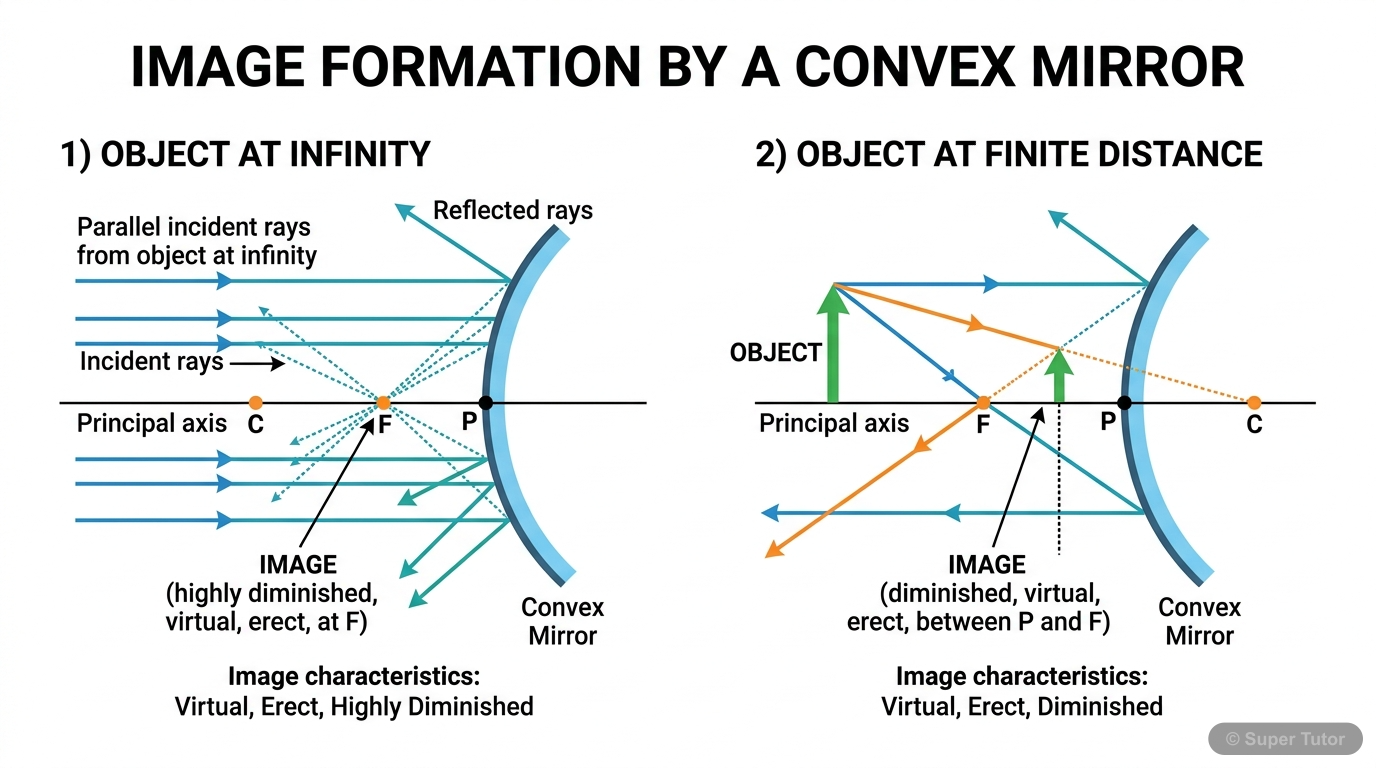
One of 13 illustrations for Light in Super Tutor — alongside flashcards, concept maps and practice questions.
Important Questions from Light
Which rule states that a ray passing through the principal focus of a concave mirror, after reflection, travels parallel to the principal axis?
Show answer
Rule 3: Ray passing through the focus
Step 1: There are four rules for constructing ray diagrams for spherical mirrors. Step 2: Rule 1 states a ray through C reflects back along the same path. Step 3: Rule 2 states a ray parallel to the principal axis passes through (or appears to come from) the focus after reflection. Step 4: Rule 3 is the reverse of Rule 2 — a ray through the focus reflects parallel to the principal axis. Step 5: Rule 4 deals with a ray hitting the pole, where angle of incidence equals angle of reflection. So the correct answer is Rule 3.
A convex mirror is commonly used as a rear-view mirror in vehicles. The primary reason for this is:
Show answer
It provides a wider field of view and always forms an erect image
Step 1: A convex mirror always forms a virtual, erect, and diminished image regardless of the object's position. Step 2: Because the reflecting surface curves outward, it captures light from a larger area, giving a wider field of view compared to a plane mirror. Step 3: The erect image helps the driver correctly identify the orientation of vehicles behind. Step 4: The diminished image means vehicles appear smaller (and farther) — this is why mirrors carry the warning 'Objects in the mirror are closer than they appear.' Step 5: Option A is wrong because convex mirrors form diminished (not magni
According to the Cartesian sign convention for spherical mirrors, which of the following is TRUE?
Show answer
Focal length of a convex mirror is positive
Step 1: In the Cartesian sign convention, the pole P is the origin, and the principal axis is the x-axis. Step 2: The object is always placed on the LEFT side of the mirror (incident light comes from the left). Step 3: Distances measured in the direction of incident light (towards the mirror, i.e., left to right) are positive. Distances measured opposite to incident light are negative. Step 4: For a convex mirror, the focus is BEHIND the mirror (on the right side), which is in the direction of incident light, so f is POSITIVE. Step 5: For a concave mirror, focus is in front (left side), so f i
The magnification produced by a spherical mirror is –2. Which of the following conclusions is correct?
Show answer
The image is real, inverted, and twice the size of the object
Step 1: The formula for magnification is m = –v/u = height of image/height of object. Step 2: The magnitude of m is 2, which means the image is TWICE the size of the object (magnified). Step 3: The NEGATIVE sign of magnification (m = –2) indicates the image is REAL and INVERTED. Step 4: A positive value of m would indicate a virtual and erect image. Step 5: So m = –2 means: real image, inverted, magnified 2 times. Option A is wrong (negative m = real, not virtual). Option C is wrong (magnitude = 2, not 0.5). Option D is wrong (erect images have positive m).
+39 more questions on Light (Tamil Nadu Board Class 9 Science)
Practise AllFrequently Asked Questions
What are the important topics in Light for Tamil Nadu Board Class 9 Science?
How many important questions are there in Light?
Sources & Official References
Content is aligned to the official syllabus. Refer to the board website for the latest curriculum.
More resources for Light
For serious students
Get the full Light chapter — start free.
Quizzes, flashcards, an AI doubt solver and a study plan for Tamil Nadu Board Class 9 Science. Free to start, no card needed.