Matter around us — Chapter Summary
Tamil Nadu Board · Class 9 · Science
Summary of Matter around us for Tamil Nadu Board Class 9 Science. Part of the Tamil Nadu Board Class 9 Science syllabus.
Interactive on Super Tutor
Studying Matter around us? Get the full interactive chapter.
Quizzes, flashcards, AI doubt-solver and a step-by-step study plan — built for chapter summary and more.
Free trial, no card needed.
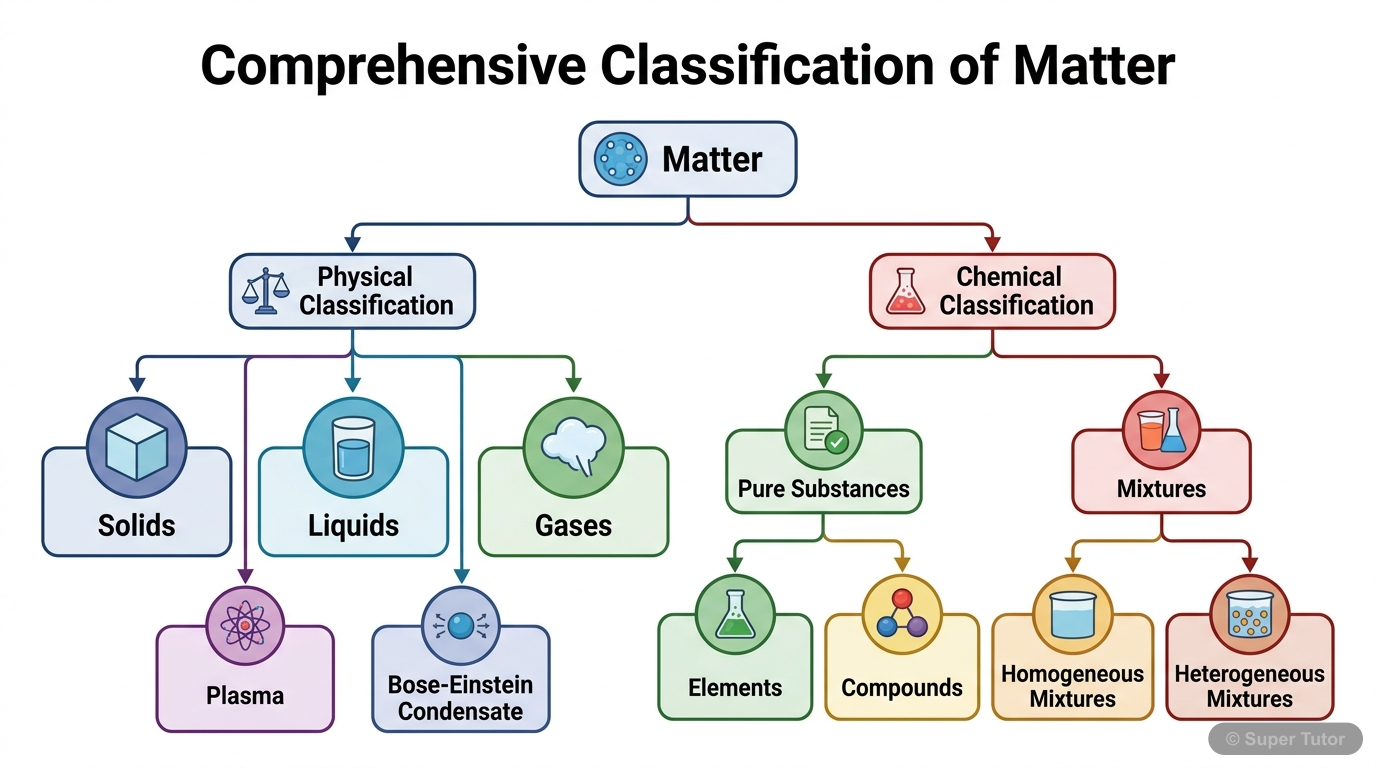
Learn better with visuals Super Tutor pairs illustrations like this with notes and quizzes for Matter around us.
Overview
Matter is everything around us that has mass and occupies space. From the air we breathe to the food we eat, from the pen we write with to the stones beneath our feet—everything is matter. In this chapter, we explore how matter is classified based on its chemical composition into pure substances (el
Key Concepts
Matter is defined as anything
Matter is defined as anything that has mass and occupies space. Every substance we encounter—whether solid, liquid, or gas—is made of matter. The univ
Elements are the simplest pure substances
Elements are the simplest pure substances that cannot be broken down into simpler substances by chemical methods. Each element is made up of only one
Compounds are pure substances formed when
Compounds are pure substances formed when two or more elements combine chemically in fixed proportions. For example, water (H₂O) is a compound made of
Mixtures are impure substances containing two
Mixtures are impure substances containing two or more kinds of elements, compounds, or both physically mixed together in any proportion. Unlike compou
Homogeneous mixtures have uniform composition throughout
Homogeneous mixtures have uniform composition throughout, with components that cannot be seen separately. Every part of a homogeneous mixture has iden
Learning Objectives
- Classify substances as elements, compounds, and mixtures based on their chemical composition
- Distinguish between homogeneous and heterogeneous mixtures with appropriate examples
- Identify and apply suitable methods to separate components of different mixtures
- Classify solutions based on the size of solute particles and compare true solutions, colloids, and suspensions
- Differentiate between various types of colloids based on the nature of dispersed phase and dispersion medium
Frequently Asked Questions
What are the important topics in Matter around us for Tamil Nadu Board Class 9 Science?
How should I revise Matter around us for Class 9 exams?
Sources & Official References
Content is aligned to the official syllabus. Refer to the board website for the latest curriculum.
More resources for Matter around us
For serious students
Get the full Matter around us chapter — start free.
Quizzes, flashcards, an AI doubt solver and a study plan for Tamil Nadu Board Class 9 Science. Free to start, no card needed.