Microbes in Human Welfare
CBSE · Class 12 · Biology
Summary of Microbes in Human Welfare for CBSE Class 12 Biology. Key concepts, important points, and chapter overview.
Interactive on Super Tutor
Studying Microbes in Human Welfare? Get the full interactive chapter.
Quizzes, flashcards, AI doubt-solver and a step-by-step study plan — built for chapter summary and more.
1,000+ Class 12 students started this chapter today
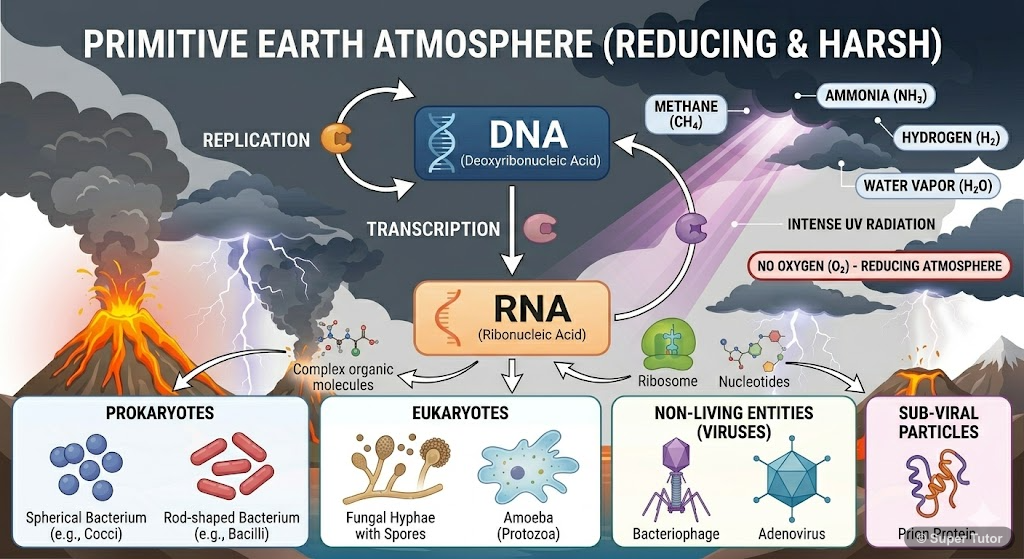
This is just one of 13+ visuals inside Super Tutor's Microbes in Human Welfare chapter
Explore the full setOverview
Microbes are essential living organisms that help humans in food preparation, industry, sewage treatment, energy production, pest control, and soil fertility. Many microbes are beneficial rather than harmful. Their activities include fermentation, production of antibiotics and bioactive molecules, t
Key Concepts
Lactic acid bacteria or LAB grow
Lactic acid bacteria or LAB grow in milk and convert it to curd by producing acids that coagulate and partially digest milk proteins. LAB also increas
Fermentation is the microbial conversion
Fermentation is the microbial conversion of food materials into useful products. The puffed-up appearance of dosa and idli dough is due to carbon diox
Microbes are grown on a large
Microbes are grown on a large scale in fermentors to produce useful products. Examples of acid producers include Aspergillus niger for citric acid, Ac
Antibiotics are chemical substances produced by
Antibiotics are chemical substances produced by some microbes that can kill or stop the growth of disease-causing microbes. Penicillin was the first a
Sewage is municipal waste water containing
Sewage is municipal waste water containing organic matter and pathogenic microbes. It cannot be discharged directly into rivers and streams. Primary t
Learning Objectives
- Understand how microbes are useful in household products such as curd, bread, cheese, and traditional fermented foods.
- Recognise the role of microbes in industrial production of acids, alcohol, antibiotics, enzymes, and other bioactive molecules.
- Explain the two-stage treatment of sewage and the role of microbes in reducing pollution.
- Describe how microbes produce biogas and why methanogens are important.
- Explain the use of microbes as biocontrol agents in agriculture.
Frequently Asked Questions
What are the important topics in Microbes in Human Welfare for CBSE Class 12 Biology?
How to score full marks in Microbes in Human Welfare — CBSE Class 12 Biology?
Sources & Official References
- NCERT Official — ncert.nic.in
- CBSE Academic — cbseacademic.nic.in
- CBSE Official — cbse.gov.in
- National Education Policy 2020 — education.gov.in
Content is aligned to the official syllabus. Refer to the board website for the latest curriculum.
More resources for Microbes in Human Welfare
Practice Quiz
Test yourself with a quick quiz
Important Questions
Practice with board exam-style questions
Revision Notes
Key points for last-minute revision
Formula Sheet
All formulas in one place
Concept Maps
See how topics connect visually
Study Plan
Step-by-step plan to ace this chapter
Flashcards
Quick-fire cards for active recall
Syllabus
What topics to cover
NCERT Solutions
Every textbook question solved step by step
For serious students
Get the full Microbes in Human Welfare chapter — for free.
Quizzes, flashcards, AI doubt-solver and a step-by-step study plan for CBSE Class 12 Biology.