Organisms and Populations
CBSE · Class 12 · Biology
Summary of Organisms and Populations for CBSE Class 12 Biology. Key concepts, important points, and chapter overview.
Interactive on Super Tutor
Studying Organisms and Populations? Get the full interactive chapter.
Quizzes, flashcards, AI doubt-solver and a step-by-step study plan — built for chapter summary and more.
1,000+ Class 12 students started this chapter today
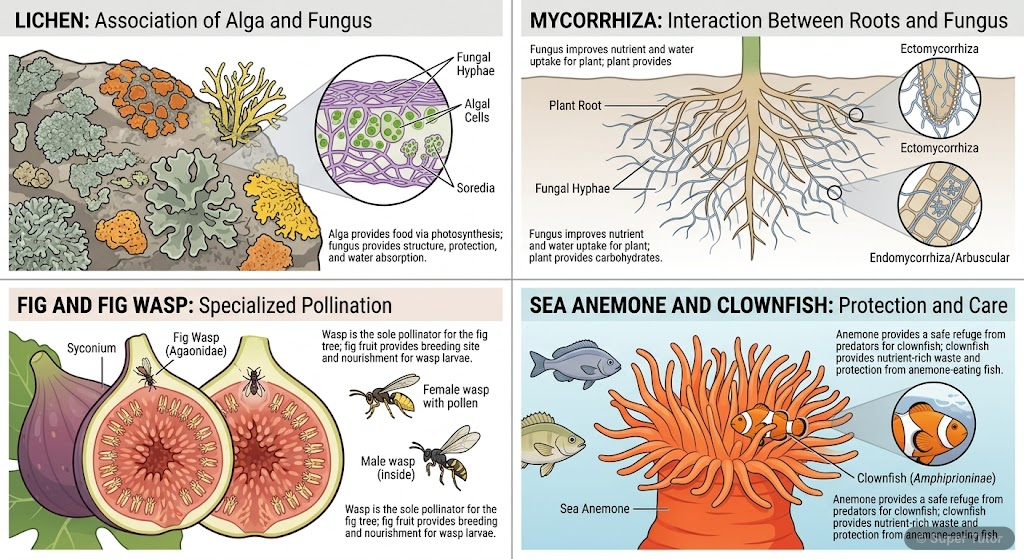
Learn better with visuals Super Tutor has hundreds of illustrations like this across every chapter — all free to try.
Get startedOverview
Ecology studies the relationships of living organisms with abiotic factors and with other species. Population ecology focuses on groups of individuals of the same species living in a defined area. A population has special attributes such as birth rate, death rate, sex ratio, age distribution and pop
Key Concepts
Ecology studies living organisms in relation
Ecology studies living organisms in relation to their physical environment and to other species. Its main levels of organisation are organisms, popula
A population is a group
A population is a group of individuals of the same species living in a defined geographical area and sharing or competing for resources. Even groups f
A population has birth rate
A population has birth rate, death rate, sex ratio and age distribution, while an individual organism does not. Age distribution is often shown using
Population density is the size
Population density is the size of a population, designated as N. It may be measured by number, biomass, per cent cover or relative density depending o
Birth rate is the number
Birth rate is the number of births per individual in a given time period, and death rate is the number of deaths per individual in a given time period
Learning Objectives
- Understand ecology at the levels of organisms, populations, communities and biomes.
- Define population and identify its special attributes.
- Explain population density and its different ways of measurement.
- Describe how natality, mortality, immigration and emigration change population size.
- Differentiate exponential growth from logistic growth.
Frequently Asked Questions
What are the important topics in Organisms and Populations for CBSE Class 12 Biology?
How to score full marks in Organisms and Populations — CBSE Class 12 Biology?
Sources & Official References
- NCERT Official — ncert.nic.in
- CBSE Academic — cbseacademic.nic.in
- CBSE Official — cbse.gov.in
- National Education Policy 2020 — education.gov.in
Content is aligned to the official syllabus. Refer to the board website for the latest curriculum.
More resources for Organisms and Populations
Practice Quiz
Test yourself with a quick quiz
Important Questions
Practice with board exam-style questions
Revision Notes
Key points for last-minute revision
Formula Sheet
All formulas in one place
Concept Maps
See how topics connect visually
Study Plan
Step-by-step plan to ace this chapter
Flashcards
Quick-fire cards for active recall
Syllabus
What topics to cover
NCERT Solutions
Every textbook question solved step by step
For serious students
Get the full Organisms and Populations chapter — for free.
Quizzes, flashcards, AI doubt-solver and a step-by-step study plan for CBSE Class 12 Biology.