Sexual Reproduction in Flowering Plants
CBSE · Class 12 · Biology
Summary of Sexual Reproduction in Flowering Plants for CBSE Class 12 Biology. Key concepts, important points, and chapter overview.
Interactive on Super Tutor
Studying Sexual Reproduction in Flowering Plants? Get the full interactive chapter.
Quizzes, flashcards, AI doubt-solver and a step-by-step study plan — built for chapter summary and more.
1,000+ Class 12 students started this chapter today
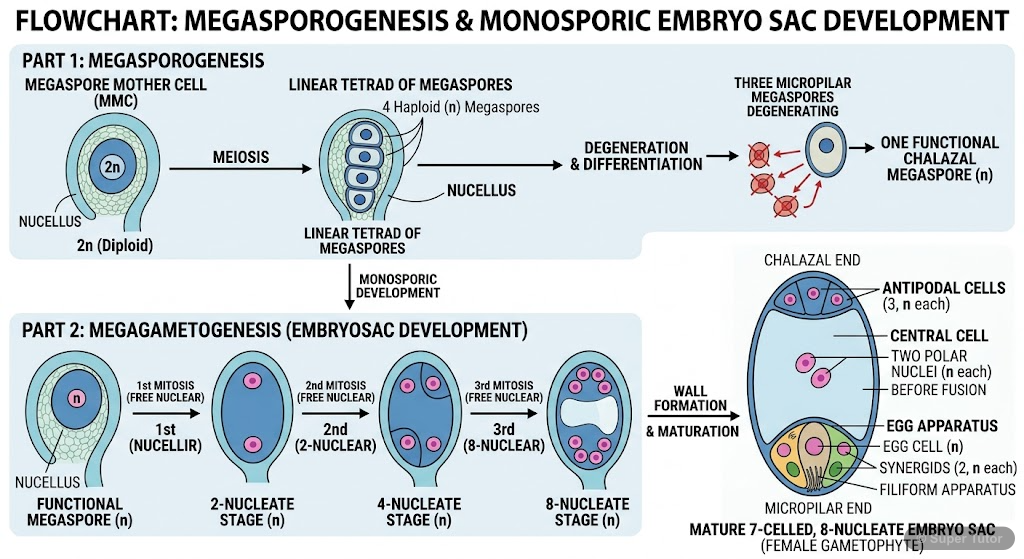
Super Tutor has 16+ illustrations like this for Sexual Reproduction in Flowering Plants alone — flashcards, concept maps, and step-by-step visuals.
See them allOverview
Sexual reproduction in angiosperms takes place through flowers, which produce male and female gametophytes, enable pollination and fertilisation, and finally form seeds and fruits. The chapter connects floral structure with reproductive processes such as microsporogenesis, megasporogenesis, pollinat
Key Concepts
The stamen is the male reproductive
The stamen is the male reproductive organ of a flower. It has a filament and a terminal bilobed anther. The anther is tetragonal and dithecous, with f
A microsporangium has four wall layers
A microsporangium has four wall layers: epidermis, endothecium, middle layers, and tapetum. The tapetum is the innermost layer and nourishes developin
Cells of the sporogenous tissue divide
Cells of the sporogenous tissue divide by meiosis to form microspore tetrads. These microspores develop into pollen grains.
A pollen grain is the male
A pollen grain is the male gametophyte. It is generally spherical, about 25-50 micrometers in diameter, and has two layers: exine made of sporopolleni
The pistil has stigma
The pistil has stigma, style, and ovary. The ovule, also called megasporangium, is attached to the placenta by a funicle and has integuments, micropyl
Learning Objectives
- Understand the structure and function of the stamen, anther, pistil, ovule, pollen grain, and embryo sac
- Explain microsporogenesis and megasporogenesis as the processes that form male and female gametophytes
- Differentiate between autogamy, geitonogamy, and xenogamy
- Describe wind, water, and animal pollination with suitable examples
- Explain pollen-pistil interaction and the role of the filiform apparatus
Frequently Asked Questions
What are the important topics in Sexual Reproduction in Flowering Plants for CBSE Class 12 Biology?
How to score full marks in Sexual Reproduction in Flowering Plants — CBSE Class 12 Biology?
Sources & Official References
- NCERT Official — ncert.nic.in
- CBSE Academic — cbseacademic.nic.in
- CBSE Official — cbse.gov.in
- National Education Policy 2020 — education.gov.in
Content is aligned to the official syllabus. Refer to the board website for the latest curriculum.
More resources for Sexual Reproduction in Flowering Plants
Practice Quiz
Test yourself with a quick quiz
Important Questions
Practice with board exam-style questions
Revision Notes
Key points for last-minute revision
Formula Sheet
All formulas in one place
Concept Maps
See how topics connect visually
Study Plan
Step-by-step plan to ace this chapter
Flashcards
Quick-fire cards for active recall
Syllabus
What topics to cover
NCERT Solutions
Every textbook question solved step by step
For serious students
Get the full Sexual Reproduction in Flowering Plants chapter — for free.
Quizzes, flashcards, AI doubt-solver and a step-by-step study plan for CBSE Class 12 Biology.