Microbes in Human Welfare
CBSE · Class 12 · Biology
NCERT Solutions for Microbes in Human Welfare — CBSE Class 12 Biology.
Interactive on Super Tutor
Studying Microbes in Human Welfare? Get the full interactive chapter.
Quizzes, flashcards, AI doubt-solver and a step-by-step study plan — built for ncert solutions and more.
1,000+ Class 12 students started this chapter today
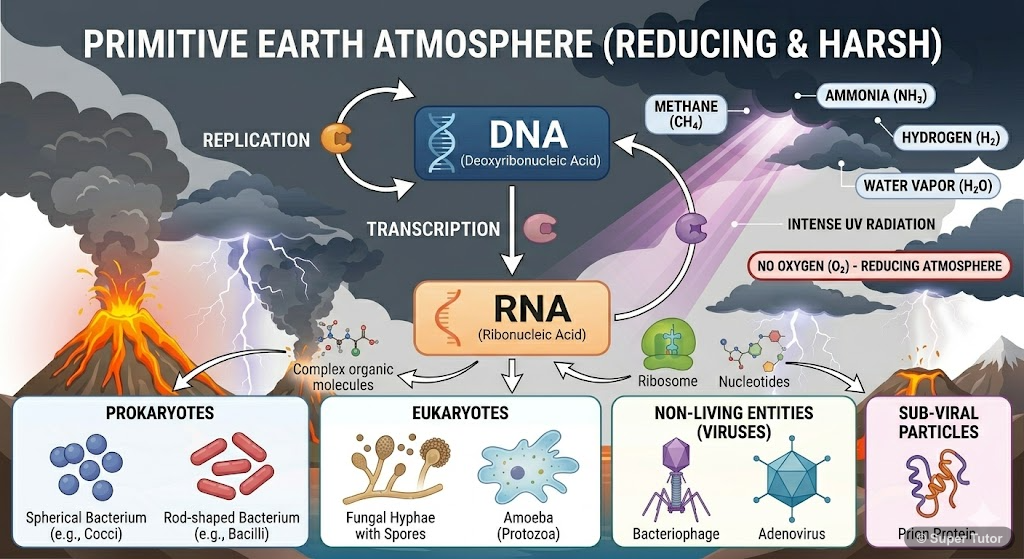
This is just one of 13+ visuals inside Super Tutor's Microbes in Human Welfare chapter
Explore the full set8 worked solutions below. Unlock all 15 free in Super Tutor
EXERCISES
1Bacteria cannot be seen with the naked eyes, but these can be seen with the help of a microscope. If you have to carry a sample from your home to your biology laboratory to demonstrate the presence of microbes with the help of a microscope, which sample would you carry and why?Show solution
Not sure why a step works? check your working in Super Tutor
2Give examples to prove that microbes release gases during metabolism.Show solution
- In making dosa and idli dough, bacteria ferment the dough and release **CO, which makes the dough puff up.
- In bread making, yeast** (*Saccharomyces cerevisiae*) ferments the dough and produces **CO.
- In sewage digesters and biogas plants, methanogens produce gases like methane, CO and H**.
Not sure why a step works? check your working in Super Tutor
3In which food would you find lactic acid bacteria? Mention some of their useful applications.Show solution
- They convert milk into curd.
- They help **increase vitamin B content and improve nutritional quality.
- In the stomach, they help check disease-causing microbes**.
- They are also involved in the fermentation of some food products.
Not sure why a step works? check your working in Super Tutor
4Name some traditional Indian foods made of wheat, rice and Bengal gram (or their products) which involve use of microbes.Show solution
- Wheat: bread
- Rice: idli and dosa
- Bengal gram: foods made from fermented batter or products prepared using microbial fermentation
These foods are prepared by microbial fermentation, which helps in raising the dough and developing texture and flavour.
Not sure why a step works? check your working in Super Tutor
5In which way have microbes played a major role in controlling diseases caused by harmful bacteria?Show solution
Not sure why a step works? check your working in Super Tutor
6Name any two species of fungus, which are used in the production of the antibiotics.Show solution
Not sure why a step works? check your working in Super Tutor
7What is sewage? In which way can sewage be harmful to us?Show solution
Not sure why a step works? check your working in Super Tutor
8What is the key difference between primary and secondary sewage treatment?Show solution
- Primary treatment is mainly physical; it removes large and small particles by filtration and sedimentation.
- Secondary treatment is biological; useful aerobic microbes break down organic matter and reduce BOD.
Not sure why a step works? check your working in Super Tutor
7 more solved questions in Microbes in Human Welfare
Every remaining exercise is solved step by step in Super Tutor, plus practice quizzes and flashcards for this chapter. Free to start.
Stuck on a step?
Ask Super Tutor AI to explain any solution on this page in a simpler way — free, 24x7.
Ask a Doubt FreeFrequently Asked Questions
What are the important topics in Microbes in Human Welfare for CBSE Class 12 Biology?
How to score full marks in Microbes in Human Welfare — CBSE Class 12 Biology?
Where can I get free NCERT Solutions for Microbes in Human Welfare Class 12 Biology?
Sources & Official References
- NCERT Official — ncert.nic.in
- CBSE Academic — cbseacademic.nic.in
- CBSE Official — cbse.gov.in
- National Education Policy 2020 — education.gov.in
Content is aligned to the official syllabus. Refer to the board website for the latest curriculum.
More resources for Microbes in Human Welfare
Practice Quiz
Test yourself with a quick quiz
Important Questions
Practice with board exam-style questions
Revision Notes
Key points for last-minute revision
Formula Sheet
All formulas in one place
Chapter Summary
Understand the chapter at a glance
Concept Maps
See how topics connect visually
Study Plan
Step-by-step plan to ace this chapter
Flashcards
Quick-fire cards for active recall
Syllabus
What topics to cover
For serious students
Get the full Microbes in Human Welfare chapter — for free.
Quizzes, flashcards, AI doubt-solver and a step-by-step study plan for CBSE Class 12 Biology.