Human Health and Disease
CBSE · Class 12 · Biology
Summary of Human Health and Disease for CBSE Class 12 Biology. Key concepts, important points, and chapter overview.
Interactive on Super Tutor
Studying Human Health and Disease? Get the full interactive chapter.
Quizzes, flashcards, AI doubt-solver and a step-by-step study plan — built for chapter summary and more.
1,000+ Class 12 students started this chapter today
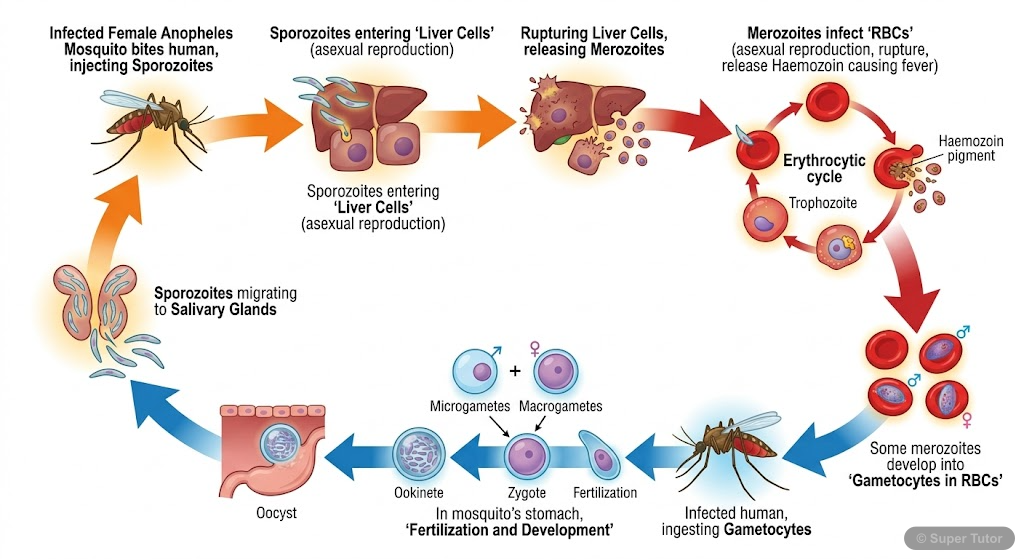
Super Tutor has 33+ illustrations like this for Human Health and Disease alone — flashcards, concept maps, and step-by-step visuals.
See them allOverview
Health is a state of complete physical, mental and social well-being, not merely the absence of disease. Human health depends on balanced diet, personal hygiene, regular exercise, clean food and water, vaccination, and control of infections. Diseases are broadly grouped into infectious and non-infec
Key Concepts
Health means complete physical
Health means complete physical, mental and social well-being. Disease is a condition in which the functioning of one or more organs or systems is dist
Typhoid is caused by Salmonella typhi
Typhoid is caused by Salmonella typhi; pneumonia by Streptococcus pneumoniae and Haemophilus influenzae; common cold by rhinoviruses; malaria by Plasm
Plasmodium enters the human body through
Plasmodium enters the human body through the bite of infected female Anopheles mosquito. It multiplies in liver cells, then attacks red blood cells, c
Innate immunity is a non
Innate immunity is a non-specific defence present from birth. It includes physical barriers like skin and mucus, physiological barriers like stomach a
Acquired immunity is specific and has
Acquired immunity is specific and has memory. The first exposure to a pathogen produces a weak primary response, while later exposure produces a stron
Learning Objectives
- Understand the meaning of health and disease
- Classify diseases into infectious and non-infectious types
- Identify common human diseases caused by bacteria, viruses, protozoans, fungi and helminths
- Explain innate immunity, acquired immunity, active immunity and passive immunity
- Describe vaccination, immunisation, allergy and autoimmune disease
Frequently Asked Questions
What are the important topics in Human Health and Disease for CBSE Class 12 Biology?
How to score full marks in Human Health and Disease — CBSE Class 12 Biology?
Sources & Official References
- NCERT Official — ncert.nic.in
- CBSE Academic — cbseacademic.nic.in
- CBSE Official — cbse.gov.in
- National Education Policy 2020 — education.gov.in
Content is aligned to the official syllabus. Refer to the board website for the latest curriculum.
More resources for Human Health and Disease
Practice Quiz
Test yourself with a quick quiz
Important Questions
Practice with board exam-style questions
Revision Notes
Key points for last-minute revision
Formula Sheet
All formulas in one place
Concept Maps
See how topics connect visually
Study Plan
Step-by-step plan to ace this chapter
Flashcards
Quick-fire cards for active recall
Syllabus
What topics to cover
NCERT Solutions
Every textbook question solved step by step
For serious students
Get the full Human Health and Disease chapter — for free.
Quizzes, flashcards, AI doubt-solver and a step-by-step study plan for CBSE Class 12 Biology.