Organisms and Populations
CBSE · Class 12 · Biology
NCERT Solutions for Organisms and Populations — CBSE Class 12 Biology.
Interactive on Super Tutor
Studying Organisms and Populations? Get the full interactive chapter.
Quizzes, flashcards, AI doubt-solver and a step-by-step study plan — built for ncert solutions and more.
1,000+ Class 12 students started this chapter today
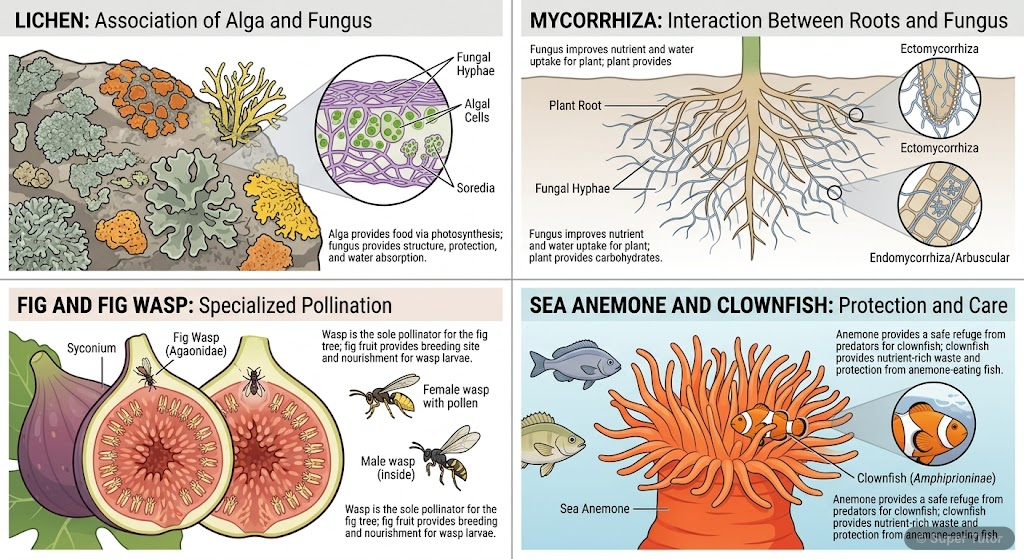
Learn better with visuals Super Tutor has hundreds of illustrations like this across every chapter — all free to try.
Get started5 worked solutions below. Unlock all 10 free in Super Tutor
EXERCISES
1List the attributes that populations possess but not individuals.Show solution
- Birth rate and death rate (as per capita rates)
- Sex ratio
- Age distribution
- Population density / size
An individual may have births and deaths, but only a population has these measurable collective properties.
Not sure why a step works? check your working in Super Tutor
2If a population growing exponentially double in size in 3 years, what is the intrinsic rate of increase (r) of the population?Show solution
and from exponential growth,
So,
Taking natural log on both sides,
So the intrinsic rate of increase is about 0.231 per year.
Not sure why a step works? check your working in Super Tutor
3Name important defence mechanisms in plants against herbivory.Show solution
- Thorns and spines, e.g. Acacia and Cactus
- Chemical defences such as poisonous or bad-tasting substances that make the herbivore sick, inhibit feeding or digestion, or kill it
- Examples of such chemicals include cardiac glycosides in Calotropis
So, plants protect themselves by morphological as well as chemical defences.
Not sure why a step works? check your working in Super Tutor
4An orchid plant is growing on the branch of mango tree. How do you describe this interaction between the orchid and the mango tree?Show solution
Not sure why a step works? check your working in Super Tutor
5What is the ecological principle behind the biological control method of managing with pest insects?Show solution
Not sure why a step works? check your working in Super Tutor
5 more solved questions in Organisms and Populations
Every remaining exercise is solved step by step in Super Tutor, plus practice quizzes and flashcards for this chapter. Free to start.
Stuck on a step?
Ask Super Tutor AI to explain any solution on this page in a simpler way — free, 24x7.
Ask a Doubt FreeFrequently Asked Questions
What are the important topics in Organisms and Populations for CBSE Class 12 Biology?
How to score full marks in Organisms and Populations — CBSE Class 12 Biology?
Where can I get free NCERT Solutions for Organisms and Populations Class 12 Biology?
Sources & Official References
- NCERT Official — ncert.nic.in
- CBSE Academic — cbseacademic.nic.in
- CBSE Official — cbse.gov.in
- National Education Policy 2020 — education.gov.in
Content is aligned to the official syllabus. Refer to the board website for the latest curriculum.
More resources for Organisms and Populations
Practice Quiz
Test yourself with a quick quiz
Important Questions
Practice with board exam-style questions
Revision Notes
Key points for last-minute revision
Formula Sheet
All formulas in one place
Chapter Summary
Understand the chapter at a glance
Concept Maps
See how topics connect visually
Study Plan
Step-by-step plan to ace this chapter
Flashcards
Quick-fire cards for active recall
Syllabus
What topics to cover
For serious students
Get the full Organisms and Populations chapter — for free.
Quizzes, flashcards, AI doubt-solver and a step-by-step study plan for CBSE Class 12 Biology.