The Bengal School and Cultural Nationalism — Chapter Summary
CBSE · Class 12 · Fine Arts
Summary of The Bengal School and Cultural Nationalism for CBSE Class 12 Fine Arts. Part of the CBSE Class 12 Fine Arts syllabus.
Interactive on Super Tutor
Studying The Bengal School and Cultural Nationalism? Get the full interactive chapter.
Quizzes, flashcards, AI doubt-solver and a step-by-step study plan — built for chapter summary and more.
Free trial, no card needed.
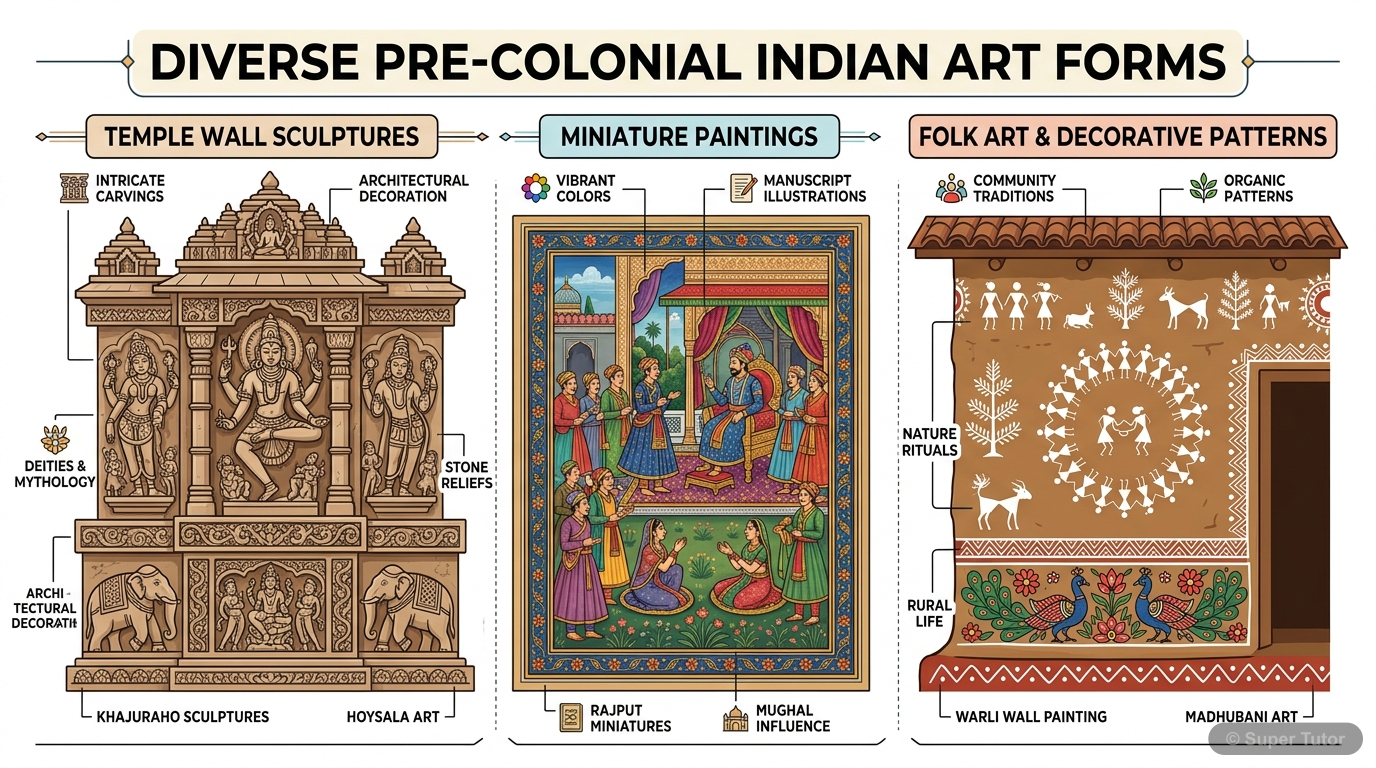
One of 10 illustrations for The Bengal School and Cultural Nationalism in Super Tutor — alongside flashcards, concept maps and practice questions.
See them allOverview
The Bengal School and Cultural Nationalism marks a major shift in modern Indian art from colonial academic realism toward a search for Indian identity, Indian subjects, and Indian styles. It began in Calcutta and connected art with the nationalist movement and Swadeshi ideas. The chapter also shows
Key Concepts
Company School painting was a mixture
Company School painting was a mixture of traditional Indian and European painting styles. Local artists painted scenes for British patrons, using clos
Raja Ravi Varma was a self
Raja Ravi Varma was a self-taught artist from the Travancore Court in Kerala who mastered academic realism in oil painting. He painted scenes from the
The Bengal School of Art
The Bengal School of Art was a nationalist art movement associated with Swadeshi and originated in Calcutta. It was not restricted only to Bengal, sin
Abanindranath Tagore spearheaded the Bengal School
Abanindranath Tagore spearheaded the Bengal School and worked with E. B. Havell, the principal of the Calcutta School of Art, to Indianise art educati
Kala Bhavana
Kala Bhavana, part of Visva-Bharati University founded by Rabindranath Tagore at Shantiniketan, was India's first national art school. Nandalal Bose h
Learning Objectives
- Understand how Company Painting mixed Indian and European styles.
- Explain the rise of Raja Ravi Varma’s academic realism and its later rejection by nationalist artists.
- Describe the origin, aims, and features of the Bengal School of Art.
- Identify the role of Abanindranath Tagore and E. B. Havell in Indianising art education.
- Recognize the importance of Kala Bhavana, Nandalal Bose, and Shantiniketan in modern Indian art.
Frequently Asked Questions
What are the important topics in The Bengal School and Cultural Nationalism for CBSE Class 12 Fine Arts?
How should I revise The Bengal School and Cultural Nationalism for the CBSE Class 12 board exam?
Sources & Official References
- NCERT Official — ncert.nic.in
- CBSE Academic — cbseacademic.nic.in
- CBSE Official — cbse.gov.in
- National Education Policy 2020 — education.gov.in
Content is aligned to the official syllabus. Refer to the board website for the latest curriculum.
More resources for The Bengal School and Cultural Nationalism
Practice Quiz
Test yourself with a quick quiz
Important Questions
Exam-style questions with answers
Revision Notes
Key points for last-minute revision
Concept Maps
See how topics connect
Study Plan
Step-by-step plan for this chapter
Flashcards
Quick-fire cards for active recall
Syllabus
What topics to cover
NCERT Solutions
Every textbook question solved step by step
For serious students
Get the full The Bengal School and Cultural Nationalism chapter — start free.
Quizzes, flashcards, an AI doubt solver and a study plan for CBSE Class 12 Fine Arts. Free to start, no card needed.