The Bengal School and Cultural Nationalism
CBSE · Class 12 · Fine Arts
NCERT Solutions for The Bengal School and Cultural Nationalism — CBSE Class 12 Fine Arts.
Interactive on Super Tutor
Studying The Bengal School and Cultural Nationalism? Get the full interactive chapter.
Quizzes, flashcards, AI doubt-solver and a step-by-step study plan — built for ncert solutions and more.
1,000+ Class 12 students started this chapter today
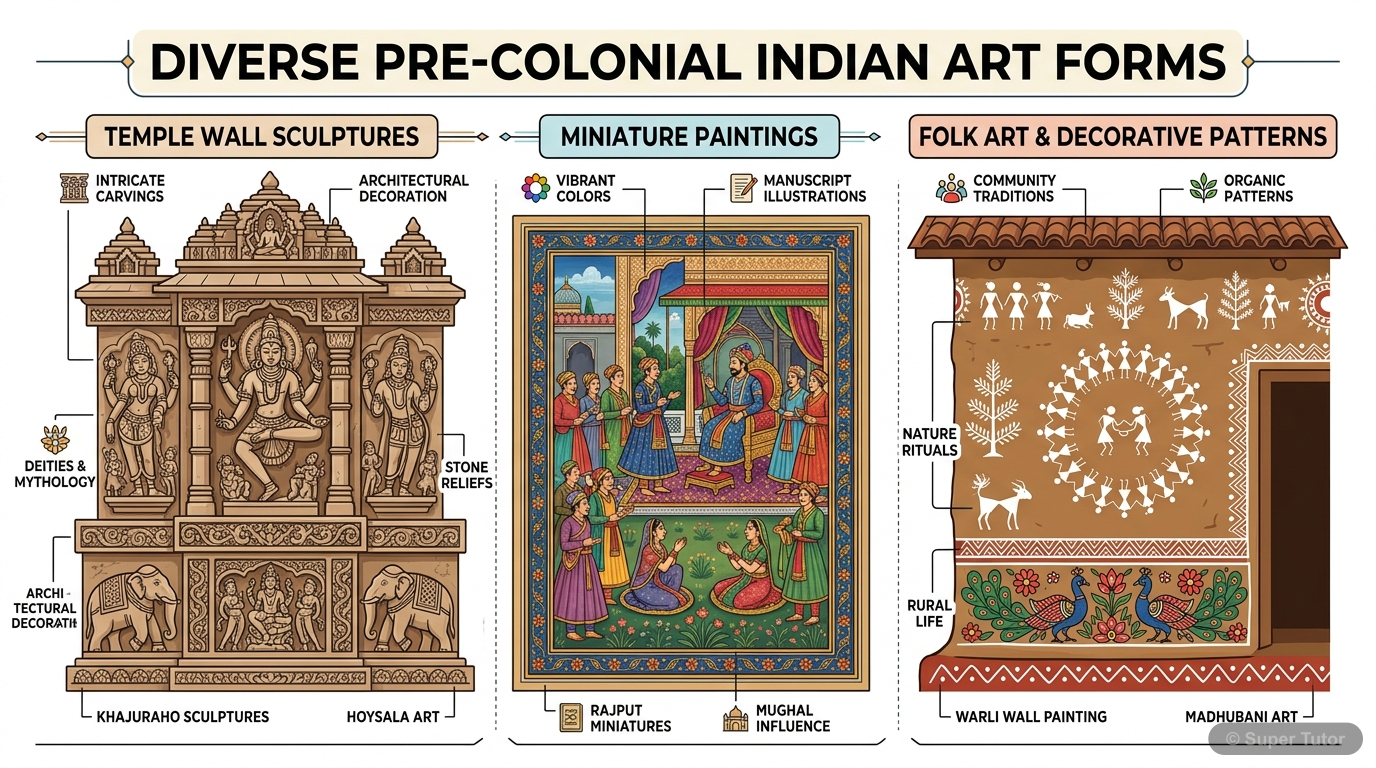
Super Tutor has 10+ illustrations like this for The Bengal School and Cultural Nationalism alone — flashcards, concept maps, and step-by-step visuals.
See them allEXERCISE — The Bengal School and Cultural Nationalism
1Collect a local newspaper of the past two weeks. Select images and text from these that you consider important in the life of modern democratic state of India. With the help of these visuals and texts, compile an album that narrates the story of an independent sovereign India in the contemporary world.Show solution
Step 1 – Collection of Material:
Collect local newspapers published over the past two weeks. Go through each edition carefully and identify images and text that reflect important aspects of modern democratic India — such as elections, judicial decisions, social movements, scientific achievements, cultural events, sports victories, economic developments, or environmental concerns.
Step 2 – Selection of Visuals and Text:
Select at least 10–15 images and corresponding news articles or headlines. Ensure that the selection covers a variety of themes:
- Political democracy (e.g., election results, Parliament sessions)
- Social justice (e.g., news about marginalised communities, women's rights)
- Economic progress (e.g., infrastructure, start-ups, agriculture)
- Cultural identity (e.g., festivals, art, literature awards)
- India's global role (e.g., foreign policy, international summits)
Step 3 – Compilation of the Album:
Arrange the selected clippings in a scrapbook or folder. Each clipping should be:
- Neatly pasted or printed
- Labelled with the name of the newspaper, date, and a brief caption written by you
- Organised thematically or chronologically
Step 4 – Narration:
Write a short paragraph (4–5 sentences) at the beginning of the album as an introduction, explaining what the album represents. Below each clipping, write 2–3 lines in your own words explaining why you chose it and what it tells us about contemporary India.
Step 5 – Conclusion:
End the album with a reflective note on what these news items collectively say about India as a sovereign, democratic republic in the contemporary world.
Note: This activity develops visual literacy, critical thinking, and an understanding of India's democratic functioning through real-world media.
2Comment on the importance of the Bengal School artists in the making of a national style of art.Show solution
The Bengal School emerged in the early 20th century as a direct response to colonial rule and the dominance of Western academic art introduced through British-established art schools.
Importance of the Bengal School in making a national style of art:
1. Rejection of Western Academic Style:
The Bengal School artists, led by Abanindranath Tagore and supported by E.B. Havell (Principal of the Calcutta School of Art), consciously rejected the Western realistic style of oil painting that was being taught in colonial art institutions. They argued that this style was alien to India's cultural sensibility.
2. Revival of Indian Classical Traditions:
The Bengal School drew inspiration from ancient Indian art traditions — the Ajanta cave paintings, Mughal miniature painting, Rajput painting, and the art of the Pahari school. By reviving these traditions, they gave Indian art a distinct identity rooted in its own heritage.
3. Influence of Asian Art:
Abanindranath Tagore and his colleagues were also inspired by Japanese wash techniques, introduced through the Japanese artists Yokoyama Taikan and Hishida Shunsō, who visited India. This led to the development of a soft, lyrical, wash-based style that became the hallmark of the Bengal School.
4. Nationalist and Spiritual Themes:
The Bengal School chose themes from Indian mythology, history, and spirituality — such as Abanindranath's famous painting *Bharat Mata* (Mother India), which depicted India as a goddess. This gave art a powerful nationalist and cultural message.
5. Establishment of a 'National' Aesthetic:
By combining Indian classical traditions with Asian influences and nationalist themes, the Bengal School created what can truly be called a 'national style' — one that was distinctly Indian, anti-colonial, and culturally self-assertive.
6. Institutional Impact:
The Bengal School also influenced art education. Abanindranath Tagore became Vice-Principal of the Government School of Art, Calcutta, and trained a whole generation of artists (such as Nandalal Bose, Surendranath Ganguly) who carried forward this national aesthetic.
Conclusion:
The Bengal School was a cultural and artistic movement that went hand in hand with the freedom struggle. It gave India a sense of pride in its own artistic heritage and laid the foundation for a distinctly Indian modern art tradition. Its importance lies not just in the paintings it produced, but in the nationalist consciousness it awakened through art.
3Write your view on any one painting by Abanindranath Tagore.Show solution
Description of the Painting:**
*Bharat Mata* depicts India personified as a four-armed goddess, serene and divine in appearance. She is shown dressed in saffron-coloured robes, holding in her four hands — sheaves of paddy (representing food/prosperity), a piece of white cloth (representing clothing), a book (representing education/knowledge), and a garland (representing spiritual blessings). The figure is calm, graceful, and deeply spiritual in expression.
Context:
This painting was created during the Swadeshi Movement (1905), when Bengal was partitioned by the British. It was a time of intense nationalist feeling, and Abanindranath used art as a medium to express the idea of India as a sacred motherland.
My View / Analysis:
1. Artistic Style: The painting uses the soft wash technique inspired by Mughal miniatures and Japanese art. The delicate lines, muted colours, and spiritual aura of the figure reflect the Bengal School's aesthetic — gentle yet powerful.
2. Symbolic Power: What makes this painting remarkable is its ability to combine the political with the spiritual. By depicting India as a goddess, Abanindranath elevated the concept of the nation to a sacred ideal, making it emotionally resonant for every Indian.
3. Cultural Identity: The painting asserts a purely Indian visual vocabulary — the goddess form, the iconographic use of four arms, the spiritual expression — all drawn from India's own artistic and religious traditions, not from Western art.
4. Nationalist Message: At a time when Indians were being told that their art and culture were inferior, *Bharat Mata* was a bold statement of cultural pride and self-respect. It inspired not just artists but the entire freedom movement.
Conclusion:
In my view, *Bharat Mata* is one of the most significant paintings in the history of Indian art. It is not merely a beautiful image; it is a cultural manifesto. It shows how art can become a vehicle for national consciousness and identity. Abanindranath Tagore, through this single painting, demonstrated that Indian art had the power to speak to the soul of a nation.
4Which art traditions of India inspired the Bengal School artists?Show solution
The Bengal School artists sought to create a national style of art by drawing upon India's own rich artistic heritage rather than following Western academic traditions.
Art Traditions of India that inspired the Bengal School artists:
1. Ajanta Cave Paintings:
The murals of the Ajanta caves (dating from the 2nd century BCE to 6th century CE) were a major source of inspiration. Their fluid lines, spiritual themes, and the technique of depicting figures with grace and inner emotion deeply influenced Bengal School artists, especially in terms of composition and the portrayal of human figures.
2. Mughal Miniature Painting:
The delicate brushwork, fine detailing, and the use of natural colours in Mughal miniatures inspired the Bengal School's technique. Abanindranath Tagore in particular studied Mughal miniatures closely and incorporated their refinement into his own style.
3. Rajput and Pahari Painting:
The lyrical quality, use of bold colours, and themes drawn from Hindu mythology and poetry (such as the Ramayana, Mahabharata, and Bhagavata Purana) in Rajput and Pahari paintings were also a significant influence on the Bengal School.
4. Kalighat Paintings:
The Kalighat pat paintings — a folk art tradition from Bengal — with their bold outlines, simplified forms, and earthy themes, also influenced artists like Jamini Roy, who later developed his own style based on this tradition.
5. Buddhist Art:
The spiritual and meditative quality of Buddhist art, including the iconography of the Buddha and Bodhisattvas, also inspired Bengal School artists in their search for a pan-Asian and pan-Indian artistic identity.
Conclusion:
The Bengal School artists drew from a wide spectrum of India's classical, medieval, and folk art traditions. This eclectic yet deeply rooted approach allowed them to create a style that was authentically Indian and distinct from Western academic art.
5What were the themes that Jamini Roy painted after he abandoned the academic style of painting?Show solution
Jamini Roy was initially trained in the Western academic style of painting at the Government School of Art, Calcutta. However, he later rejected this style and turned to indigenous Indian folk art traditions for inspiration.
Themes painted by Jamini Roy after abandoning the academic style:
1. Folk and Rural Life:
Jamini Roy drew heavily from the Kalighat pat painting tradition of Bengal. He painted scenes from the everyday life of rural Bengal — simple village people, their joys and sorrows, and their relationship with nature.
2. Mythological and Religious Themes:
He painted figures and scenes from Hindu mythology — such as Krishna and the Gopis, the infant Krishna (Bal Krishna), scenes from the Ramayana (especially Rama, Sita, and Lakshmana), and images of the Mother Goddess. These themes connected his art to the spiritual and cultural life of ordinary Indians.
3. Figures of Women and Children:
Jamini Roy frequently painted women and children in a bold, stylised manner. His figures have thick black outlines, elongated eyes (inspired by the Kalighat style), and flat areas of colour — giving them a distinctive, iconic quality.
4. Christian Themes:
Interestingly, Jamini Roy also painted Christian subjects such as the Madonna and Child, but rendered them in his own folk-art style, giving them an Indian visual identity. This showed his universal humanist outlook.
5. Animals and Birds:
He also painted animals — especially cats, horses, and birds — in a simplified, decorative folk style, reflecting the close relationship between rural communities and the natural world.
Style used for these themes:
For all these themes, Jamini Roy used bold outlines, flat areas of bright colour (often made from natural and locally available pigments), and a simplified, almost geometric treatment of forms — all inspired by the Kalighat pat tradition and other folk art forms of Bengal.
Conclusion:
After abandoning the academic style, Jamini Roy's themes became deeply rooted in Indian folk culture, mythology, and everyday rural life. His work was a powerful assertion that true Indian art must draw from its own living folk traditions rather than from imported Western models.
Stuck on a step?
Ask Super Tutor AI to explain any solution on this page in a simpler way — free, 24x7.
Ask a Doubt FreeFrequently Asked Questions
What are the important topics in The Bengal School and Cultural Nationalism for CBSE Class 12 Fine Arts?
How to score full marks in The Bengal School and Cultural Nationalism — CBSE Class 12 Fine Arts?
Where can I get free NCERT Solutions for The Bengal School and Cultural Nationalism Class 12 Fine Arts?
Sources & Official References
- NCERT Official — ncert.nic.in
- CBSE Academic — cbseacademic.nic.in
- CBSE Official — cbse.gov.in
- National Education Policy 2020 — education.gov.in
Content is aligned to the official syllabus. Refer to the board website for the latest curriculum.
More resources for The Bengal School and Cultural Nationalism
Important Questions
Practice with board exam-style questions
Syllabus
What topics to cover
Revision Notes
Key points for last-minute revision
Study Plan
Step-by-step plan to ace this chapter
Flashcards
Quick-fire cards for active recall
Formula Sheet
All formulas in one place
Chapter Summary
Understand the chapter at a glance
Practice Quiz
Test yourself with a quick quiz
Concept Maps
See how topics connect visually
For serious students
Get the full The Bengal School and Cultural Nationalism chapter — for free.
Quizzes, flashcards, AI doubt-solver and a step-by-step study plan for CBSE Class 12 Fine Arts.