The Deccani Schools of Painting — Chapter Summary
CBSE · Class 12 · Fine Arts
Summary of The Deccani Schools of Painting for CBSE Class 12 Fine Arts. Part of the CBSE Class 12 Fine Arts syllabus.
Interactive on Super Tutor
Studying The Deccani Schools of Painting? Get the full interactive chapter.
Quizzes, flashcards, AI doubt-solver and a step-by-step study plan — built for chapter summary and more.
Free trial, no card needed.
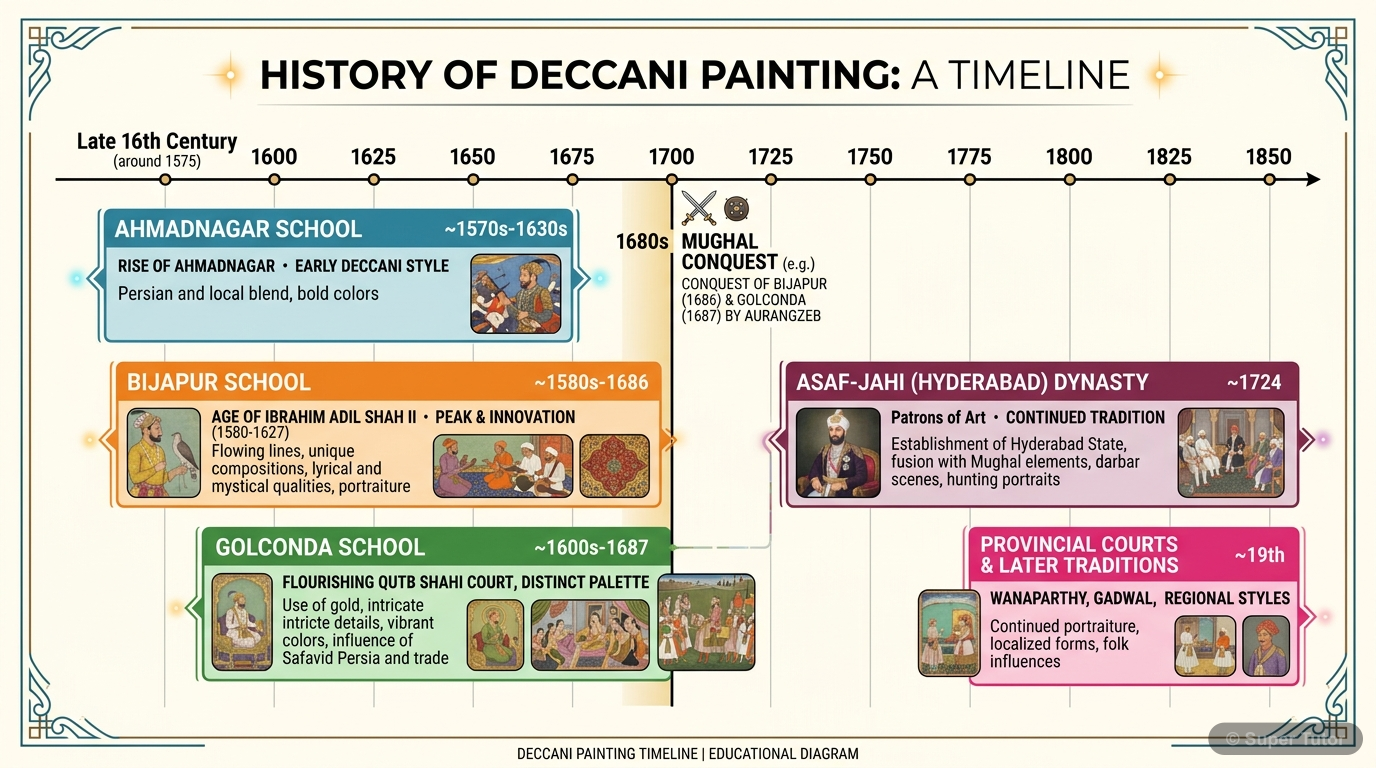
One of 11 illustrations for The Deccani Schools of Painting in Super Tutor — alongside flashcards, concept maps and practice questions.
See them allOverview
Deccani painting developed as a distinct school in the plateau region of southern India under the Sultans of the Deccan. Its history can largely be traced from the late sixteenth century until the 1680s, when the Mughals conquered the Deccan. Even after that, Deccani painting continued to appear in
Key Concepts
Deccani painting was not simply
Deccani painting was not simply a branch of Indo-Persian art. It developed its own strong identity under Deccan rulers who supported artists and commi
The earliest examples appear in
The earliest examples appear in a volume of poems celebrating the reign of Hussain Nizam Shah I of Ahmadnagar. Battle scenes are less important artist
Bijapur painting was supported by Ali
Bijapur painting was supported by Ali Adil Shah I and Ibrahim II. Important works include Nujum al-Ulum, Ragamala paintings and symbolic compositions
Golconda became independent in 1512
Golconda became independent in 1512 and grew wealthy through trade, diamonds and later wider commercial exchange. Golconda paintings are known for gol
Deccani paintings show Persian features such
Deccani paintings show Persian features such as high circular horizons, gold skies and elegant decoration, along with Indian elements such as local dr
Learning Objectives
- Understand the rise of Deccani painting as a distinct school.
- Identify the major centres of Deccani painting: Ahmadnagar, Bijapur and Golconda.
- Recognise the main themes, styles and visual features of Deccani miniatures.
- Study important paintings and their royal or religious contexts.
- Compare Persian, Indian and Mughal influences within Deccani art.
Frequently Asked Questions
What are the important topics in The Deccani Schools of Painting for CBSE Class 12 Fine Arts?
How should I revise The Deccani Schools of Painting for the CBSE Class 12 board exam?
Sources & Official References
- NCERT Official — ncert.nic.in
- CBSE Academic — cbseacademic.nic.in
- CBSE Official — cbse.gov.in
- National Education Policy 2020 — education.gov.in
Content is aligned to the official syllabus. Refer to the board website for the latest curriculum.
More resources for The Deccani Schools of Painting
Practice Quiz
Test yourself with a quick quiz
Important Questions
Exam-style questions with answers
Revision Notes
Key points for last-minute revision
Concept Maps
See how topics connect
Study Plan
Step-by-step plan for this chapter
Flashcards
Quick-fire cards for active recall
Syllabus
What topics to cover
NCERT Solutions
Every textbook question solved step by step
For serious students
Get the full The Deccani Schools of Painting chapter — start free.
Quizzes, flashcards, an AI doubt solver and a study plan for CBSE Class 12 Fine Arts. Free to start, no card needed.