Chapter 2 of 8
NCERT Solutions

The Rajasthani Schools of Painting

CBSE · Class 12 · Fine Arts

NCERT Solutions for The Rajasthani Schools of Painting — CBSE Class 12 Fine Arts.

5 concepts

Interactive on Super Tutor

Studying The Rajasthani Schools of Painting? Get the full interactive chapter.

Quizzes, flashcards, AI doubt-solver and a step-by-step study plan — built for ncert solutions and more.

1,000+ Class 12 students started this chapter today
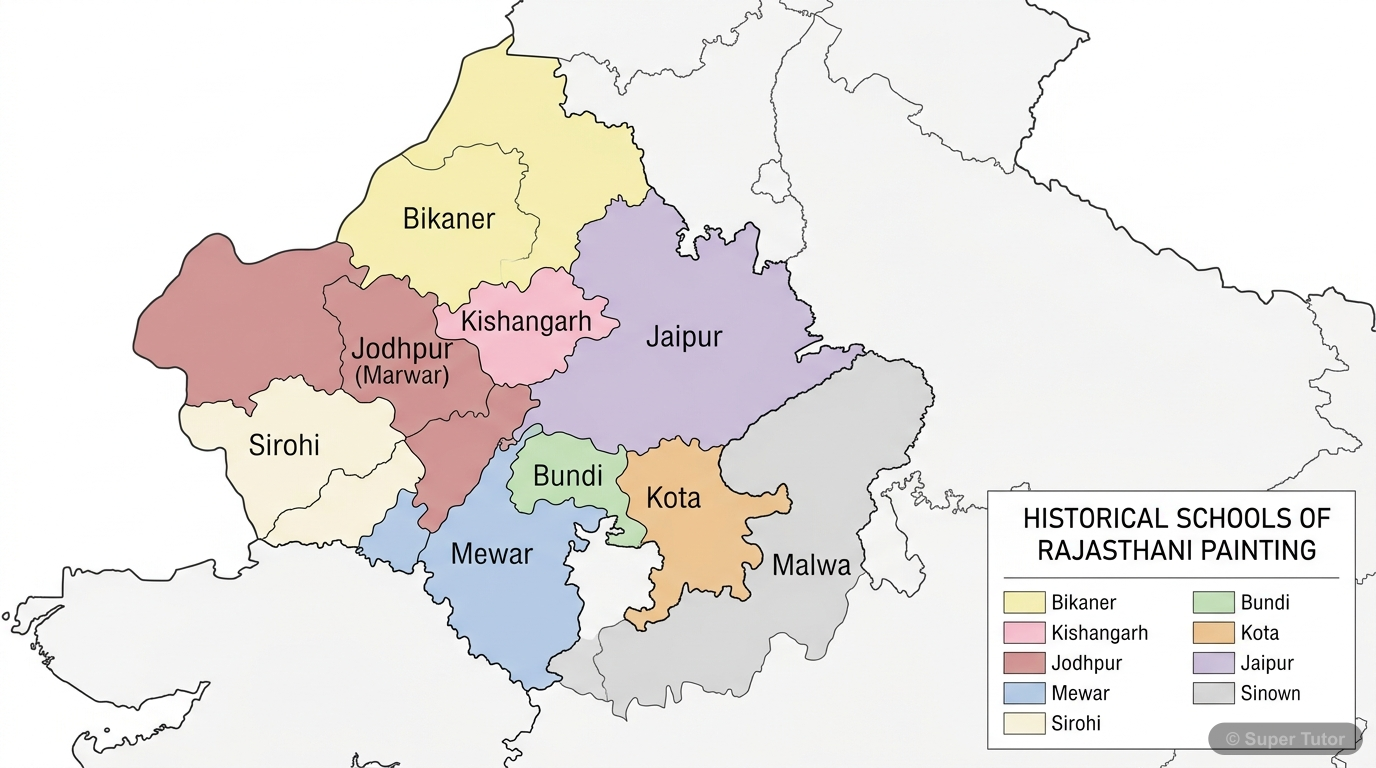
A geographical map showing the locations of various Rajasthani painting schools mentioned in the chapter, such as Mewar, Bundi, Kota, Jaipur, Bikaner, Kishangarh, Jodhpur (Marwar), Malwa, and Sirohi,
Super Tutor

Super Tutor has 13+ illustrations like this for The Rajasthani Schools of Painting alone — flashcards, concept maps, and step-by-step visuals.

See them all
5 Questions Solved · 1 Section

EXERCISE — The Rajasthani Schools of Painting

1In what ways do you think that the Western Indian manuscript painting tradition guided the developments of miniature painting traditions in Rajasthan?Show solution
Given / Context: The Western Indian (or Apabhramsha) manuscript painting tradition flourished mainly in Gujarat and Rajasthan between the 10th and 16th centuries. It was primarily associated with illustrated Jain manuscripts such as the Kalpasutra and Kalakacharya Katha, as well as Hindu texts like the Bhagavata Purana.

Answer (Step-by-step):

Step 1 – Identify the Western Indian Manuscript Tradition:
The Western Indian manuscript tradition is one of the oldest surviving painting traditions of India. It was characterised by:
- Flat, two-dimensional figures with angular, stylised forms.
- Figures shown in profile with a projecting farther eye (the 'further eye' convention).
- Bold, primary colours — red, yellow, blue, and green — used as flat washes.
- Thick black outlines defining figures and objects.
- Decorative, patterned backgrounds.
- Compact, crowded compositions within the manuscript page.

Step 2 – Link to Rajasthani Miniature Painting:
The Rajasthani schools of miniature painting — Mewar, Marwar, Bundi-Kota, Amber-Jaipur, Kishangarh, etc. — emerged in the 16th–17th centuries. The Western Indian tradition guided them in the following ways:

1. Stylistic Continuity: The flat, linear quality of figures, bold outlines, and the use of pure, vivid colours seen in early Rajasthani paintings (especially early Mewar works like the 1605 Ragamala) are directly inherited from the Western Indian manuscript style.

2. Iconographic Conventions: The angular face shown in three-quarter profile with the projecting farther eye continued in early Rajasthani paintings, particularly in Mewar and Marwar schools.

3. Themes and Texts: The tradition of illustrating religious and literary texts — Bhagavata Purana, Gita Govinda, Ragamala, Baramasa — was established by the manuscript tradition and was enthusiastically adopted by Rajasthani painters.

4. Patronage Pattern: The tradition of royal and religious patronage for illustrated manuscripts set the model for Rajput rulers who later became the chief patrons of Rajasthani miniature painting.

5. Colour Palette: The preference for bright, unmodulated colours (red backgrounds, yellow ochre, lapis blue) in Rajasthani paintings echoes the bold palette of Western Indian manuscripts.

6. Format and Composition: The small, intimate format of manuscript illustrations directly influenced the miniature format adopted by Rajasthani painters.

Conclusion:
Thus, the Western Indian manuscript tradition provided the stylistic vocabulary, iconographic conventions, thematic content, and patronage model upon which the Rajasthani schools of miniature painting were built and subsequently developed their own regional identities.
2Describe different schools of Rajasthani paintings and give examples to support their characteristics.Show solution
Given / Context: Rajasthani painting is not a single homogeneous style but a group of regional schools that developed under different Rajput rulers. The major schools are Mewar, Marwar, Bundi-Kota, Amber-Jaipur, and Kishangarh.

Answer:

---

1. Mewar School (Udaipur)

- Period: 16th–19th century; flourished under Rana Amar Singh I, Jagat Singh I.
- Characteristics:
- Bold, vivid colours — red, yellow, green — used as flat washes.
- Figures are sturdy, with angular features; the 'farther eye' convention is visible in early works.
- Strong local flavour; landscapes show local flora, fauna, and architecture.
- Themes: Ragamala, Rasikapriya, Gita Govinda, Bhagavata Purana.
- Examples:
- *Ragamala series* (1605) — one of the earliest dated Rajasthani paintings.
- *Rasikapriya* illustrations under Jagat Singh I.
- Paintings by artists Sahibdin and Manohar are celebrated.

---

2. Marwar School (Jodhpur)

- Period: 17th–19th century; patronised by rulers of Jodhpur, Bikaner, Nagaur, Pali.
- Characteristics:
- Strong, bold lines and flat colour areas.
- Figures are robust with expressive faces.
- Landscapes are arid, reflecting the desert environment of Marwar.
- Themes: Ragamala, Dhola-Maru (a local romantic legend), portraits, court scenes.
- Examples:
- *Dhola-Maru* paintings — a romantic tale unique to Marwar.
- Bikaner sub-school shows Mughal influence with finer brushwork and use of shading.
- *Ragamala* series from Pali (1623).

---

3. Bundi-Kota School

- Period: 17th–19th century.
- Characteristics:
- Lush, exuberant landscapes with dense foliage, flowering trees, and animals.
- Rich use of green; figures are graceful and elegant.
- Bundi paintings are more lyrical and poetic; Kota paintings emphasise hunting scenes and vigorous action.
- Themes: Ragamala, Baramasa, hunting scenes, court life.
- Examples:
- *Ragamala* paintings from Bundi — known for their rich green backgrounds and graceful female figures.
- Kota hunting scenes — dynamic compositions showing royal hunts of tigers and boars.
- *Baramasa* (twelve months) series.

---

4. Amber-Jaipur School

- Period: 17th–19th century; flourished under Sawai Jai Singh II, Sawai Pratap Singh.
- Characteristics:
- Early works show strong Mughal influence (fine brushwork, naturalistic portraiture).
- Under Pratap Singh, a distinct Jaipur style emerged blending Mughal and indigenous features.
- Preference for large-format paintings and life-size portraits.
- Lavish use of gold in the 19th century.
- Themes: Gita Govinda, Ragamala, Bhagavata Purana, royal portraits, court scenes.
- Examples:
- Portraits by Sahibram (accomplished portrait painter in Sawai Jai Singh II's court).
- *Gita Govinda* and *Ragamala* series under Pratap Singh.
- Elephant fights and hunting scenes under Sawai Ishwari Singh.

---

5. Kishangarh School

- Period: 18th century; flourished under Raja Savant Singh (also known as the poet Nagaridas).
- Characteristics:
- Highly idealised, elongated figures with distinctive facial features — arched eyebrows, lotus-shaped eyes, sharp nose, and receding chin.
- Romantic and devotional mood; deeply influenced by the Bhakti movement.
- Radha and Krishna are the dominant subjects; Radha is often modelled on the legendary beauty Bani Thani.
- Lyrical, dreamy landscapes with moonlit lakes and flowering trees.
- Examples:
- *Bani Thani* — the most celebrated painting of the Kishangarh school, painted by Nihal Chand; Radha is depicted with idealised, elongated features.
- *Radha-Krishna* series based on the poetry of Nagaridas.

---

Conclusion:
Each school of Rajasthani painting developed its own distinctive style, colour palette, and thematic preference under the patronage of local Rajput rulers, while sharing a common foundation in the Western Indian manuscript tradition and later absorbing Mughal influences to varying degrees.
3What is Ragamala? Give examples of Ragamala paintings from various schools of Rajasthan.Show solution
Given / Context: Ragamala is a recurring theme in Rajasthani miniature painting. The question asks for its definition and examples from different Rajasthani schools.

Answer:

What is Ragamala?

'Ragamala' literally means 'Garland of Ragas'. It is a series of illustrated paintings based on the classical Indian musical modes called *ragas* and *raginis*. In Indian classical music, each raga is associated with:
- A specific time of day or night.
- A specific season.
- A specific mood or emotion (*rasa*).
- A specific deity, hero, or heroine (*nayaka-nayika*).

The Ragamala tradition translates these musical concepts into visual imagery. Each raga or ragini is personified as a human figure — often a romantic couple, a devotee, or a warrior — placed in an appropriate natural setting that evokes the mood of the raga. The paintings are accompanied by short descriptive verses (*dhyana shlokas*) that describe the visual form of each raga.

The standard Ragamala set consists of 36 paintings (6 male ragas, each with 5 raginis = 30, plus 6 putra ragas), though the number varies by tradition.

Significance:
Ragamala paintings beautifully illustrate the Indian concept of the unity of arts — music, poetry, and painting — all expressing the same emotional state.

---

Examples of Ragamala Paintings from Various Rajasthani Schools:

1. Mewar School:
- The *Ragamala series of 1605* is one of the earliest dated Rajasthani paintings. It was painted at Chawand (then the capital of Mewar) during the reign of Rana Amar Singh I.
- The paintings show bold, flat colours — vivid red backgrounds, yellow, and green — with sturdy, angular figures.
- The artist Sahibdin later produced celebrated Ragamala illustrations under Jagat Singh I.
- These works retain the indigenous Rajput flavour with minimal Mughal influence.

2. Marwar School:
- A *Ragamala series from Pali* (1623) is an important early example from the Marwar region.
- The figures are bold and robust; the landscape reflects the arid Marwar terrain.
- Colours are strong and unmodulated, with characteristic flat washes.

3. Bundi School:
- Bundi produced some of the most lyrical and visually rich Ragamala paintings.
- They are characterised by lush green landscapes, dense flowering trees, lotus ponds, and graceful female figures.
- The mood is romantic and poetic, perfectly suited to the emotional content of the ragas.
- The *Bundi Ragamala* series is celebrated for its exuberant natural settings.

4. Amber-Jaipur School:
- Ragamala paintings were produced under Sawai Pratap Singh (1779–1803), who was himself a scholar and devotee of Krishna.
- These paintings show a blend of Mughal refinement and indigenous Rajput boldness.
- Themes from Ragamala were combined with Gita Govinda imagery.

---

Conclusion:
Ragamala paintings are a unique synthesis of music, poetry, and visual art. Each Rajasthani school interpreted the Ragamala themes through its own distinctive style, making these series invaluable records of both artistic and musical traditions of India.
4Draw a map and label all schools of Rajasthani miniature paintings.Show solution
Given / Context: This is a map-based activity question. Since a hand-drawn map cannot be reproduced here, the answer provides a structured description of the geographical locations of all major Rajasthani schools, which should be used to draw and label the map.

Instructions for Drawing the Map:

Step 1: Draw the outline map of Rajasthan (a roughly rectangular state in north-western India).

Step 2: Mark and label the following cities/regions as centres of Rajasthani miniature painting schools:

| School | Centre / City | Location in Rajasthan |
|---|---|---|
| Mewar School | Udaipur (also Chawand, Nathdwara) | South-central Rajasthan |
| Marwar School | Jodhpur, Bikaner, Nagaur, Pali | Western and north-western Rajasthan |
| Bundi-Kota School | Bundi, Kota | South-eastern Rajasthan |
| Amber-Jaipur School | Amber, Jaipur | Eastern Rajasthan |
| Kishangarh School | Kishangarh | Central Rajasthan (near Ajmer) |
| Alwar School | Alwar | North-eastern Rajasthan |
| Devgarh School | Devgarh | Central Rajasthan |

Step 3: Use different symbols or colours for each school and provide a legend/key.

Step 4: Mark major rivers (Chambal, Banas, Luni) and neighbouring states for reference.

Key Points to Note on the Map:
- Mewar (Udaipur) — the oldest and most prolific school; earliest dated Ragamala (1605) from Chawand.
- Marwar (Jodhpur/Bikaner) — known for Dhola-Maru and desert landscapes.
- Bundi-Kota — known for lush landscapes and hunting scenes.
- Jaipur — known for large-format paintings and life-size portraits.
- Kishangarh — known for the iconic *Bani Thani* painting.

Note: Students must draw the actual map in their answer books, label all the above centres clearly, and add a title: *'Map showing Schools of Rajasthani Miniature Painting'*.
5Which texts provided the content or theme for miniature paintings? Describe them with examples.Show solution
Given / Context: Rajasthani miniature paintings drew their themes from a wide range of religious, literary, and musical texts. The question asks for identification and description of these texts with examples of paintings based on them.

Answer:

The following texts provided the major themes and content for Rajasthani miniature paintings:

---

1. Gita Govinda
- Author: Jayadeva (12th century, Sanskrit).
- Content: A lyrical poem describing the love of Radha and Krishna — their union, separation (*viraha*), and reunion. It is divided into 12 cantos (*sargas*) and 24 songs (*prabandhas*).
- Themes in Painting: The romantic and devotional episodes between Radha and Krishna — Krishna dancing with the gopis, Radha's longing, their meeting in the forest bower (*kunja*).
- Examples:
- *Gita Govinda* illustrations from Mewar (under Jagat Singh I, by Sahibdin) — bold colours, lush forest settings.
- *Gita Govinda* series from Jaipur (under Pratap Singh) — refined style blending Mughal and Rajput features.

---

2. Ragamala (Garland of Ragas)
- Content: A collection of verses describing the visual personifications of classical Indian musical modes (ragas and raginis), each associated with a season, time of day, and emotional mood.
- Themes in Painting: Each raga is depicted as a human figure in an appropriate natural setting — a woman waiting for her lover in the rain (Megha raga), a devotee in meditation, a warrior, etc.
- Examples:
- *Ragamala series* (1605, Chawand) — Mewar school; earliest dated Rajasthani painting.
- *Ragamala from Pali* (1623) — Marwar school.
- *Bundi Ragamala* — Bundi school; celebrated for lush green landscapes.

---

3. Rasikapriya
- Author: Keshavdas (16th century, Brajbhasha Hindi).
- Content: A treatise on poetics and aesthetics that classifies the hero (*nayaka*) and heroine (*nayika*) into various types based on their emotional states and situations in love.
- Themes in Painting: Various types of heroines — the woman waiting for her lover (*abhisarika*), the woman whose lover has been unfaithful (*khandita*), etc.
- Examples:
- *Rasikapriya* illustrations from Mewar — the nayika types are depicted with bold colours and expressive faces.
- *Rasikapriya* series from Jaipur (under Sawai Jai Singh II).

---

4. Baramasa (Twelve Months)
- Content: A poetic genre describing the twelve months of the year and their associated moods, seasons, and the emotional states of lovers — particularly the longing of a woman for her absent beloved through the changing seasons.
- Themes in Painting: Each month is depicted with its characteristic season, flora, fauna, and the emotional state of the heroine.
- Examples:
- *Baramasa* series from Bundi — lush landscapes with seasonal flowers, birds, and graceful female figures.
- *Baramasa* paintings from Mewar and Marwar.

---

5. Bhagavata Purana
- Content: One of the eighteen major Puranas, the Bhagavata Purana (especially its 10th Skandha/Book) narrates the life and exploits of Lord Krishna — his birth, childhood miracles, the Rasa Lila (circular dance with the gopis), the slaying of demons, and his teachings.
- Themes in Painting: Krishna's childhood (Bal Lila), the Rasa Lila, Krishna lifting the Govardhan mountain, battle scenes.
- Examples:
- *Bhagavata Purana* illustrations from Mewar (by Sahibdin, 1648) — a landmark series with bold, vivid compositions.
- *Bhagavata Purana* series from Jaipur (under Pratap Singh).

---

6. Mahabharata and Ramayana
- Content: The two great Sanskrit epics narrating the stories of the Pandavas and Kauravas (Mahabharata) and the life of Rama (Ramayana).
- Themes in Painting: Battle scenes, court scenes, forest episodes, the abduction of Sita, the battle of Lanka.
- Examples:
- *Ramayana* illustrations from Mewar and Marwar.
- *Mahabharata* scenes from Jaipur.

---

7. Bihari Satsai
- Author: Bihari Lal (17th century, Brajbhasha Hindi).
- Content: A collection of 700 (*satsai* = seven hundred) couplets on the themes of love, devotion, and worldly wisdom, centred on Radha and Krishna.
- Themes in Painting: Romantic episodes of Radha and Krishna, the nayaka-nayika tradition.
- Examples:
- *Bihari Satsai* illustrations from Jaipur and Bundi schools.

---

Conclusion:
The rich literary and musical heritage of India — from Sanskrit epics and Puranas to medieval Hindi poetry — provided an inexhaustible source of themes for Rajasthani miniature painters. These texts not only gave the painters their subject matter but also defined the emotional (*rasa*) and aesthetic framework within which they worked, making Rajasthani miniature painting a truly interdisciplinary art form.

Stuck on a step?

Ask Super Tutor AI to explain any solution on this page in a simpler way — free, 24x7.

Ask a Doubt Free

Frequently Asked Questions

What are the important topics in The Rajasthani Schools of Painting for CBSE Class 12 Fine Arts?
Key topics in The Rajasthani Schools of Painting include Rajasthani Schools of Painting Overview, Rajasthani Schools of Painting - Complete Overview, Overview of Rajasthani Schools of Painting. These are the concepts CBSE Class 12 examiners draw on most — study them first, then practise related questions.
How to score full marks in The Rajasthani Schools of Painting — CBSE Class 12 Fine Arts?
Start by understanding all key concepts. Practise previous year questions from this chapter. Revise formulas and definitions regularly. Use flashcards for quick revision before the exam.
Where can I get free NCERT Solutions for The Rajasthani Schools of Painting Class 12 Fine Arts?
This page has free step-by-step NCERT Solutions for every exercise question in The Rajasthani Schools of Painting (CBSE Class 12 Fine Arts) — written the way examiners award marks: given, formula, working, answer.

Sources & Official References

Content is aligned to the official syllabus. Refer to the board website for the latest curriculum.

For serious students

Get the full The Rajasthani Schools of Painting chapter — for free.

Quizzes, flashcards, AI doubt-solver and a step-by-step study plan for CBSE Class 12 Fine Arts.