The Manuscript Painting Tradition
CBSE · Class 12 · Fine Arts
NCERT Solutions for The Manuscript Painting Tradition — CBSE Class 12 Fine Arts.
Interactive on Super Tutor
Studying The Manuscript Painting Tradition? Get the full interactive chapter.
Quizzes, flashcards, AI doubt-solver and a step-by-step study plan — built for ncert solutions and more.
1,000+ Class 12 students started this chapter today
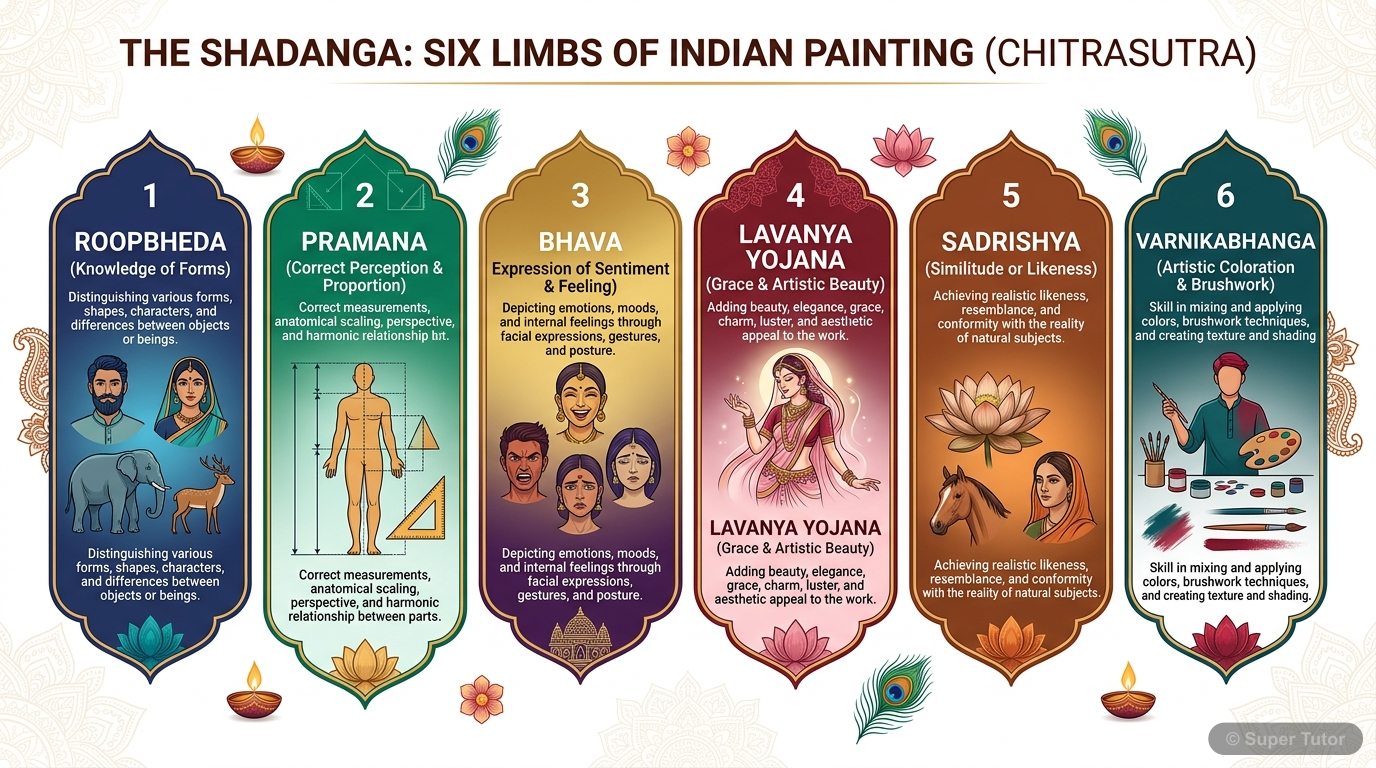
This is just one of 11+ visuals inside Super Tutor's The Manuscript Painting Tradition chapter
Explore the full setEXERCISE — The Manuscript Painting Tradition
1What are manuscript paintings? Name two places, where the tradition of manuscript painting was prevalent?Show solution
Answer:
Manuscript Paintings:
Manuscript paintings are illustrations or decorative paintings made on handwritten texts (manuscripts). These manuscripts were written on palm leaves, paper, or cloth, and the paintings were created alongside the text to illustrate religious stories, epics, or philosophical ideas. They served both as a means of preserving sacred knowledge and as a form of artistic expression. The tradition flourished under royal and monastic patronage, and the manuscripts were often bound between wooden covers that were also painted.
Two places where the tradition of manuscript painting was prevalent:
1. Nalanda (Bihar): The famous Buddhist monastery of Nalanda was a major centre of Pala manuscript painting. A fine example is the *Astasahasrika Prajnaparamita* (Perfection of Wisdom), painted during the reign of Pala King Ramapala in the last quarter of the eleventh century.
2. Gujarat and Rajasthan: These regions were important centres of the Jain manuscript painting tradition. Jain texts such as the *Kalpasutra* and *Kalakacharya Katha* were illustrated here, characterised by bold, angular lines and bright colours.
Conclusion: Thus, manuscript painting was a rich and widespread tradition in India, reflecting both religious devotion and artistic excellence.
2Take a chapter from any one of our language textbooks and make an illustrated folio with selected text (in minimum five pages).Show solution
Objective: To understand and experience the tradition of manuscript painting by creating a personal illustrated folio inspired by the manuscript painting tradition.
Materials Required:
- Thick handmade paper or cartridge sheets (minimum 5 pages)
- Pencil, fine-tipped pen or brush
- Watercolours, poster colours, or natural pigments
- A chapter from a language textbook (e.g., a story or poem from Hindi, English, or Sanskrit textbook)
Step-by-Step Process:
Step 1 — Selection of Text:
Choose a chapter or story from your language textbook (for example, a folk tale or a poem). Select key passages — at least one for each page (minimum five pages).
Step 2 — Layout Planning:
Divide each page into two sections:
- Upper portion: for the painting/illustration
- Lower portion: for the handwritten text (in neat calligraphic style)
This layout is inspired by traditional Pala and Jain manuscripts where text and image appeared together.
Step 3 — Drawing the Illustrations:
For each selected passage, draw an illustration that depicts the scene or idea described in the text. You may draw inspiration from:
- Pala style: flowing, sinuous lines with subdued colour tones
- Jain style: bold, angular lines with bright flat colours
Step 4 — Colouring:
Fill the illustrations with appropriate colours. Use flat colour fills as seen in traditional manuscript paintings. Avoid shading or perspective — keep the style flat and decorative.
Step 5 — Writing the Text:
Write the selected text neatly below or beside the illustration on each page. You may use a fine pen or brush to write in a calligraphic style.
Step 6 — Border Decoration:
Add decorative borders on each page using geometric or floral patterns, as seen in traditional manuscripts.
Step 7 — Cover Page:
Create a painted wooden-cover-style front and back page for your folio, as was the tradition in Pala and Jain manuscripts.
Step 8 — Binding:
Bind the pages together with a thread through the centre (in the style of palm-leaf manuscripts) or staple them neatly.
Expected Outcome:
A minimum five-page illustrated folio that combines handwritten text with original paintings, reflecting the spirit of the Indian manuscript painting tradition.
Note: The folio will be evaluated on the basis of creativity, neatness, relevance of illustrations to the text, and the use of traditional stylistic elements.
Stuck on a step?
Ask Super Tutor AI to explain any solution on this page in a simpler way — free, 24x7.
Ask a Doubt FreeFrequently Asked Questions
What are the important topics in The Manuscript Painting Tradition for CBSE Class 12 Fine Arts?
How to score full marks in The Manuscript Painting Tradition — CBSE Class 12 Fine Arts?
Where can I get free NCERT Solutions for The Manuscript Painting Tradition Class 12 Fine Arts?
Sources & Official References
- NCERT Official — ncert.nic.in
- CBSE Academic — cbseacademic.nic.in
- CBSE Official — cbse.gov.in
- National Education Policy 2020 — education.gov.in
Content is aligned to the official syllabus. Refer to the board website for the latest curriculum.
More resources for The Manuscript Painting Tradition
Important Questions
Practice with board exam-style questions
Syllabus
What topics to cover
Revision Notes
Key points for last-minute revision
Study Plan
Step-by-step plan to ace this chapter
Flashcards
Quick-fire cards for active recall
Formula Sheet
All formulas in one place
Chapter Summary
Understand the chapter at a glance
Practice Quiz
Test yourself with a quick quiz
Concept Maps
See how topics connect visually
For serious students
Get the full The Manuscript Painting Tradition chapter — for free.
Quizzes, flashcards, AI doubt-solver and a step-by-step study plan for CBSE Class 12 Fine Arts.