The Deccani Schools of Painting
CBSE · Class 12 · Fine Arts
NCERT Solutions for The Deccani Schools of Painting — CBSE Class 12 Fine Arts.
Interactive on Super Tutor
Studying The Deccani Schools of Painting? Get the full interactive chapter.
Quizzes, flashcards, AI doubt-solver and a step-by-step study plan — built for ncert solutions and more.
1,000+ Class 12 students started this chapter today
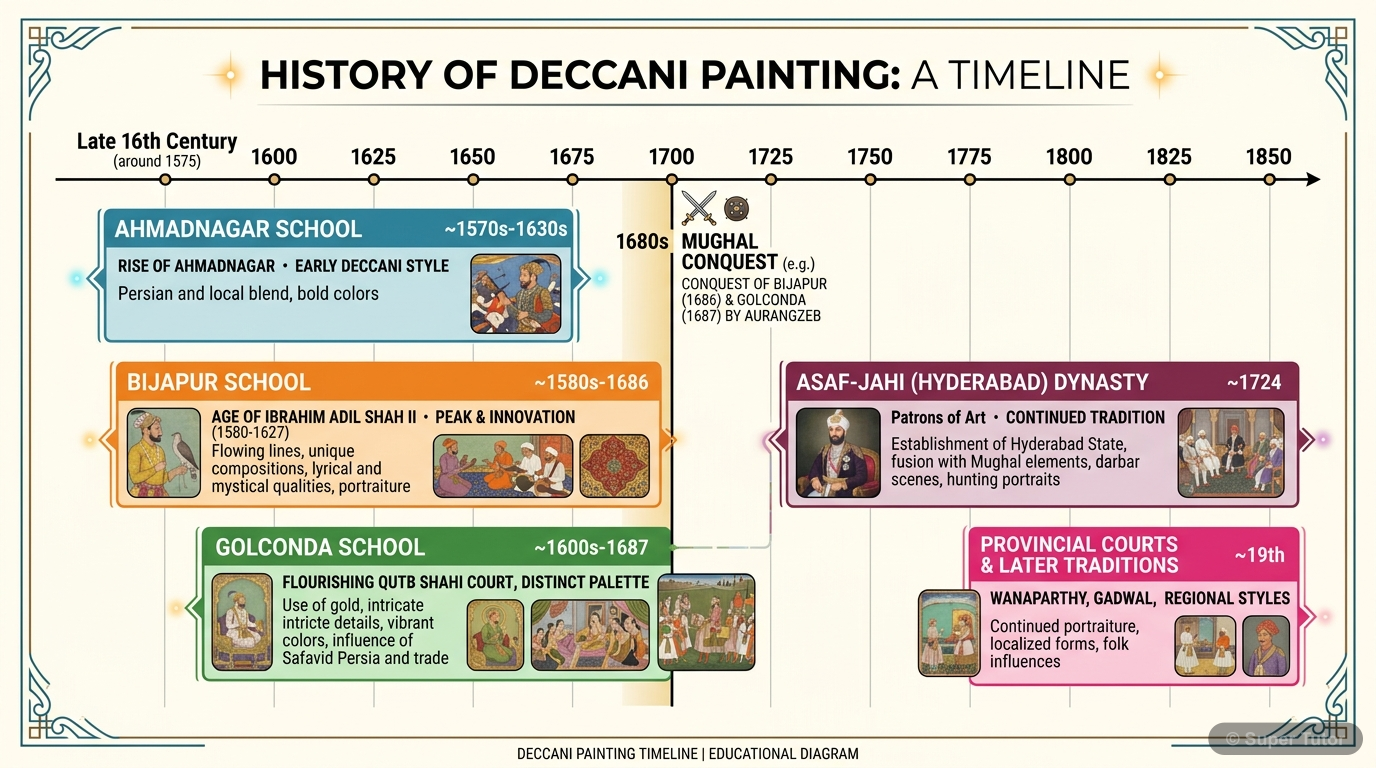
This is just one of 11+ visuals inside Super Tutor's The Deccani Schools of Painting chapter
Explore the full setEXERCISE — The Deccani Schools of Painting
1What are the unique features of Deccani painting of Yogini? Find out about artists doing similar works nowadays.Show solution
Unique Features of the Deccani Painting of Yogini:
1. Elongated, graceful figures: The Yogini is depicted with a tall, slender, and elegant form — a hallmark of the Deccani style, quite different from the more robust Mughal figures.
2. Rich, jewel-like colours: Deep greens, blues, and warm ochres are used with great luminosity. Gold is freely applied in the background, borders, and ornaments.
3. Distinctive sky treatment: The sky is often rendered in horizontal bands of gold and blue, a feature unique to Deccani painting.
4. Lush, stylised landscape: Plants and trees are silhouetted against dark, dense foliage. The trees have tinted or highlighted edges, giving them a glowing quality.
5. Spiritual and mystical mood: The Yogini is shown in a contemplative, serene posture, conveying an atmosphere of inner calm and spiritual power.
6. Decorative treatment of costume and jewellery: The figure wears elaborately detailed garments and ornaments, rendered with fine brushwork.
7. Persian and indigenous synthesis: The composition blends Persian spatial conventions (flat background, decorative borders) with local Indian iconographic traditions.
8. Soft, lyrical line quality: The outlines are fluid and gentle, unlike the precise, firm lines of Mughal painting.
Contemporary Artists Working in Similar Traditions:
Several contemporary Indian miniature painters continue the Deccani tradition. Artists such as Ghulam Mohammad Sheikh (who draws on classical miniature traditions in his modern works) and painters trained at institutions like the Government Museum and Art Gallery, Hyderabad or the Lalit Kala Akademi keep this tradition alive. Students are encouraged to research local artists in Hyderabad, Bijapur, and Aurangabad who practise miniature painting in the Deccani style.
2What were the popular themes painted in the Deccani School? Describe some of them.Show solution
Popular Themes in the Deccani School of Painting:
1. Portraits of Royalty and Nobility:
Kings, sultans, and nobles were depicted in formal portraits, often shown standing or seated on a throne, surrounded by imperial symbols such as the nimbus (halo), fly-whisk, canopy, and attendants. For example, portraits of Ibrahim Adil Shah II of Bijapur show him as a refined, cultured ruler.
2. Ragamala (Musical Modes):
Ragamala paintings illustrated the moods and emotions associated with different musical ragas. Each raga was personified as a figure in a specific setting — a woman waiting for her beloved, a scene of rain and longing, etc. These paintings are rich in colour and lyrical in mood.
3. Romantic and Courtly Themes:
Scenes of lovers in gardens, courtesans, and courtly gatherings were very popular. The painting *Poet in a Garden* (Golconda, 1605–1615) is a fine example, showing a refined courtly atmosphere with lush greenery.
4. Sufi and Mystical Themes:
Illustrations of Sufi poetry manuscripts were a major theme, especially in Bijapur. Figures of Yoginis, ascetics, and mystics were painted to convey spiritual ideas. The tall woman speaking to a bird is a well-known Deccani image with Sufi symbolism.
5. Hunting and Outdoor Scenes:
Royal hunts, processions, and outdoor festivities were depicted, showcasing the power and leisure of the Deccani sultans.
6. Illustrations of Literary Works:
Manuscripts of Persian and Urdu poems, such as the *Kitab-e-Nujum* and Sufi texts, were richly illustrated with miniatures showing narrative scenes.
Conclusion: The Deccani School combined Persian elegance, local Indian traditions, and Sufi spirituality to create a uniquely rich thematic repertoire.
3Write a note in 100 words on two paintings you like from the Deccani School.Show solution
Note on Two Deccani Paintings:
1. Poet in a Garden (Golconda, 1605–1615):
This exquisite painting from Golconda depicts a poet seated in a lush garden. The rich green foliage, gold-tinted sky, and the poet's elegant attire reflect the refined aesthetic of the Golconda court. The composition is serene and lyrical, capturing the Deccani love for nature and poetry. The fine brushwork and jewel-like colours make it a masterpiece of the school.
2. Tall Woman Speaking to a Bird (Bijapur):
This painting illustrates a Sufi poem and shows a tall, graceful woman in conversation with a bird — a symbol of the soul seeking the divine. The dark, dense foliage in the background, the silhouetted plants, and the gold-and-blue banded sky are quintessentially Deccani. The woman's elongated form and richly detailed costume reflect the fashion of Ibrahim II's court. The painting beautifully blends mystical symbolism with decorative splendour.
4How is the Deccani style of painting different from the Mughal style of painting?Show solution
Differences between Deccani and Mughal Styles of Painting:
| Feature | Deccani Style | Mughal Style |
|---|---|---|
| Figures | Tall, elongated, slender, and graceful | More naturalistic, robust, and three-dimensional |
| Colour Palette | Rich, jewel-like, luminous; heavy use of gold | More naturalistic and subdued; gold used sparingly |
| Sky Treatment | Sky rendered in horizontal bands of gold and blue | Sky shown naturalistically, often with clouds |
| Landscape | Stylised, lush; plants silhouetted against dark foliage; tinted tree edges | More realistic landscape with spatial depth |
| Influence | Strong Persian and indigenous Deccan influence; also absorbs Vijayanagara elements | Strong Persian influence combined with European naturalism |
| Mood | Lyrical, mystical, spiritual; associated with Sufi themes | Documentary, courtly, and realistic |
| Draping of Costumes | Flat, decorative treatment | Plastic, three-dimensional rendering of fabric folds |
| Portraiture | Formal, iconic, symbolic | Highly individualised, psychologically expressive |
| Centres | Ahmadnagar, Bijapur, Golconda, Hyderabad | Agra, Delhi, Lahore, Fatehpur Sikri |
Conclusion: While both schools share Persian roots, the Deccani style is more decorative, mystical, and colourful, whereas the Mughal style is more realistic, naturalistic, and documentary in character.
5What are the imperial symbols in a Deccani royal painting?Show solution
Imperial Symbols in a Deccani Royal Painting:
1. Nimbus / Halo (Tassavir): A luminous halo or aureole around the head of the king, symbolising divine light, power, and sacred authority. It is often rendered in gold.
2. Canopy (Chatr): A royal umbrella or canopy held above the king's head, signifying sovereignty and protection. It is one of the most ancient symbols of kingship in India.
3. Fly-whisk (Chauri): Attendants holding fly-whisks (made of yak tail hair) on either side of the king symbolise royal service and high status.
4. Throne (Takht): The king is depicted seated on an ornate throne, often decorated with jewels and fine textiles, indicating his supreme position.
5. Attendants and Courtiers: The presence of numerous attendants, nobles, and guards around the king reinforces his power and the grandeur of his court.
6. Rich Garments and Jewellery: The king's elaborate costume — including a jewelled turban, pearl necklaces, armlets, and embroidered robes — signals his wealth and imperial status.
7. Weapons and Regalia: Swords, daggers, and shields are sometimes depicted as symbols of military power.
8. Floral and Gold Background: A richly decorated gold or floral background elevates the king above ordinary mortals, giving the portrait a sacred, iconic quality.
Conclusion: These symbols collectively project the Deccani sultan as a divinely ordained, powerful, and cultured ruler.
6Which were the centres of painting in Deccan? Show them on a map.Show solution
Major Centres of Painting in the Deccan:
1. Ahmadnagar — One of the earliest centres of Deccani painting; associated with the Nizam Shahi dynasty. The *Tarif-i-Hussain Shahi* manuscript is an important early example from this centre.
2. Bijapur — A major centre under the Adil Shahi dynasty, especially during the reign of Ibrahim Adil Shah II (1580–1627). Known for its lyrical, mystical paintings and Sufi-themed works.
3. Golconda — Flourished under the Qutb Shahi dynasty. Known for elegant, refined paintings such as *Poet in a Garden* (1605–1615). Later evolved into the Hyderabad school.
4. Hyderabad — Continued the Golconda tradition after the Mughal conquest; became an important centre under the Nizams in the 18th century.
5. Aurangabad — Developed as a centre of painting after the Mughal conquest of the Deccan, blending Mughal and Deccani styles.
Map Instructions (for students):
- Draw an outline map of peninsular India (the Deccan region).
- Mark the following cities with dots and labels:
- Ahmadnagar (Maharashtra)
- Bijapur (Karnataka)
- Golconda / Hyderabad (Telangana)
- Aurangabad (Maharashtra)
- Use a legend to indicate these as 'Centres of Deccani Painting.'
- The map should show the approximate geographical spread of the Deccani Sultanates across the present-day states of Maharashtra, Karnataka, and Telangana.
Note: Since the map must be drawn by the student, the above information should be used to accurately locate and label each centre on an outline map of India.
Stuck on a step?
Ask Super Tutor AI to explain any solution on this page in a simpler way — free, 24x7.
Ask a Doubt FreeFrequently Asked Questions
What are the important topics in The Deccani Schools of Painting for CBSE Class 12 Fine Arts?
How to score full marks in The Deccani Schools of Painting — CBSE Class 12 Fine Arts?
Where can I get free NCERT Solutions for The Deccani Schools of Painting Class 12 Fine Arts?
Sources & Official References
- NCERT Official — ncert.nic.in
- CBSE Academic — cbseacademic.nic.in
- CBSE Official — cbse.gov.in
- National Education Policy 2020 — education.gov.in
Content is aligned to the official syllabus. Refer to the board website for the latest curriculum.
More resources for The Deccani Schools of Painting
Important Questions
Practice with board exam-style questions
Syllabus
What topics to cover
Revision Notes
Key points for last-minute revision
Study Plan
Step-by-step plan to ace this chapter
Flashcards
Quick-fire cards for active recall
Formula Sheet
All formulas in one place
Chapter Summary
Understand the chapter at a glance
Practice Quiz
Test yourself with a quick quiz
Concept Maps
See how topics connect visually
For serious students
Get the full The Deccani Schools of Painting chapter — for free.
Quizzes, flashcards, AI doubt-solver and a step-by-step study plan for CBSE Class 12 Fine Arts.