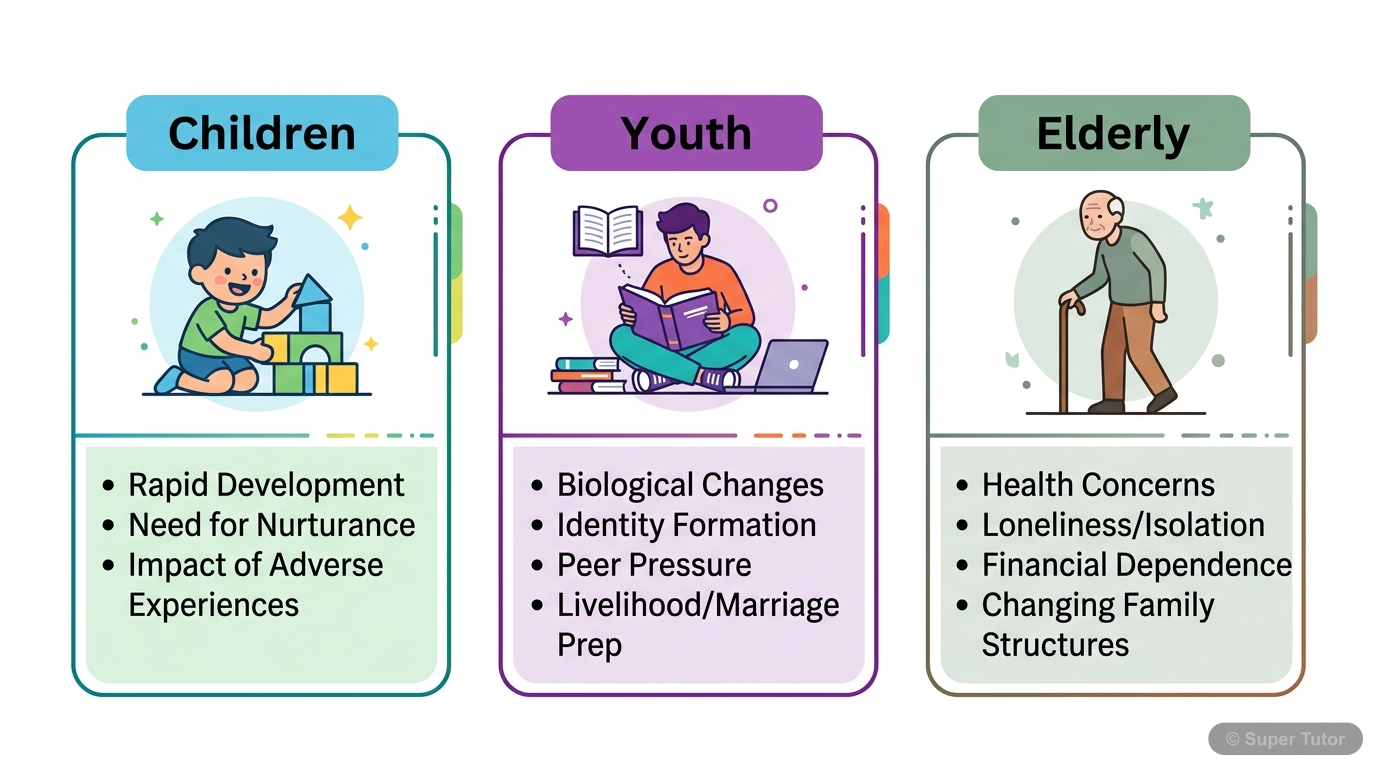
Management of Support Services, Institutions and Programmes for Children, Youth and Elderly
CBSE · Class 12 · Home Science
NCERT Solutions for Management of Support Services, Institutions and Programmes for Children, Youth and Elderly — CBSE Class 12 Home Science.
Interactive on Super Tutor
Studying Management of Support Services, Institutions and Programmes for Children, Youth and Elderly? Get the full interactive chapter.
Quizzes, flashcards, AI doubt-solver and a step-by-step study plan — built for ncert solutions and more.
1,000+ Class 12 students started this chapter today

Super Tutor has 10+ illustrations like this for Management of Support Services, Institutions and Programmes for Children, Youth and Elderly alone — flashcards, concept maps, and step-by-step visuals.
See them allReview Questions — Management of Support Services, Institutions and Programmes for Children, Youth and Elderly
1Why are children, youth and elderly vulnerable?Show solution
Answer:
Children are vulnerable because:
- They are physically and mentally immature and cannot protect or fend for themselves.
- They are completely dependent on adults for their basic needs — food, shelter, clothing, education and emotional security.
- They are easily exploited, abused or neglected if proper care is not provided.
- They lack the cognitive ability to distinguish between safe and unsafe situations.
Youth are vulnerable because:
- They are in a transitional phase between childhood and adulthood, facing identity crises and peer pressure.
- They are susceptible to substance abuse, risky behaviour, unemployment and mental health issues.
- Lack of proper guidance, education or employment opportunities can push them towards anti-social activities.
- They may face issues of early marriage, school dropout, and exploitation in the workforce.
Elderly are vulnerable because:
- Physical decline — reduced strength, mobility, and immunity — makes them dependent on others.
- They often face social isolation, loneliness and neglect, especially in nuclear families.
- Retirement leads to loss of income, social role and status, causing psychological distress.
- They are prone to chronic illnesses and may lack access to adequate healthcare.
- They can be victims of elder abuse, financial exploitation or abandonment.
Conclusion: All three groups — children, youth and elderly — face unique challenges that make them vulnerable and in need of targeted support services and programmes.
2What type of programmes are appropriate for youth?Show solution
Appropriate programmes for youth include:
1. Vocational Training and Skill Development Programmes:
- Equip youth with employable skills in areas like IT, tailoring, carpentry, healthcare, etc.
- Example: Pradhan Mantri Kaushal Vikas Yojana (PMKVY).
2. Educational Support Programmes:
- Scholarships, coaching centres, and bridge courses for school dropouts to re-enter the education system.
3. Health and Reproductive Health Programmes:
- Awareness programmes on nutrition, mental health, substance abuse prevention, and reproductive health.
- Example: Rashtriya Kishor Swasthya Karyakram (RKSK).
4. Sports and Cultural Programmes:
- Provide constructive outlets for energy and talent; promote teamwork and discipline.
5. Counselling and Mental Health Services:
- Career counselling, psychological counselling for stress, depression and identity issues.
6. Leadership and Civic Engagement Programmes:
- Youth parliaments, NSS (National Service Scheme), NCC — to develop leadership, responsibility and community service.
7. Entrepreneurship Development Programmes:
- Training and financial support to help youth start their own enterprises.
- Example: Stand-Up India, Startup India.
8. Anti-Substance Abuse and Crime Prevention Programmes:
- Awareness campaigns and rehabilitation programmes for youth involved in substance abuse.
Conclusion: Programmes for youth should be holistic — addressing education, health, employment, recreation and social participation — so that they can become productive and responsible citizens.
3What are some of the concerns with respect to the elderly?Show solution
Major concerns with respect to the elderly are:
1. Physical Health Concerns:
- Increased susceptibility to chronic diseases such as diabetes, hypertension, arthritis, osteoporosis and heart disease.
- Decline in sensory abilities — vision, hearing and mobility.
- Need for regular medical care, medicines and sometimes long-term nursing care.
2. Mental Health Concerns:
- Risk of dementia, Alzheimer's disease and depression.
- Feelings of loneliness, worthlessness and anxiety, especially when living alone.
3. Economic Concerns:
- Loss of income after retirement; dependence on pension or family support.
- Rising medical expenses can deplete savings.
- Lack of financial security for those in the unorganised sector.
4. Social Concerns:
- Social isolation due to the breakdown of joint family systems.
- Loss of social role and status after retirement.
- Neglect and abandonment by family members.
5. Elder Abuse:
- Physical, emotional, financial or sexual abuse by caregivers or family members.
- Denial of basic needs and rights.
6. Housing and Care Concerns:
- Inadequate housing that is not elder-friendly (e.g., no ramps, unsafe staircases).
- Lack of affordable old-age homes and day-care centres.
7. Psychological Concerns:
- Difficulty in adjusting to the loss of a spouse, friends or peers.
- Feeling of being a burden on the family.
Conclusion: Addressing the concerns of the elderly requires a multi-pronged approach involving family support, community services, government policies and healthcare systems.
4Describe two programmes each for children, youth and elderly.Show solution
---
A. Two Programmes for Children:
1. Integrated Child Development Services (ICDS):
- Launched in 1975, it is one of the world's largest programmes for early childhood care and development.
- It provides services such as supplementary nutrition, immunisation, health check-up, referral services, pre-school non-formal education and nutrition and health education.
- It targets children below 6 years of age, pregnant women and lactating mothers through Anganwadi centres.
2. Mid-Day Meal Scheme (PM POSHAN):
- A centrally sponsored scheme that provides free cooked meals to children in government and government-aided schools (Classes I–VIII).
- It aims to improve nutritional status, increase school enrolment and attendance, and reduce dropout rates.
- It also addresses hunger and malnutrition among school-going children.
---
B. Two Programmes for Youth:
1. Nehru Yuva Kendra Sangathan (NYKS):
- Established in 1972 under the Ministry of Youth Affairs and Sports.
- It aims to involve rural youth in nation-building activities through youth clubs.
- Activities include skill development, awareness campaigns, sports, cultural programmes and community service.
2. Pradhan Mantri Kaushal Vikas Yojana (PMKVY):
- A flagship scheme of the Ministry of Skill Development and Entrepreneurship.
- It provides short-term skill training to youth to make them employable in various sectors.
- Successful trainees receive a government-recognised certificate and financial reward.
---
C. Two Programmes for the Elderly:
1. National Programme for Health Care of the Elderly (NPHCE):
- Launched by the Ministry of Health and Family Welfare.
- It provides dedicated healthcare services to the elderly at district hospitals, community health centres and primary health centres.
- Services include geriatric OPDs, physiotherapy, and training of healthcare workers in geriatric care.
2. Integrated Programme for Older Persons (IPOP):
- A scheme by the Ministry of Social Justice and Empowerment.
- It provides financial assistance to NGOs and institutions to run old-age homes, day-care centres, mobile medicare units and multi-service centres for the elderly.
- It aims to improve the quality of life of older persons by providing basic amenities like shelter, food, medical care and entertainment.
---
Conclusion: These programmes reflect the government's commitment to the welfare of children, youth and the elderly through targeted interventions.
5What advice will you give to someone who is planning to set up her/his own institution for children/youth/elderly?Show solution
Advice for setting up an institution for children/youth/elderly:
1. Identify the Need and Target Group:
- Conduct a needs assessment in the community to understand what services are lacking.
- Clearly define the target group — age, gender, socio-economic background — and the specific services to be offered.
2. Develop a Vision and Mission:
- Have a clear vision (long-term goal) and mission (purpose) for the institution.
- This will guide all planning and activities.
3. Legal Registration:
- Register the institution as a Trust, Society or Section 8 Company under the relevant laws (e.g., Societies Registration Act, Indian Trusts Act).
- Obtain necessary licences and permissions from local authorities and the government.
4. Develop a Business/Programme Plan:
- Prepare a detailed plan covering objectives, activities, staffing, budget and timeline.
- Plan for both short-term and long-term sustainability.
5. Secure Funding:
- Identify sources of funding — government grants, CSR funds, donations, international aid or self-funding.
- Apply for government schemes that provide financial assistance to NGOs working with children, youth or the elderly.
6. Infrastructure and Facilities:
- Ensure the physical space is safe, accessible and appropriate for the target group.
- For children: child-friendly, safe environment.
- For elderly: barrier-free, elder-friendly infrastructure.
7. Recruit Qualified and Compassionate Staff:
- Hire trained professionals — social workers, counsellors, healthcare workers, teachers.
- Conduct background checks, especially for staff working with children.
- Provide regular training and capacity building.
8. Develop Programmes and Activities:
- Design evidence-based, culturally sensitive programmes that address the holistic needs of the target group.
9. Build Community Partnerships:
- Collaborate with local government bodies, hospitals, schools, NGOs and community leaders.
- Community involvement ensures sustainability and acceptance.
10. Monitoring and Evaluation:
- Set up a system to regularly monitor and evaluate the impact of the programmes.
- Use feedback to improve services continuously.
11. Ethical Practices:
- Maintain confidentiality, dignity and rights of the beneficiaries at all times.
- Follow child protection policies if working with children.
Conclusion: Setting up an institution is a challenging but rewarding endeavour. With proper planning, legal compliance, qualified staff and community support, one can create a meaningful and sustainable institution that makes a real difference in the lives of vulnerable groups.
6Describe the knowledge and skills you will need in order to pursue a career in management of institutions and programmes for children/youth/elderly.Show solution
A. Knowledge Required:
1. Knowledge of Human Development:
- Understanding of physical, cognitive, emotional and social development across the lifespan — childhood, adolescence and old age.
- Knowledge of the specific needs, challenges and vulnerabilities of each age group.
2. Knowledge of Social Issues:
- Awareness of poverty, gender inequality, disability, abuse, neglect and other social issues that affect children, youth and the elderly.
3. Knowledge of Laws and Policies:
- Familiarity with relevant laws such as the Protection of Children from Sexual Offences (POCSO) Act, Juvenile Justice Act, Rights of Persons with Disabilities Act, Maintenance and Welfare of Parents and Senior Citizens Act, etc.
- Knowledge of government schemes and programmes for the target groups.
4. Knowledge of Programme Planning and Management:
- Understanding of how to design, implement, monitor and evaluate social programmes.
5. Knowledge of Health and Nutrition:
- Basic understanding of health, nutrition and hygiene needs of the target groups.
6. Knowledge of Research Methods:
- Ability to conduct needs assessments, surveys and evaluations to understand community needs and programme effectiveness.
---
B. Skills Required:
1. People Skills (Interpersonal Skills):
- Ability to communicate effectively with beneficiaries, families, staff and stakeholders.
- Empathy, patience and sensitivity — especially when working with vulnerable populations.
- Counselling and listening skills.
2. Administrative and Management Skills:
- Ability to plan, organise, coordinate and supervise the functioning of an institution.
- Financial management — budgeting, accounting and resource allocation.
- Record-keeping and documentation skills.
3. Leadership Skills:
- Ability to motivate and guide a team of workers towards common goals.
- Decision-making and problem-solving abilities.
4. Communication Skills:
- Written communication for report writing, proposals and correspondence.
- Oral communication for presentations, meetings and community outreach.
5. Networking and Collaboration Skills:
- Ability to build partnerships with government agencies, NGOs, donors and community organisations.
6. Research and Analytical Skills:
- Ability to collect, analyse and interpret data to improve programmes.
- Skills in monitoring and evaluation.
7. Crisis Management Skills:
- Ability to handle emergencies, conflicts and difficult situations calmly and effectively.
8. Computer and Technology Skills:
- Proficiency in using computers for data management, communication and reporting.
---
C. Personal Qualities:
- Commitment and dedication to social service.
- Patience, compassion and non-judgmental attitude.
- Ethical conduct and integrity.
Conclusion: A career in this field is both challenging and fulfilling. A combination of relevant academic qualifications (such as a degree in Social Work, Human Development, Psychology or Home Science), practical experience and the above knowledge and skills will prepare one to effectively manage institutions and programmes for children, youth and the elderly.
Practical 1 — Care and Welfare of the Elderly
Practical 1Theme: Care and Welfare of the Elderly. Task: To prepare a script and enact a play about dynamics in a large joint family. Purpose: In families there are people of all ages. A healthy, happy family is one where the needs and requirements of members of every age-group are fulfilled and each member has an important place in the family. Role-play is a powerful technique to communicate these dynamics.Show solution
---
Step 1 — Formation of Group:
A group of 5–6 students is selected. Roles are assigned as follows:
- Grandfather (Dada ji) — 70 years old, retired
- Grandmother (Dadi ji) — 65 years old, homemaker
- Father — 45 years old, working professional
- Mother — 42 years old, working/homemaker
- Teenage grandchild (15 years) — school student
- Young grandchild (8 years) — primary school student
---
Step 2 — Sample Script (15-minute Role Play):
Setting: Evening in a joint family home. The family is gathered in the living room.
Scene 1 — The Problem:
The teenage grandchild is busy on the phone and ignores Dada ji who wants to share a story from his youth. Dadi ji is in the kitchen, feeling tired but still cooking because she feels it is her duty.
Dada ji: *(to grandchild)* Beta, come sit with me. I want to tell you about how we used to celebrate festivals when I was young.
Grandchild: *(distracted)* Not now, Dada ji. I'm busy.
Father: *(entering)* What's going on? *(notices Dada ji looking sad)* Beta, put the phone down. Dada ji is talking to you.
Scene 2 — The Discussion:
Mother comes from the kitchen and notices Dadi ji struggling to carry a heavy pot.
Mother: Maa ji, please sit down. I will finish the cooking. You have done enough for this family. Now it is our turn to take care of you.
Dadi ji: *(smiling)* I feel useless if I don't do anything.
Mother: You are not useless at all! You take care of the little one, you tell us stories, you keep the family together. That is the most important work.
Scene 3 — Resolution:
The family sits together for dinner. The teenage grandchild apologises to Dada ji and asks him to share his story. The whole family listens with interest. The young child sits on Dadi ji's lap.
Father: *(to children)* Our grandparents are our roots. They have given us everything. It is our responsibility to respect them, listen to them and make sure they are happy and healthy.
Dada ji: *(emotionally)* This is all I need — to feel that I belong here, that I am still important.
*(The family shares a warm group hug.)*
---
Step 3 — Discussion and Analysis (Post Role-Play):
After the role-play, the teacher guides a discussion on the following points:
1. Role of the elderly in the family:
- Grandparents contribute wisdom, experience, emotional support and cultural continuity.
- They play an important role in childcare and passing on values and traditions.
2. Attitude of younger members:
- Younger members should show respect, patience and empathy towards the elderly.
- They should involve the elderly in family decisions and activities.
- Ignoring or neglecting the elderly has negative emotional consequences for them.
3. Well-being of the family:
- A family where every member — young and old — feels valued and included is a healthy family.
- Intergenerational bonding strengthens family ties and provides emotional security to all members.
4. Challenges faced by the elderly in modern families:
- Loneliness, feeling of being a burden, health issues, and loss of role.
- The shift from joint to nuclear families has increased these challenges.
---
Conclusion:
This role-play activity helps students develop empathy and understanding towards the elderly. It highlights the importance of intergenerational respect and the need to ensure the physical, emotional and social well-being of elderly family members. A family that honours its elderly members is a truly healthy and happy family.
Practical 2 — Making a Small Booklet of Four-Line Poems
Practical 2Theme: Making a small booklet of four-line poems on environment, birds and animals, with illustrations. Purpose: Providing students learning experiences of developing and preparing play material and poem booklets so that young children's language development could be promoted.Show solution
---
Materials Required:
- Chart paper or old notebook covers
- Scissors and ruler
- Glue/adhesive
- Coloured pens, wax crayons or sketch pens
- Old magazines and newspapers (for pictures)
- Hole punch
- String or ribbon
- Bold markers for writing
---
Step-by-Step Procedure:
Step 1 — Form Groups and Choose a Theme:
Students form groups of six. Each group selects one theme from: environment, birds, animals, water, nature, seasons, etc.
Step 2 — Write Four-Line Poems:
Each group writes 4–5 original four-line poems related to their chosen theme. The language should be simple, rhythmic and suitable for young children.
*Sample Poems:*
Theme: Birds
Theme: Environment
Theme: Water
Step 3 — Prepare the Cards:
- From one sheet of chart paper, cut cards of size .
- Old notebook covers can also be used as cards.
- Prepare 4–5 cards (one poem per card) plus one cover page.
Step 4 — Illustrate the Cards:
- Collect relevant pictures from magazines/newspapers related to the theme.
- Alternatively, draw and paint original illustrations.
- Stick the picture on the card using glue, or draw it directly on the card.
Step 5 — Write the Poem:
- Write the poem on the card using bold, big letters with coloured pens or wax crayons.
- Ensure the writing is clear, neat and attractive for young children.
Step 6 — Prepare the Cover Page:
- Design a cover page with the title of the booklet written in large, colourful letters.
- Decorate the cover with relevant pictures or drawings.
Step 7 — Bind the Booklet:
- Arrange the cards in order: cover page first, then poem cards.
- Make holes in the top-left corner of each card using a hole punch.
- Thread a string or ribbon through the holes and tie it securely.
- The booklet of poems is ready!
---
Educational Value of the Activity:
1. Language Development: Rhyming poems help young children develop phonological awareness, vocabulary and listening skills.
2. Cognitive Development: Illustrations help children connect words with images, promoting concept formation.
3. Creativity: Students develop creativity in writing, drawing and designing.
4. Environmental Awareness: Themes like environment, birds and animals promote awareness and love for nature.
5. Fine Motor Skills: Cutting, pasting and writing develop fine motor skills in both the students making the booklet and the children using it.
---
Conclusion:
This practical activity provides students with hands-on experience in developing educational play material for young children. The poem booklet is an effective, low-cost resource that can be used in Anganwadis, pre-schools and homes to promote language development and a love for reading in young children.
Stuck on a step?
Ask Super Tutor AI to explain any solution on this page in a simpler way — free, 24x7.
Ask a Doubt FreeFrequently Asked Questions
What are the important topics in Management of Support Services, Institutions and Programmes for Children, Youth and Elderly for CBSE Class 12 Home Science?
How to score full marks in Management of Support Services, Institutions and Programmes for Children, Youth and Elderly — CBSE Class 12 Home Science?
Where can I get free NCERT Solutions for Management of Support Services, Institutions and Programmes for Children, Youth and Elderly Class 12 Home Science?
Sources & Official References
- NCERT Official — ncert.nic.in
- CBSE Academic — cbseacademic.nic.in
- CBSE Official — cbse.gov.in
- National Education Policy 2020 — education.gov.in
Content is aligned to the official syllabus. Refer to the board website for the latest curriculum.
More resources for Management of Support Services, Institutions and Programmes for Children, Youth and Elderly
Important Questions
Practice with board exam-style questions
Syllabus
What topics to cover
Revision Notes
Key points for last-minute revision
Study Plan
Step-by-step plan to ace this chapter
Flashcards
Quick-fire cards for active recall
Formula Sheet
All formulas in one place
Chapter Summary
Understand the chapter at a glance
Practice Quiz
Test yourself with a quick quiz
Concept Maps
See how topics connect visually
For serious students
Get the full Management of Support Services, Institutions and Programmes for Children, Youth and Elderly chapter — for free.
Quizzes, flashcards, AI doubt-solver and a step-by-step study plan for CBSE Class 12 Home Science.