Chapter 1 of 14
Concept Maps
Judiciary — Concept Maps
CBSE · Class 12 · Legal Studies
4 concept maps of Judiciary for CBSE Class 12 Legal Studies, each also written out as a text outline. Part of the CBSE Class 12 Legal Studies syllabus.
5 concepts
Interactive on Super Tutor
Studying Judiciary? Get the full interactive chapter.
Quizzes, flashcards, AI doubt-solver and a step-by-step study plan — built for concept maps and more.
Free trial, no card needed.
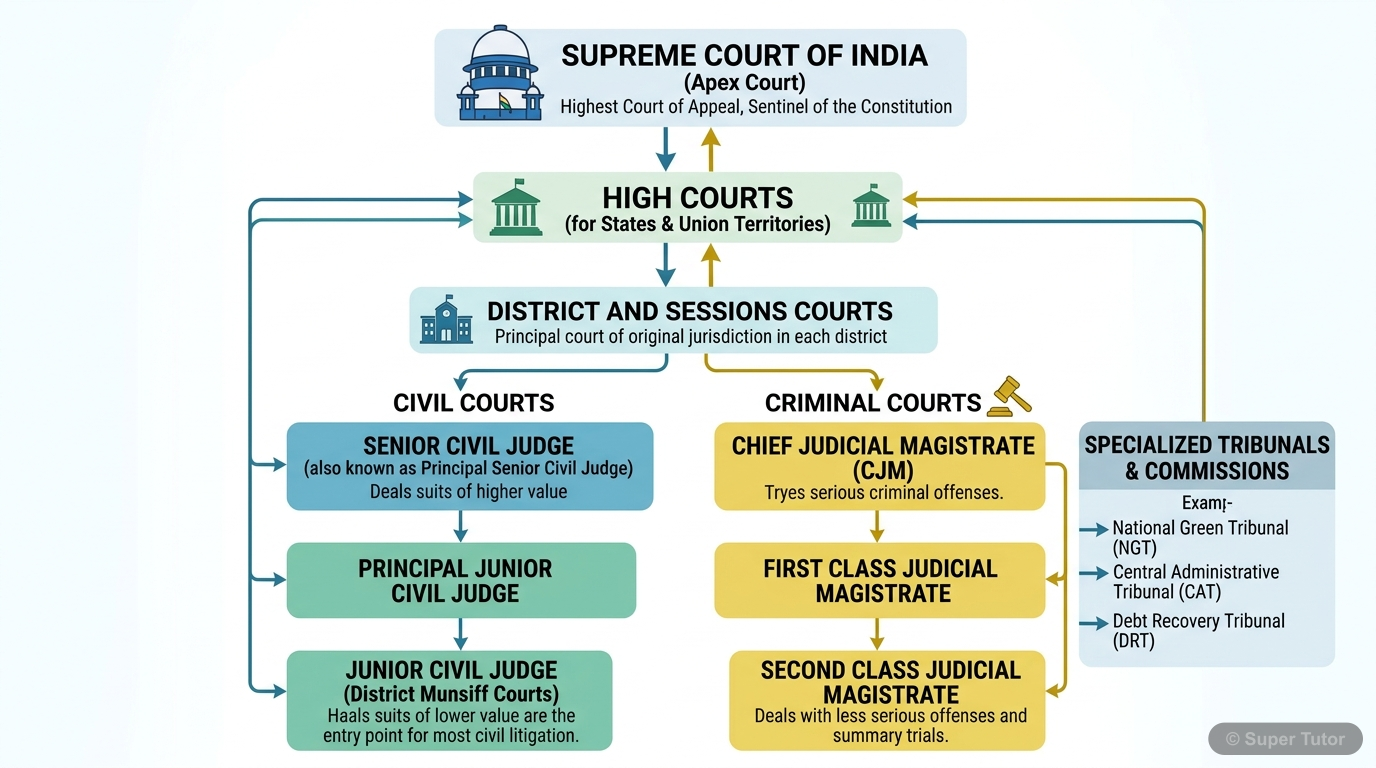
Super Tutor
Learn better with visuals Super Tutor pairs illustrations like this with notes and quizzes for Judiciary.
4 Concept Maps
Hierarchical Structure of Indian Judiciary
The map in words
- Supreme Court New Delhi - 34 Judges
- High Courts State Level - 25 Courts
- District Courts District & Sessions Judge
- Sub-ordinate Courts Civil & Criminal
- Junior Civil Judge
- Senior Civil Judge
- Chief Judicial Magistrate
- First Class Magistrate
- Sub-ordinate Courts Civil & Criminal
- District Courts District & Sessions Judge
- High Courts State Level - 25 Courts
- Tribunals Specialized Bodies
- Administrative Tribunals
- Consumer Forums
- Green Tribunal
Indian Judiciary: Complete Overview
The map in words
- Indian Judiciary
- Structure
- Supreme Court
- CJI plus 33 judges
- Apex court
- High Courts
- 25 High Courts
- State level
- Subordinate Courts
- District Courts
- Civil and Criminal
- Supreme Court
- Independence
- Constitutional Safeguards
- Article 50
- Security of tenure
- Salary Protection
- Consolidated Fund
- No legislative vote
- Post Retirement
- Practice restrictions
- Constitutional Safeguards
- Powers
- Original Jurisdiction
- Inter state disputes
- Article 131
- Appellate Jurisdiction
- From High Courts
- Special Leave
- Writ Jurisdiction
- Article 32
- Five writs
- Original Jurisdiction
- Judicial Review
- Legislative Actions
- Constitutional validity
- Executive Actions
- Natural justice
- Basic Structure
- Kesavananda Bharati
- Legislative Actions
- Appointments
- Collegium System
- SC: CJI plus 4
- HC: CJ plus 2
- Qualifications
- Experience requirements
- Removal
- Impeachment process
- Collegium System
- Structure
Indian Judiciary Structure Overview
The map in words
- Indian Judiciary
- Structure
- Supreme Court
- 34 Judges
- Apex Court
- New Delhi
- High Courts
- 25 Courts
- State Level
- Appellate
- Subordinate Courts
- District Courts
- Civil Courts
- Criminal Courts
- Supreme Court
- Independence
- Security Tenure
- Fixed Salary
- Article 50
- No Practice After
- Functions
- Original Jurisdiction
- Appellate Jurisdiction
- Advisory Jurisdiction
- Judicial Review
- PIL
- Appointments
- Collegium System
- Presidential Order
- Consultation Process
- Three Judges Cases
- Structure
Indian Judiciary
The map in words
- Indian Judiciary
- Structure and Hierarchy
- Constitutional Mandate
- Judicial Powers
- Legal Officers
- Access to Justice
Explore these maps interactively
Explore DiagramsFrequently Asked Questions
What are the important topics in Judiciary for CBSE Class 12 Legal Studies?
Key topics in Judiciary include Structure and Hierarchy of Indian Judiciary, Independence and Constitutional Safeguards, Supreme Court: Jurisdiction and Powers, Public Interest Litigation and Judicial Activism. Study these first, then practise questions on each for the CBSE Class 12 board exam.
What do the concept maps for Judiciary show?
The 4 maps show how the ideas in Judiciary connect: Hierarchical Structure of Indian Judiciary; Indian Judiciary: Complete Overview. Each map is also written out as an outline on this page.
Sources & Official References
- NCERT Official — ncert.nic.in
- CBSE Academic — cbseacademic.nic.in
- CBSE Official — cbse.gov.in
- National Education Policy 2020 — education.gov.in
Content is aligned to the official syllabus. Refer to the board website for the latest curriculum.
More resources for Judiciary
For serious students
Get the full Judiciary chapter — start free.
Quizzes, flashcards, an AI doubt solver and a study plan for CBSE Class 12 Legal Studies. Free to start, no card needed.