Journey Inside the Atom — Flashcards
CBSE · Class 9 · Science
72 flashcards for Journey Inside the Atom (CBSE Class 9 Science) to test yourself on key terms and facts. Part of the CBSE Class 9 Science syllabus.
Interactive on Super Tutor
Studying Journey Inside the Atom? Get the full interactive chapter.
Quizzes, flashcards, AI doubt-solver and a step-by-step study plan — built for flashcards and more.
Free trial, no card needed.
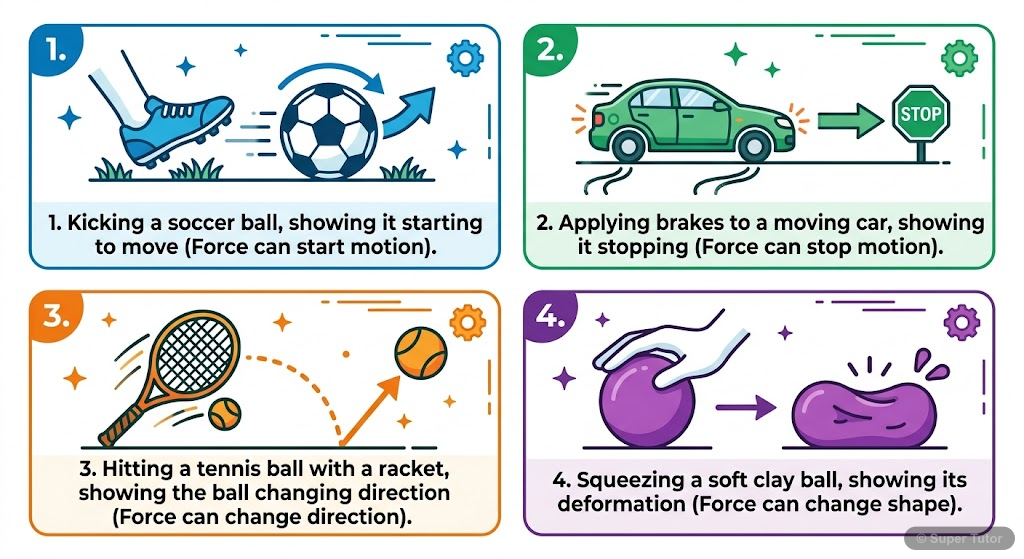
Learn better with visuals Super Tutor pairs illustrations like this with notes and quizzes for Journey Inside the Atom.
What is matter made of at the smallest level?
Answer
Matter is made of tiny particles called atoms. Atoms are the basic building blocks of matter.
सूक्ष्मतम स्तर पर पदार्थ किससे बना होता है?
Answer
पदार्थ परमाणु कहलाने वाले बहुत छोटे कणों से बना होता है। परमाणु पदार्थ के मूल निर्माण खंड हैं।…
परमाणु कहलाने वाले अविभाज्य कणों का विचार सबसे पहले किसने दिया?
Answer
आचार्य कणाद ने बताया कि पदार्थ का बार-बार विभाजन करने पर सबसे छोटे कण, जिने परमानु कहा जाता है, मिलेंगे। उनके विचार संस्कृत ग्रंथ वैशेषिक सूत्र में दर्ज हैं।…
Who first suggested the idea of indivisible particles called parmanus?
Answer
Acharya Kanada suggested that repeated division of matter would reach the smallest particles called parmanus. His ideas are recorded in the Sanskrit text Vaisesika Sutras.
What did Leucippus and Democritus call indivisible particles?
Answer
They called indivisible particles atomos, which means indivisible.
ल्यूकिप्पस और डेमोक्रिटस ने अविभाज्य कणों को क्या कहा?
Answer
उन्होंने अविभाज्य कणों को atomos कहा, जिसका अर्थ अविभाज्य है।…
परमाणु के प्राचीन विचार और डाल्टन के परमाणु सिद्धांत में क्या अंतर है?
Answer
प्राचीन विचार काल्पनिक और दार्शनिक था, जबकि डाल्टन का परमाणु सिद्धांत पदार्थ किस प्रकार बना है, इसका पहला वैज्ञानिक वर्णन था और यह वैज्ञानिक प्रयोगों पर आधारित था।…
Why is the ancient idea of the atom different from Dalton's atomic theory?
Answer
The ancient idea was imaginary and philosophical, while Dalton's atomic theory was the first scientific description of how matter is made and was based on scientific experiments.
+64 more flashcards
Practise AllFrequently Asked Questions
What are the important topics in Journey Inside the Atom for CBSE Class 9 Science?
How many flashcards are available for Journey Inside the Atom?
How should I revise Journey Inside the Atom for Class 9 exams?
Sources & Official References
- NCERT Official — ncert.nic.in
- CBSE Academic — cbseacademic.nic.in
- CBSE Official — cbse.gov.in
- National Education Policy 2020 — education.gov.in
Content is aligned to the official syllabus. Refer to the board website for the latest curriculum.
More resources for Journey Inside the Atom
Practice Quiz
Test yourself with a quick quiz
Important Questions
Exam-style questions with answers
Revision Notes
Key points for last-minute revision
Formula Sheet
The chapter's formulas in one place
Chapter Summary
Understand the chapter at a glance
Concept Maps
See how topics connect
Study Plan
Step-by-step plan for this chapter
Syllabus
What topics to cover
NCERT Solutions
Every textbook question solved step by step
For serious students
Get the full Journey Inside the Atom chapter — start free.
Quizzes, flashcards, an AI doubt solver and a study plan for CBSE Class 9 Science. Free to start, no card needed.