Journey Inside the Atom — Chapter Summary
CBSE · Class 9 · Science
Summary of Journey Inside the Atom for CBSE Class 9 Science. Key concepts: Acharya Kanada proposed, Dalton proposed in 1808 that and J.
Interactive on Super Tutor
Studying Journey Inside the Atom? Get the full interactive chapter.
Quizzes, flashcards, AI doubt-solver and a step-by-step study plan — built for chapter summary and more.
Free trial, no card needed.
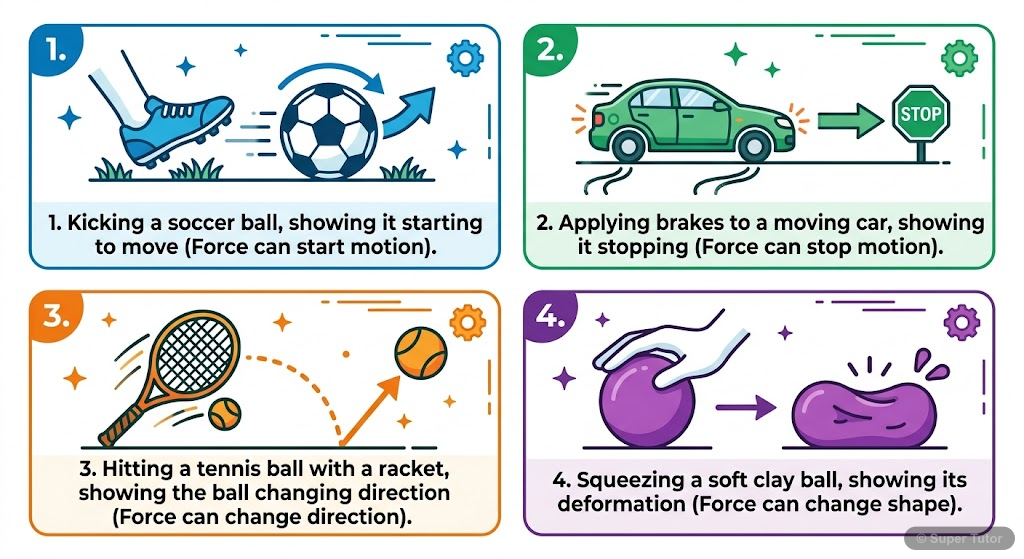
Learn better with visuals Super Tutor pairs illustrations like this with notes and quizzes for Journey Inside the Atom.
Overview
Matter is made of tiny particles called atoms. The idea of the atom began as a philosophical thought in ancient India and Greece, and later became a scientific theory through experiments. The chapter traces how scientists changed atomic models step by step after new evidence was found. It explains t
Key Concepts
Acharya Kanada proposed indivisible particles called
Acharya Kanada proposed indivisible particles called parmanus, and Leucippus and Democritus proposed atomos. This was an imaginary idea, not based on
Dalton proposed in 1808 that matter
Dalton proposed in 1808 that matter is made of indivisible atoms based on scientific experiments. He also introduced pictorial symbols for elements in
J
J. J. Thomson discovered the electron in 1897 using cathode ray tube experiments. Electrons are negatively charged subatomic particles with negligible
Thomson described the atom as
Thomson described the atom as a positively charged sphere with electrons distributed throughout it, like plums in pudding or seeds in a watermelon.
Geiger and Marsden worked under Rutherford
Geiger and Marsden worked under Rutherford in 1911 and tested Thomson's model by firing alpha particles at thin gold foil. Most particles passed throu
Learning Objectives
- Understand how the idea of the atom developed from ancient thought to scientific theory
- Describe the discoveries of electron, proton, and neutron
- Explain Thomson's, Rutherford's, and Bohr's models of the atom
- Understand atomic number, mass number, and electronic configuration
- Learn the meaning of valency, isotopes, and isobars
Frequently Asked Questions
What are the important topics in Journey Inside the Atom for CBSE Class 9 Science?
How should I revise Journey Inside the Atom for Class 9 exams?
Sources & Official References
- NCERT Official — ncert.nic.in
- CBSE Academic — cbseacademic.nic.in
- CBSE Official — cbse.gov.in
- National Education Policy 2020 — education.gov.in
Content is aligned to the official syllabus. Refer to the board website for the latest curriculum.
More resources for Journey Inside the Atom
Practice Quiz
Test yourself with a quick quiz
Important Questions
Exam-style questions with answers
Revision Notes
Key points for last-minute revision
Formula Sheet
The chapter's formulas in one place
Concept Maps
See how topics connect
Study Plan
Step-by-step plan for this chapter
Flashcards
Quick-fire cards for active recall
Syllabus
What topics to cover
NCERT Solutions
Every textbook question solved step by step
For serious students
Get the full Journey Inside the Atom chapter — start free.
Quizzes, flashcards, an AI doubt solver and a study plan for CBSE Class 9 Science. Free to start, no card needed.