Journey Inside the Atom — Syllabus
CBSE · Class 9 · Science
What Journey Inside the Atom covers in CBSE Class 9 Science: 4 topics, for the 2026-27 session. Part of the CBSE Class 9 Science syllabus.
Interactive on Super Tutor
Studying Journey Inside the Atom? Get the full interactive chapter.
Quizzes, flashcards, AI doubt-solver and a step-by-step study plan — built for syllabus and more.
Free trial, no card needed.
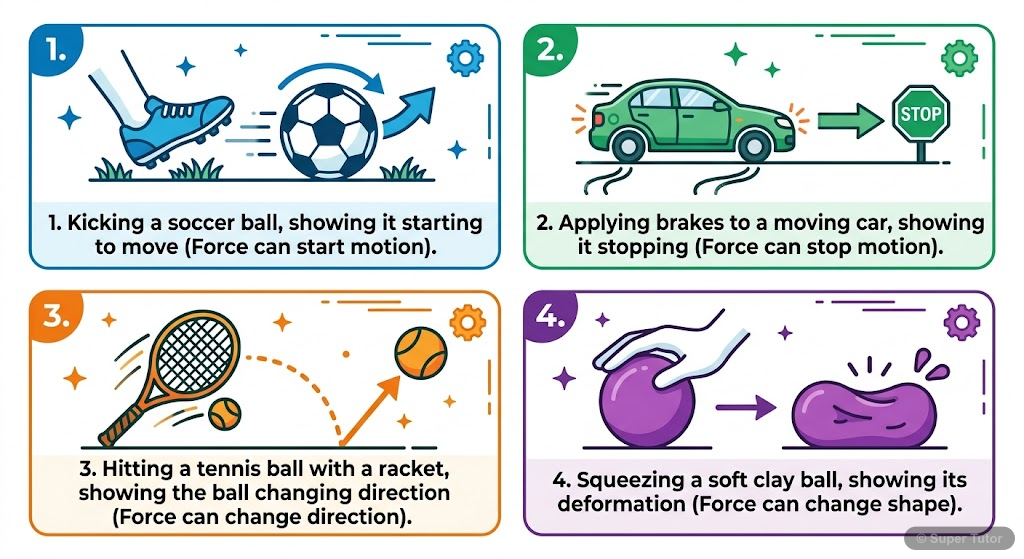
Learn better with visuals Super Tutor pairs illustrations like this with notes and quizzes for Journey Inside the Atom.
Topics in Journey Inside the Atom
1. Origin and Development of Atomic Ideas
- Acharya Kanada suggested that matter divided repeatedly reaches the smallest particles called parmanus.
- Leucippus and Democritus suggested indivisible particles called atomos, meaning indivisible.
- These early ideas were imaginary and not based on experiments.
2. Discovery of Subatomic Particles and Atomic Models
- J. J. Thomson discovered the electron in 1897 using cathode ray tube experiments.
- The electron has a negative charge of -1.602 × 10^-19 C, but it is taken as -1 by convention.
- Thomson proposed the plum pudding model, also compared to a watermelon.
3. Atomic Number, Mass Number, and Electronic Configuration
- Atomic number (Z) is the number of protons in the nucleus.
- For a neutral atom, number of protons equals number of electrons.
- Hydrogen has atomic number 1 with 1 proton and 1 electron, and no neutron.
4. Isotopes, Isobars, and Atomic Mass
- Atoms of the same element can have different numbers of neutrons.
- Isotopes are atoms of the same element with the same atomic number but different mass numbers.
- Protium, deuterium, and tritium are isotopes of hydrogen.
Key Concepts
Central concept: Atomic structure and the development of ideas about the atom
Work through every topic in Journey Inside the Atom with notes and quizzes
Start This ChapterFrequently Asked Questions
What are the important topics in Journey Inside the Atom for CBSE Class 9 Science?
How should I revise Journey Inside the Atom for Class 9 exams?
Sources & Official References
- NCERT Official — ncert.nic.in
- CBSE Academic — cbseacademic.nic.in
- CBSE Official — cbse.gov.in
- National Education Policy 2020 — education.gov.in
Content is aligned to the official syllabus. Refer to the board website for the latest curriculum.
More resources for Journey Inside the Atom
Practice Quiz
Test yourself with a quick quiz
Important Questions
Exam-style questions with answers
Revision Notes
Key points for last-minute revision
Formula Sheet
The chapter's formulas in one place
Chapter Summary
Understand the chapter at a glance
Concept Maps
See how topics connect
Study Plan
Step-by-step plan for this chapter
Flashcards
Quick-fire cards for active recall
NCERT Solutions
Every textbook question solved step by step
For serious students
Get the full Journey Inside the Atom chapter — start free.
Quizzes, flashcards, an AI doubt solver and a study plan for CBSE Class 9 Science. Free to start, no card needed.