Journey Inside the Atom — NCERT Solutions
CBSE · Class 9 · Science
NCERT Solutions for Journey Inside the Atom, CBSE Class 9 Science: 60 textbook questions solved step by step. Part of the CBSE Class 9 Science syllabus.
Interactive on Super Tutor
Studying Journey Inside the Atom? Get the full interactive chapter.
Quizzes, flashcards, AI doubt-solver and a step-by-step study plan — built for NCERT solutions and more.
Free trial, no card needed.
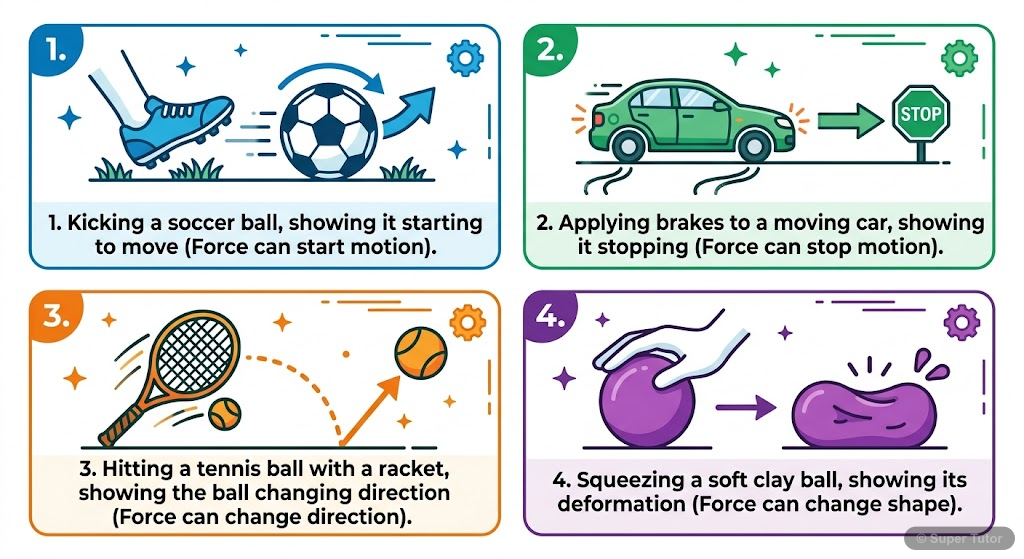
Learn better with visuals Super Tutor pairs illustrations like this with notes and quizzes for Journey Inside the Atom.
The first 30 solutions are open to read. The other 30 are free with a Super Tutor account.
Think It Over
1Are atoms the smallest indivisible particles?Show solution
No. The chapter says atoms were once thought to be indivisible, but later experiments showed that atoms are made of smaller subatomic particles like electrons, protons, and neutrons. So atoms are not the smallest indivisible particles.
2Why do electrons not fall into the nucleus even though they are attracted to protons in it?Show solution
In Bohr's model, electrons move in fixed energy levels or shells called stationary states. While moving in one allowed shell, an electron does not lose energy, so it does not spiral into the positively charged nucleus. Rutherford's model could not explain this stability, but Bohr's model did.
3Why did scientists keep modifying atomic models?Show solution
Scientists kept modifying atomic models because new experiments gave new evidence that earlier models could not explain. For example, the gold foil experiment showed that Thomson's model was incorrect, and Rutherford's model still could not explain atomic stability. So models were improved step by step as science advanced.
Pause and Ponder
1(i)Suppose you made up your own 'atom', as Thomson described, using clay for the positive charge and small beads for the electrons spread through it. What will happen if:Show solution
If the positive charge in the clay is less than the total negative charge of the beads, the model would not be neutral; it would have a net negative charge. If the clay itself carries a little negative charge, that would reduce the positive charge further, so it would again fail to represent a neutral atom. A neutral atom needs total positive and negative charges to be equal.
2Could an orange or a lemon, which also contain seeds inside soft pulp, be a good comparison? In what ways does it match Thomson's idea and where does it fall short?Show solution
Yes, an orange or a lemon can be a rough comparison because, like Thomson's idea, it has seeds embedded inside soft pulp. The pulp can represent the positive charge and the seeds the electrons. But it falls short because in Thomson's model the electrons are spread throughout the positive sphere, not just placed in one region, and the comparison does not explain the exact balance of charge in an atom.
3Why did Thomson conclude that electrons are present in all atoms?Show solution
Thomson concluded that electrons are present in all atoms because the nature of cathode rays was independent of the material of the cathode and the gas in the tube. This showed that the negatively charged particles were a fundamental component of all atoms, not just of one particular substance.
4What do you think would happen if -particles were replaced with negatively charged particles in Rutherford's gold foil experiment?Show solution
If negatively charged particles were used instead of alpha particles, they would be repelled by the electrons in the atom and attracted toward the positive nucleus. Their path would be affected very differently from alpha particles. Since Rutherford's experiment depended on the behavior of positively charged alpha particles, replacing them with negative particles would not give the same scattering observations.
5Rutherford found that a few -particles bounced back sharply. How does this single surprising result completely rule out Thomson's 'plum pudding model' of the atom?Show solution
A few alpha particles bouncing back showed that the atom could not be a uniform sphere of positive charge as Thomson proposed. If positive charge were spread evenly, no alpha particle would have met a very concentrated, massive centre and bounced back sharply. The result proved that most of the atom is empty space and that nearly all the positive charge and mass are concentrated in a tiny nucleus. That contradicts the plum pudding model completely.
6If you could ask Rutherford one question about his work, what would it be?Show solution
A good question would be: How did you infer that the atom has a tiny, dense nucleus from the scattering of only a few alpha particles? This would help understand the reasoning behind Rutherford's conclusion.
7Assertion (A): Rutherford concluded that most of the mass of an atom is concentrated in a small region at the centre called the nucleus.
Reason (R): According to Thomson's model, electrons are embedded in a uniformly distributed positive charge sphere.
Choose the correct option:Show solution
Both statements are true. Rutherford did conclude that most of the mass is concentrated in a small central nucleus, and Thomson's model did describe electrons embedded in a uniformly distributed positive sphere. However, R is not the correct explanation of A; Rutherford's conclusion came from the gold foil experiment, not from Thomson's description. So the correct option is (ii).
8Imagine you are a scientist who has discovered a new element. Name this element after yourself and justify that the symbol you have chosen follows the IUPAC rules.Show solution
One possible name is Chatgptium with symbol Cg. This follows IUPAC-style rules because the symbol has two letters, the first letter is capital and the second is lowercase. If I chose a symbol, I would make sure it uses the element name properly and follows the convention of writing symbols with a capital first letter and a lowercase second letter.
9What problems could arise if every scientist used different symbols for the same element?Show solution
If different scientists used different symbols for the same element, it would create confusion and make communication difficult. Scientists around the world would not know whether the same symbol referred to the same element, so it would be hard to compare results, write formulas, and share research clearly.
10An atom with an atomic number of 26 has 56 nucleons. Find out its number of electrons, protons and neutrons.Show solution
Atomic number , so the atom has 26 protons. Since the atom is neutral, it also has 26 electrons. The mass number (nucleons) is 56, so
So the atom has 26 electrons, 26 protons, and 30 neutrons.
11The nucleus of an atom contains 20 protons. If its mass number is 41, find the number of neutrons in it.Show solution
Mass number and protons .
Using
the number of neutrons is 21.
12An atom has 18 neutrons and an atomic number of 17. What is its mass number?Show solution
Atomic number , so protons = 17. Neutrons = 18.
Mass number
So the mass number is 35.
13An atom has 11 electrons. Find the number of neutrons in it.Show solution
The atom has mass number and 11 electrons. Since the atom is neutral, it has 11 protons. Then
So the number of neutrons is 12.
14Identify the number of electrons in the outermost shell of the following elements:Show solution
Use the electronic configurations from the chapter:
- Carbon, : so outermost shell has 4 electrons.
- Fluorine, : so outermost shell has 7 electrons.
- Silicon, : so outermost shell has 4 electrons.
So the numbers are 4, 7, 4.
15Write the electronic configuration of the elements having atomic numbers 12, 16 and 18.Show solution
From the table in the chapter:
- Atomic number 12 (magnesium) has electronic configuration 2, 8, 2.
- Atomic number 16 (sulfur) has electronic configuration 2, 8, 6.
- Atomic number 18 (argon) has electronic configuration 2, 8, 8.
16Solve this riddle: I am an atom with a mass number of 23 and 11 protons. I am a soft metal and react vigorously with water. Who am I and how many neutrons do I have? You can also create one such riddle.Show solution
An atom with 11 protons has atomic number 11, which is sodium (Na). Its mass number is 23, so
So the atom is sodium and it has 12 neutrons. A suitable riddle of this type could be made using mass number, atomic number, and a property of the element.
17Two different atoms have 11 protons each, but one has 12 neutrons, and the other has 13 neutrons. How do their atomic numbers and mass numbers compare? Are they the same element or different elements?Show solution
Both atoms have the same number of protons, so their atomic number is the same: 11. But their mass numbers are different:
- First atom:
- Second atom:
Since they have the same atomic number but different mass numbers, they are isotopes of the same element, not different elements.
18If a bromine atom is available in the form of, say two isotopes, (49.7%) and (50.3%), calculate the average atomic mass of the bromine atom.Show solution
Use the weighted average:
So the average atomic mass is about 80.0 u. Using rounding, this is commonly written as 79.99 u or 80.0 u.
1Choose the correct option:Show solution
The question asks for the correct option to the Rutherford gold foil assertion-reason item. Rutherford concluded that most of the mass of an atom is concentrated in a small central nucleus, and the statement about Thomson's model is also true. However, the reason is not the correct explanation of the assertion. Therefore the correct option is (ii). If the printed option list is the standard one from the chapter, mark (ii) as correct.
2Which of the following statements are correct or incorrect according to the Bohr's atomic model? Give a reason for each statement.Show solution
According to Bohr's atomic model:
- (i) Incorrect — electrons do not lose energy while moving in fixed orbits, so they do not slowly fall into the nucleus.
- (ii) Incorrect — electrons cannot exist anywhere around the nucleus with no fixed energy; they occupy fixed energy levels.
- (iii) Correct — electrons revolve around the nucleus in orbits of fixed energy without losing energy.
- (iv) Incorrect — electrons are not found between energy levels; they can exist only in the allowed shells.
So only statement (iii) is correct.
3(i)Explain the relation between the following:Show solution
The relation is:
- Y and Z: They have the same number of protons, 17, but different numbers of neutrons, 18 and 20. So they are isotopes of the same element.
- Z and X: X has 18 protons and Z has 17 protons, but both have the same mass number:
- X:
- Z:
So they are isobars.
5Explain and arrange the following statements in the correct chronological order to show how atomic models have evolved over time.Show solution
The correct chronological order is:
- Dalton's model — atoms were indivisible particles.
- Thomson's model — atom as a sphere of positive charge with electrons embedded in it.
- Rutherford's model — atom has a dense central nucleus and electrons around it.
- Bohr's model — electrons move in fixed orbits with definite energy.
So the order is (iv) → (ii) → (iii) → (i).
Revise, Reflect, Refine
1(i)The experiment clearly showed the existence of neutrons in the nucleus.Show solution
Rutherford's gold foil experiment showed the presence of a small, dense nucleus and that most of the atom is empty space. It did not show the existence of neutrons; neutrons were discovered later by James Chadwick in 1932.
1(iv)The way alpha particles were deflected showed that electrons move around the nucleus.Show solution
The scattering pattern showed the existence of a small nucleus and that most of the atom is empty space. It did not directly show that electrons move around the nucleus; that was part of Rutherford's model, but the experiment itself did not prove it.
2(i)Electrons lose energy while moving in fixed orbits and slowly fall into the nucleus.Show solution
In Bohr's model, electrons move in fixed energy orbits and do not lose energy while in those allowed shells. So they do not slowly fall into the nucleus.
2(ii)Electrons can exist anywhere around the nucleus with no fixed energy.Show solution
According to Bohr's model, electrons cannot exist anywhere around the nucleus. They can exist only in fixed shells or energy levels.
2(iii)Electrons revolve around the nucleus in orbits of fixed energy without losing energy.Show solution
Bohr stated that electrons revolve around the nucleus in allowed fixed shells or stationary states and do not lose energy while staying in those orbits.
Free with a Super Tutor account
Free with a Super Tutor account
Free with a Super Tutor account
Free with a Super Tutor account
Free with a Super Tutor account
Free with a Super Tutor account
Free with a Super Tutor account
Free with a Super Tutor account
Reason (R): The number of electrons is equal to the number of protons in an atom.
Choose the correct option:
Free with a Super Tutor account
Free with a Super Tutor account
Free with a Super Tutor account
Free with a Super Tutor account
Free with a Super Tutor account
Free with a Super Tutor account
Free with a Super Tutor account
Free with a Super Tutor account
Free with a Super Tutor account
Free with a Super Tutor account
Free with a Super Tutor account
Free with a Super Tutor account
Free with a Super Tutor account
Free with a Super Tutor account
Free with a Super Tutor account
Free with a Super Tutor account
Free with a Super Tutor account
Free with a Super Tutor account
Free with a Super Tutor account
Free with a Super Tutor account
Free with a Super Tutor account
Free with a Super Tutor account
30 more solved questions in Journey Inside the Atom
They are free with a Super Tutor account, along with practice quizzes and flashcards for this chapter. Free to start, no card needed.
Frequently Asked Questions
What are the important topics in Journey Inside the Atom for CBSE Class 9 Science?
Are these NCERT Solutions for Journey Inside the Atom free?
How should I revise Journey Inside the Atom for Class 9 exams?
Sources & Official References
- NCERT Official — ncert.nic.in
- CBSE Academic — cbseacademic.nic.in
- CBSE Official — cbse.gov.in
- National Education Policy 2020 — education.gov.in
Content is aligned to the official syllabus. Refer to the board website for the latest curriculum.
More resources for Journey Inside the Atom
Practice Quiz
Test yourself with a quick quiz
Important Questions
Exam-style questions with answers
Revision Notes
Key points for last-minute revision
Formula Sheet
The chapter's formulas in one place
Chapter Summary
Understand the chapter at a glance
Concept Maps
See how topics connect
Study Plan
Step-by-step plan for this chapter
Flashcards
Quick-fire cards for active recall
Syllabus
What topics to cover
For serious students
Get the full Journey Inside the Atom chapter — start free.
Quizzes, flashcards, an AI doubt solver and a study plan for CBSE Class 9 Science. Free to start, no card needed.