Sense Organs — Chapter Summary
ICSE · Class 10 · Biology
Summary of Sense Organs for ICSE Class 10 Biology. Key concepts: Sense organs receive external, A stimulus is a change and Exteroceptors are present.
Interactive on Super Tutor
Studying Sense Organs? Get the full interactive chapter.
Quizzes, flashcards, AI doubt-solver and a step-by-step study plan — built for chapter summary and more.
Free trial, no card needed.
Learn better with visuals Super Tutor pairs illustrations like this with notes and quizzes for Sense Organs.
Get startedOverview
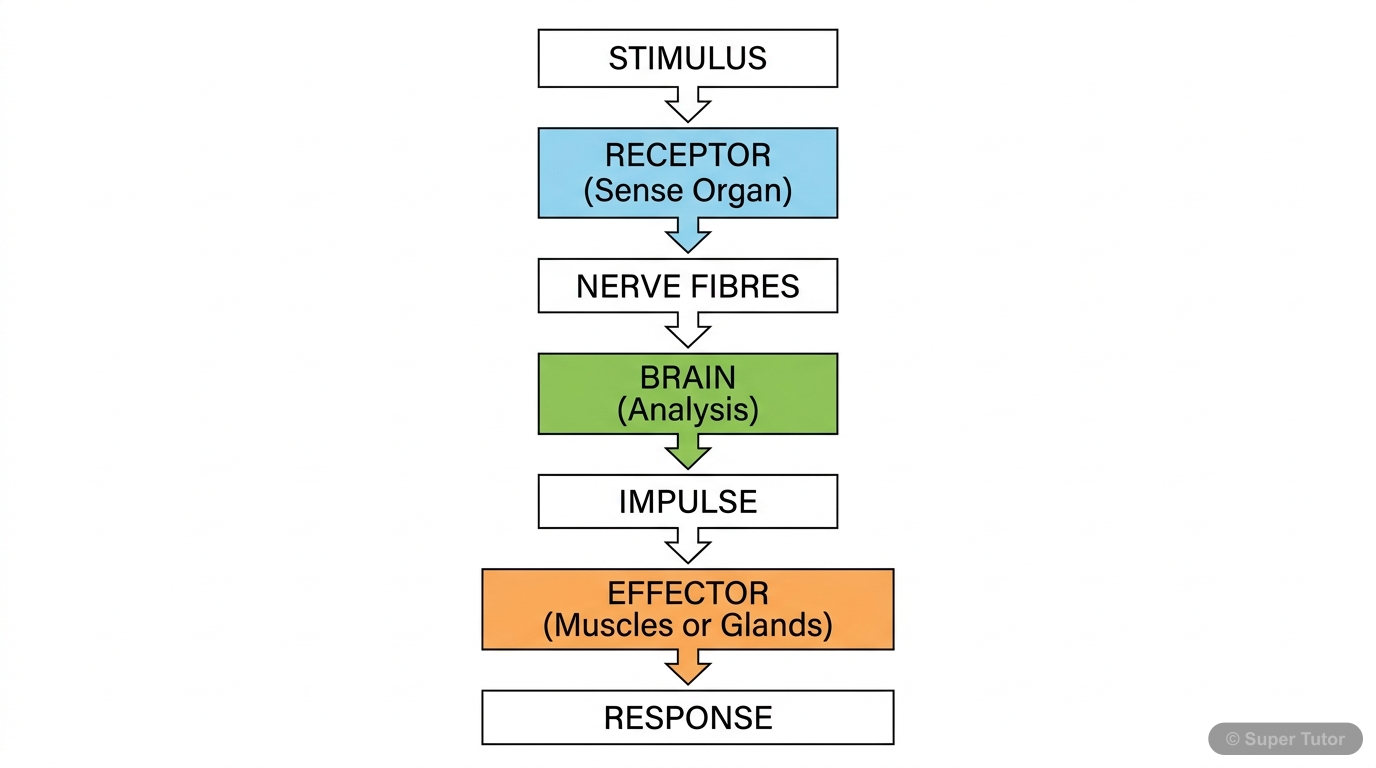
Sense organs are specialized organs that receive external or internal changes and are called receptors. A stimulus is a change in the environment or within the body that produces a response. The body responds only after the brain receives information from the receptor and sends instructions to an ef
Key Concepts
Sense organs receive external or internal
Sense organs receive external or internal changes and are also called receptors. They detect stimuli and pass information to the brain or spinal cord.
A stimulus is a change
A stimulus is a change that produces a response. The brain processes the information and sends instructions to an effector. An effector is a body part
Exteroceptors are present outside the body
Exteroceptors are present outside the body, while interoceptors are present within the body. Mechanoreceptors detect sound, touch, vibrations, and pre
The eye has three coats
The eye has three coats: outer fibrous coat, middle vascular coat, and inner nervous coat. Sclera and cornea form the outer fibrous coat; choroid, cil
The retina contains rods and cones
The retina contains rods and cones. Rods contain rhodopsin and help in seeing in darkness. Cones contain iodopsin and are sensitive to red, blue, and
Learning Objectives
- Define sense organs, stimulus, response, receptor, and effector
- Classify receptors as exteroceptors and interoceptors
- Identify the main types of receptors such as mechanoreceptors, thermoreceptors, chemoreceptors, and photoreceptors
- Describe the structure and functions of the eye
- Explain image formation, accommodation, and common defects of vision
Frequently Asked Questions
What are the important topics in Sense Organs for ICSE Class 10 Biology?
How should I revise Sense Organs for the ICSE Class 10 board exam?
Sources & Official References
Content is aligned to the official syllabus. Refer to the board website for the latest curriculum.
More resources for Sense Organs
For serious students
Get the full Sense Organs chapter — start free.
Quizzes, flashcards, an AI doubt solver and a study plan for ICSE Class 10 Biology. Free to start, no card needed.