Endocrine System — Chapter Summary
ICSE · Class 10 · Biology
Summary of Endocrine System for ICSE Class 10 Biology. Key concepts: Endocrine glands are ductless, The pituitary gland and The hypothalamus releases.
Interactive on Super Tutor
Studying Endocrine System? Get the full interactive chapter.
Quizzes, flashcards, AI doubt-solver and a step-by-step study plan — built for chapter summary and more.
Free trial, no card needed.
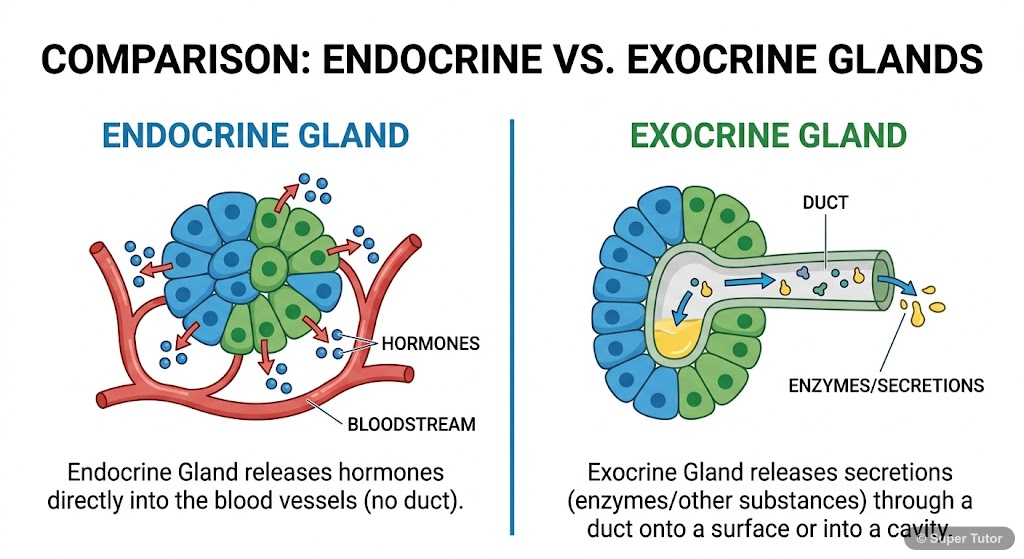
One of 11 illustrations for Endocrine System in Super Tutor — alongside flashcards, concept maps and practice questions.
See them allOverview
The endocrine system is made of ductless glands that release hormones directly into the blood. Hormones are chemical messengers that control and coordinate body activities, help in growth and development, support reproduction, and maintain homeostasis. Endocrine control is slower than nervous contro
Key Concepts
Endocrine glands are ductless glands
Endocrine glands are ductless glands. Their secretions are called hormones, and these are released directly into the blood. Hormones act as chemical m
The pituitary gland
The pituitary gland, also called hypophysis, is a whitish pea-sized gland weighing about 0.5 g. It hangs from the hypothalamus by the infundibulum and
The hypothalamus releases releasing hormones such
The hypothalamus releases releasing hormones such as TSH-RH that control the pituitary gland. It regulates pituitary tropic hormone release.
The thyroid gland is a bilobed
The thyroid gland is a bilobed, H-shaped gland in the neck below the larynx on either side of the trachea. It weighs about 25-40 g and is connected by
The pancreas is a mixed
The pancreas is a mixed or heterocrine gland in the loop of the duodenum below the stomach. Its exocrine part secretes pancreatic juice, while the end
Learning Objectives
- Understand the meaning of endocrine glands and hormones
- Differentiate between exocrine and endocrine glands
- Describe the main endocrine glands and their locations
- Explain the functions of major hormones such as TSH, ADH, thyroxine, insulin, glucagon, adrenaline, and noradrenaline
- Relate hormone deficiency and excess to important disorders
Frequently Asked Questions
What are the important topics in Endocrine System for ICSE Class 10 Biology?
How should I revise Endocrine System for the ICSE Class 10 board exam?
Sources & Official References
Content is aligned to the official syllabus. Refer to the board website for the latest curriculum.
More resources for Endocrine System
For serious students
Get the full Endocrine System chapter — start free.
Quizzes, flashcards, an AI doubt solver and a study plan for ICSE Class 10 Biology. Free to start, no card needed.