Transpiration — Chapter Summary
ICSE · Class 10 · Biology
Summary of Transpiration for ICSE Class 10 Biology. Key concepts: Transpiration is the loss, Evaporation is a physical and There are three main types.
Interactive on Super Tutor
Studying Transpiration? Get the full interactive chapter.
Quizzes, flashcards, AI doubt-solver and a step-by-step study plan — built for chapter summary and more.
Free trial, no card needed.
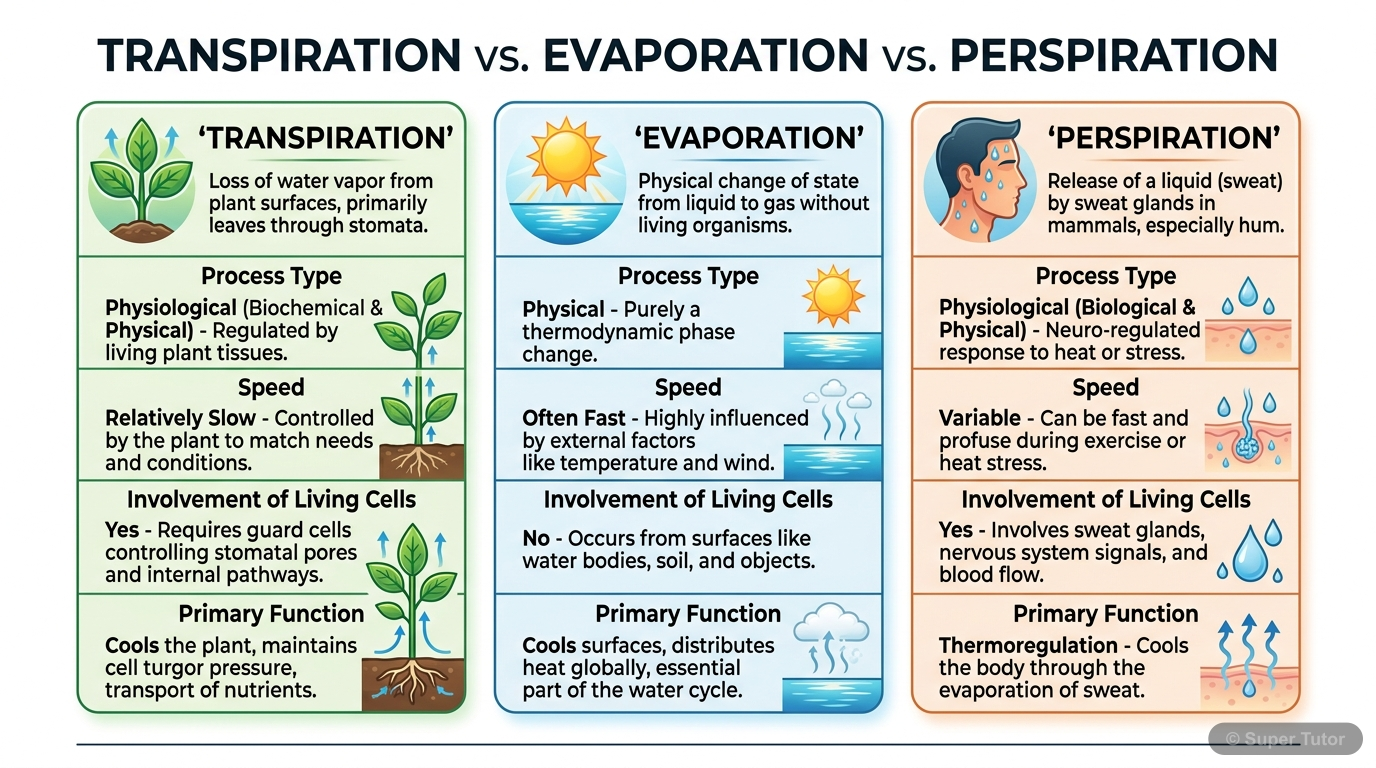
Learn better with visuals Super Tutor pairs illustrations like this with notes and quizzes for Transpiration.
Get startedOverview
Transpiration is the loss of water vapours from the aerial parts of a plant. Leaves take part most actively in this process. Water absorbed by roots is used only in a small amount for life processes, while the rest is lost to the atmosphere through the surface of stems, leaves, buds, and flowers. Tr
Key Concepts
Transpiration is the loss of water
Transpiration is the loss of water vapours from aerial parts of a plant. It is a physiological process and is brought about by living cells. Leaves ta
Evaporation is a physical process
Evaporation is a physical process in which water from water bodies changes into vapour, while transpiration is a physiological process from plant part
There are three main types
There are three main types: stomatal transpiration through stomata, cuticular transpiration through the cuticle, and lenticular transpiration through
Stomata are minute pores found
Stomata are minute pores found in the epidermis of leaves and herbaceous stems. Each stoma is surrounded by two guard cells and subsidiary cells. Toge
Guard cells are bean
Guard cells are bean-shaped epidermal cells that surround each stoma. They contain chloroplasts, so they can photosynthesise. The inner wall of each g
Learning Objectives
- Define transpiration and distinguish it from evaporation and perspiration.
- Identify the main sites of transpiration in plants.
- Explain the three types of transpiration: stomatal, cuticular, and lenticular.
- Describe how stomata open and close.
- Explain the mechanism of stomatal transpiration and ascent of sap.
Frequently Asked Questions
What are the important topics in Transpiration for ICSE Class 10 Biology?
How should I revise Transpiration for the ICSE Class 10 board exam?
Sources & Official References
Content is aligned to the official syllabus. Refer to the board website for the latest curriculum.
More resources for Transpiration
For serious students
Get the full Transpiration chapter — start free.
Quizzes, flashcards, an AI doubt solver and a study plan for ICSE Class 10 Biology. Free to start, no card needed.