Electrolysis
ICSE · Class 10 · Chemistry
Practice quiz for Electrolysis — ICSE Class 10 Chemistry. MCQs and questions with answers to test your preparation.
Interactive on Super Tutor
Studying Electrolysis? Get the full interactive chapter.
Quizzes, flashcards, AI doubt-solver and a step-by-step study plan — built for practice quiz and more.
1,000+ Class 10 students started this chapter today
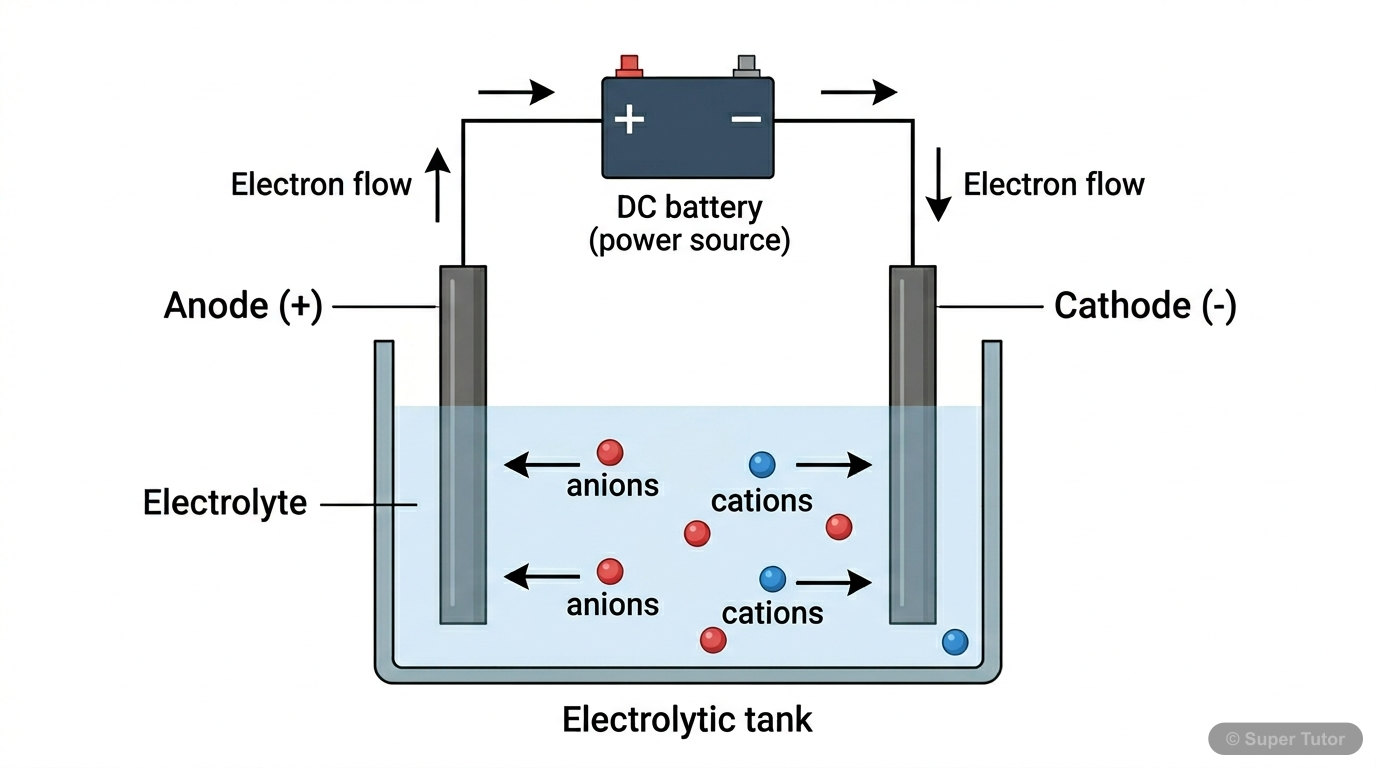
Learn better with visuals Super Tutor has hundreds of illustrations like this across every chapter — all free to try.
Get startedQuick Quiz: Electrolysis
0/4Tap an answer to check it instantly. No sign-up needed for these 4.
Which of the following substances can conduct electricity in aqueous solution?
The electrode where reduction occurs is called:
During electrolysis of molten lead bromide, what is produced at the cathode?
The process of depositing a thin layer of one metal over another using electrolysis is called:
Sample Questions
Which of the following are strong electrolytes?
Show answer
HCl, NaOH, H2SO4
HCl, NaOH, and H2SO4 are strong electrolytes that dissociate almost completely in aqueous solution. CH3COOH (acetic acid) and NH4OH are weak electrolytes that partially dissociate.
Cations are positively charged ions.
Show answer
True
Cations are indeed positively charged ions formed when atoms lose electrons. They migrate toward the cathode during electrolysis.
Which of the following processes occur during electrolysis?
Show answer
Ion migration, Oxidation at anode, Reduction at cathode
During electrolysis, ions migrate to oppositely charged electrodes, oxidation occurs at the anode, and reduction occurs at the cathode. Elements or compounds can be formed.
In the electrochemical series, metals with higher tendency to lose electrons are placed:
Show answer
At the top
In the electrochemical series, metals are arranged in decreasing order of their tendency to lose electrons. More reactive metals like lithium are at the top.
+40 more questions available
Practice AllFrequently Asked Questions
What are the important topics in Electrolysis for ICSE Class 10 Chemistry?
How to score full marks in Electrolysis — ICSE Class 10 Chemistry?
Sources & Official References
Content is aligned to the official syllabus. Refer to the board website for the latest curriculum.
More resources for Electrolysis
Important Questions
Practice with board exam-style questions
Revision Notes
Key points for last-minute revision
Formula Sheet
All formulas in one place
Chapter Summary
Understand the chapter at a glance
Concept Maps
See how topics connect visually
Study Plan
Step-by-step plan to ace this chapter
Flashcards
Quick-fire cards for active recall
Syllabus
What topics to cover
NCERT Solutions
Every textbook question solved step by step
For serious students
Get the full Electrolysis chapter — for free.
Quizzes, flashcards, AI doubt-solver and a step-by-step study plan for ICSE Class 10 Chemistry.