Study of Acids, Bases and Salts — Practice Quiz
ICSE · Class 10 · Chemistry
Try a 4-question quiz on Study of Acids, Bases and Salts for ICSE Class 10 Chemistry: tap an answer to check it and see why.
Interactive on Super Tutor
Studying Study of Acids, Bases and Salts? Get the full interactive chapter.
Quizzes, flashcards, AI doubt-solver and a step-by-step study plan — built for practice quiz and more.
Free trial, no card needed.
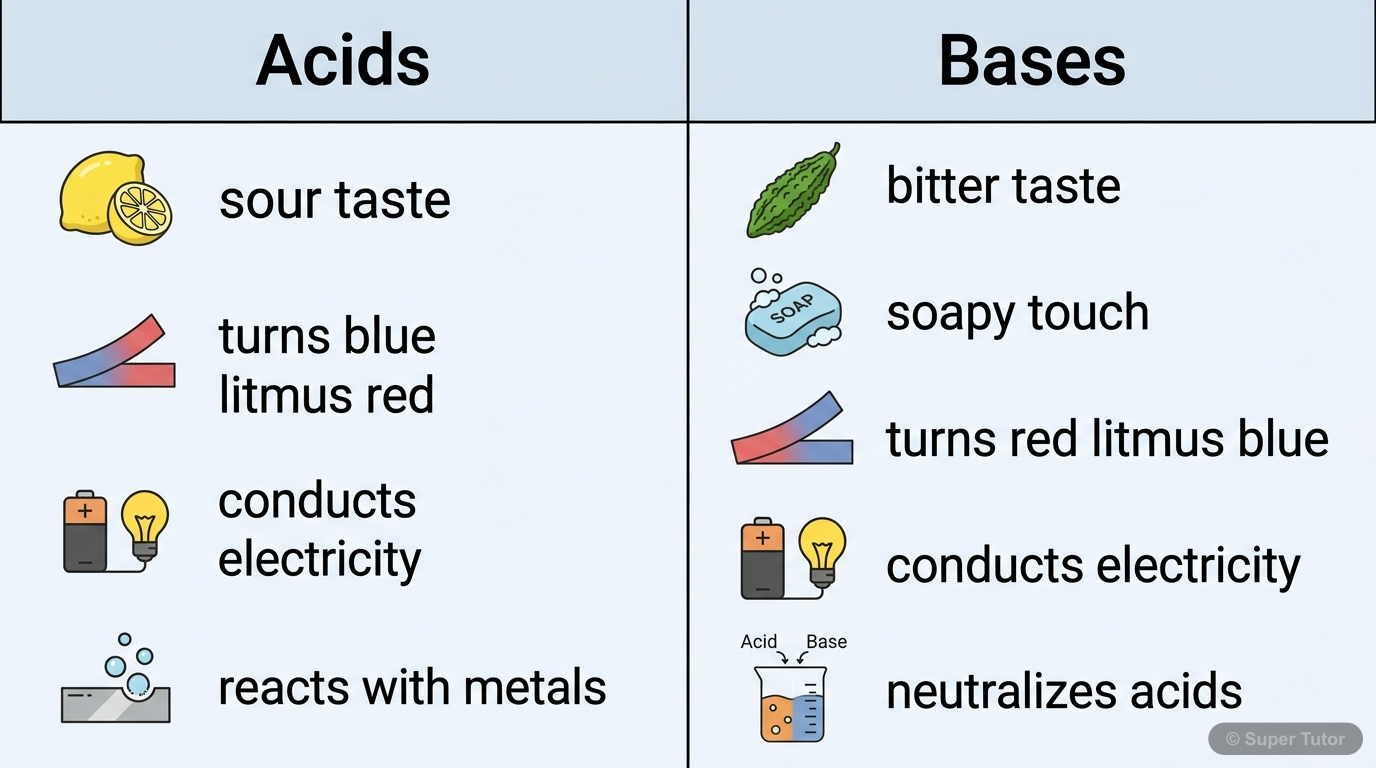
One of 15 illustrations for Study of Acids, Bases and Salts in Super Tutor — alongside flashcards, concept maps and practice questions.
See them allQuick Quiz: Study of Acids, Bases and Salts
0/4Tap an answer to check it instantly. No sign-up needed for these 4.
Which of the following is the correct definition of an acid?
What is the pH value of pure water at 25°C?
The basicity of sulphuric acid (H2SO4) is:
Which of the following is NOT an alkali?
Sample Questions
Which of the following are properties of acids? (Select all correct answers)
Show answer
Sour taste, Turn blue litmus red, React with metals to produce hydrogen
Acids have sour taste, turn blue litmus red, and react with active metals to produce hydrogen gas. Bitter taste and turning red litmus blue are properties of bases.
Which type of salt is NaHSO4?
Show answer
Acid salt
NaHSO4 (sodium hydrogen sulphate) is an acid salt because it contains a replaceable hydrogen atom from the original acid H2SO4. It is formed by partial replacement of hydrogen atoms.
What happens when zinc reacts with dilute hydrochloric acid?
Show answer
Hydrogen gas is produced
When zinc reacts with dilute HCl, hydrogen gas is produced along with zinc chloride: Zn + 2HCl → ZnCl2 + H2↑. This is a characteristic reaction of acids with active metals.
Which of the following are examples of organic acids? (Select all correct answers)
Show answer
Acetic acid (CH3COOH), Formic acid (HCOOH), Citric acid
Organic acids contain carbon and are derived from living organisms. Acetic acid (vinegar), formic acid (bee sting), and citric acid (citrus fruits) are organic acids. HCl and H2SO4 are mineral acids.
+40 more questions on Study of Acids, Bases and Salts (ICSE Class 10 Chemistry)
Practise AllFrequently Asked Questions
What are the important topics in Study of Acids, Bases and Salts for ICSE Class 10 Chemistry?
How many practice questions are there for Study of Acids, Bases and Salts?
Sources & Official References
Content is aligned to the official syllabus. Refer to the board website for the latest curriculum.
More resources for Study of Acids, Bases and Salts
Important Questions
Exam-style questions with answers
Revision Notes
Key points for last-minute revision
Formula Sheet
The chapter's formulas in one place
Chapter Summary
Understand the chapter at a glance
Concept Maps
See how topics connect
Study Plan
Step-by-step plan for this chapter
Flashcards
Quick-fire cards for active recall
Syllabus
What topics to cover
For serious students
Get the full Study of Acids, Bases and Salts chapter — start free.
Quizzes, flashcards, an AI doubt solver and a study plan for ICSE Class 10 Chemistry. Free to start, no card needed.