Mole Concept and Stoichiometry — Practice Quiz
ICSE · Class 10 · Chemistry
Try a 4-question quiz on Mole Concept and Stoichiometry for ICSE Class 10 Chemistry: tap an answer to check it and see why.
Interactive on Super Tutor
Studying Mole Concept and Stoichiometry? Get the full interactive chapter.
Quizzes, flashcards, AI doubt-solver and a step-by-step study plan — built for practice quiz and more.
Free trial, no card needed.
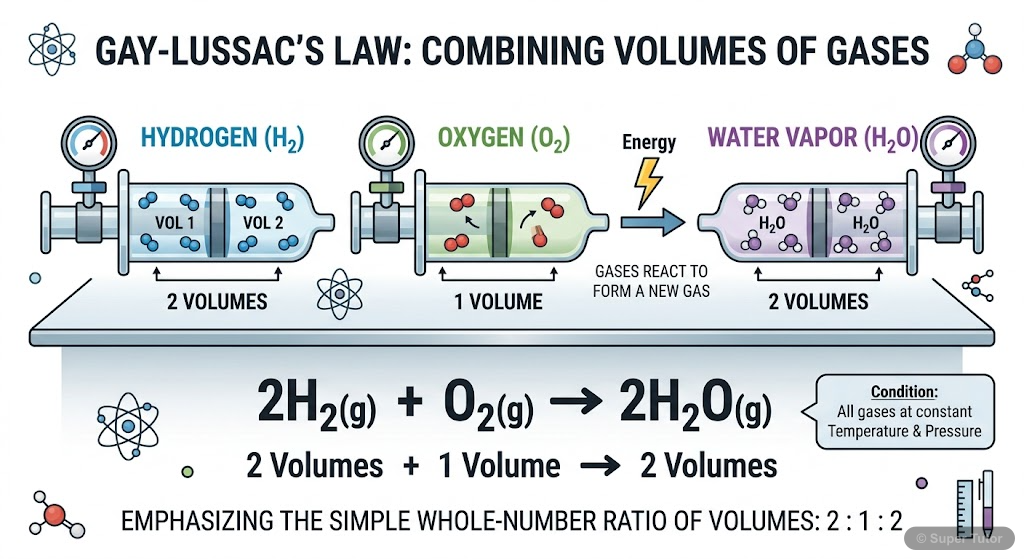
One of 9 illustrations for Mole Concept and Stoichiometry in Super Tutor — alongside flashcards, concept maps and practice questions.
See them allQuick Quiz: Mole Concept and Stoichiometry
0/4Tap an answer to check it instantly. No sign-up needed for these 4.
What is Avogadro's number?
According to Gay Lussac's law of combining volumes, gases combine in:
What is the molar volume of any gas at STP?
The relationship between molecular mass and vapour density is:
Sample Questions
Which of the following are diatomic molecules?
Show answer
H₂, O₂, Cl₂
H₂, O₂, and Cl₂ are diatomic molecules containing two atoms each. He is monoatomic and O₃ is triatomic.
One mole of carbon atoms has a mass of:
Show answer
12 g
One mole of carbon atoms has a mass equal to its atomic mass in grams, which is 12 g for carbon.
Which of the following represent one mole quantities?
Show answer
6.023 × 10²³ atoms, 6.023 × 10²³ molecules, 22.4 L of any gas at STP
One mole equals Avogadro's number of particles (atoms or molecules) or 22.4 L of gas at STP. 1 gram is not a universal mole quantity.
The empirical formula represents:
Show answer
Simplest whole number ratio of atoms
The empirical formula shows the simplest whole number ratio of different atoms in a compound, not the actual number of atoms.
+34 more questions on Mole Concept and Stoichiometry (ICSE Class 10 Chemistry)
Practise AllFrequently Asked Questions
What are the important topics in Mole Concept and Stoichiometry for ICSE Class 10 Chemistry?
How many practice questions are there for Mole Concept and Stoichiometry?
Sources & Official References
Content is aligned to the official syllabus. Refer to the board website for the latest curriculum.
More resources for Mole Concept and Stoichiometry
Important Questions
Exam-style questions with answers
Revision Notes
Key points for last-minute revision
Formula Sheet
The chapter's formulas in one place
Chapter Summary
Understand the chapter at a glance
Concept Maps
See how topics connect
Study Plan
Step-by-step plan for this chapter
Flashcards
Quick-fire cards for active recall
Syllabus
What topics to cover
For serious students
Get the full Mole Concept and Stoichiometry chapter — start free.
Quizzes, flashcards, an AI doubt solver and a study plan for ICSE Class 10 Chemistry. Free to start, no card needed.